
Ripple's Strategic Position in the Global Remittance Market and XRP's Price Catalysts in 2025
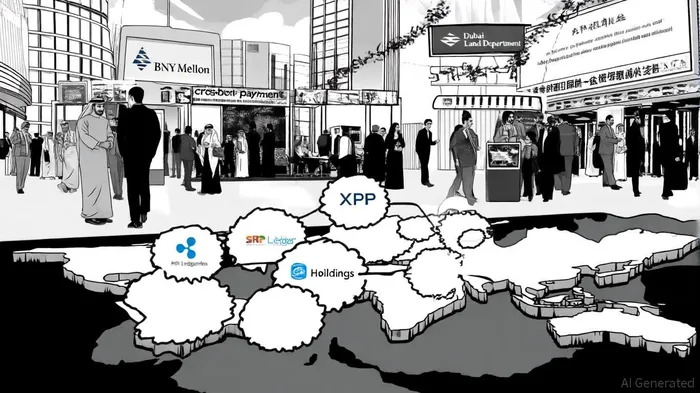
The year 2025 has marked a seismic shift in Ripple's trajectory, driven by regulatory clarity and institutional adoption that position XRPXRP-- as a formidable contender in the global remittance market. The resolution of the SEC lawsuit in August 2025, coupled with strategic partnerships and technological advancements, has created a unique confluence of catalysts for XRP's price appreciation. This analysis explores how these developments are reshaping XRP's undervaluation narrative and unlocking its near-term upside potential.
Regulatory Clarity: A Foundation for Institutional Confidence
The SEC's August 2025 settlement with Ripple—ending a four-year legal battle—established a critical precedent: XRP is notNOT-- a security when traded on secondary markets[1]. This ruling removed a major regulatory overhang, enabling institutional investors to engage with XRP without fear of legal repercussions. According to a report by CoinPulse, the settlement spurred a 500% surge in XRP's price in the first half of 2025, pushing its market capitalization to $172 billion[3].
The settlement also imposed an injunction limiting institutional sales of XRP, but this restriction was offset by Ripple's rapid expansion into institutional services. The acquisition of Hidden Road for $1.25 billion in 2025[2] and the launch of Ripple USD (RLUSD) with BNY Mellon as a custodian[2] demonstrated Ripple's commitment to building infrastructure that aligns with institutional-grade security and compliance. These moves have attracted over $1.1 billion in institutional XRP purchases in 2025 alone[3], signaling a shift in risk perception among traditional finance players.
Institutional Adoption: Bridging the Gap to Mainstream Finance
Ripple's partnerships with global financial institutions have been pivotal in embedding XRP into the fabric of cross-border payments. The collaboration with Dubai Land Department to tokenize real estate assets[2] and the planned introduction of RLUSD in Japan via SBI Holdings[2] highlight XRP's versatility beyond remittances. These initiatives are not merely speculative; they represent tangible use cases that validate XRP's role as a bridge currency in high-cost corridors.
The pending approval of XRP-based ETFs, such as the Grayscale XRP Trust and the 21Shares Core XRP Trust[1], further underscores institutional confidence. Analysts estimate a 95% chance of approval by October 2025[1], which could unlock billions in capital flows. For context, BitcoinBTC-- ETFs have historically driven price appreciation by 30–50% post-approval[4]. If XRP ETFs follow a similar trajectory, the asset could see a significant re-rating.
Technological Advancements: Enhancing Utility and Liquidity
Ripple's technical upgrades in 2025 have fortified XRP's utility. The launch of an EthereumETH-- Virtual Machine (EVM) sidechain[2] and a native automated market makerMKR-- (AMM) on the XRP Ledger[4] have expanded the platform's capabilities. The EVM sidechain, for instance, attracted $120 million in total value locked (TVL) within a week of its launch[2], demonstrating developer and user interest. These innovations not only improve on-chain liquidity but also position XRP as a settlement asset in decentralized finance (DeFi) ecosystems.
Competitive Landscape and Price Catalysts
While stablecoins and central bank digital currencies (CBDCs) pose challenges, XRP's real-world adoption in cross-border payments remains unmatched. Ripple's network processes over 1,500 transactions per second with sub-second finality[4], a critical advantage in corridors where speed and cost efficiency are paramount. Furthermore, the U.S. SEC's shift toward structured rulemaking rather than aggressive litigation[3] has created a more favorable regulatory environment for XRP to scale.
Price-wise, XRP's technical indicators suggest a potential breakout above $3.50, with a 2025 price target of $5.25 by 2030 if adoption accelerates[2]. Short-term volatility, including dips below $2.86, reflects profit-taking and institutional selling pressure[1], but these fluctuations are likely to be temporary given the underlying fundamentals.
Conclusion: A Case for Undervaluation and Upside
XRP's undervaluation relative to its market capitalization and utility is evident. Despite being a top-three cryptocurrency by market cap, XRP's price remains below its 2018 peak, even as institutional adoption and regulatory clarity create a tailwind for growth. The combination of real-world use cases, technological innovation, and institutional infrastructure positions XRP to outperform in 2025 and beyond. For investors, the key takeaway is clear: Ripple's strategic positioning in the global remittance market, bolstered by regulatory progress, offers a compelling case for long-term value creation.






Comentarios
Aún no hay comentarios