
Ripple's Strategic Partnerships: A Catalyst for Institutional Adoption of Tokenized Assets
The asset management industry is undergoing a seismic shift as tokenization bridges the gap between traditional finance and blockchain innovation. At the forefront of this transformation is Ripple, whose strategic partnerships in 2025 have positioned the XRPXRP-- Ledger as a critical infrastructure for institutional-grade digital asset solutions. By collaborating with financial heavyweights like DBS and Franklin Templeton, Ripple is notNOT-- only accelerating tokenization but also redefining liquidity, efficiency, and accessibility for institutional investors.
Tokenization as a Financial Infrastructure Revolution
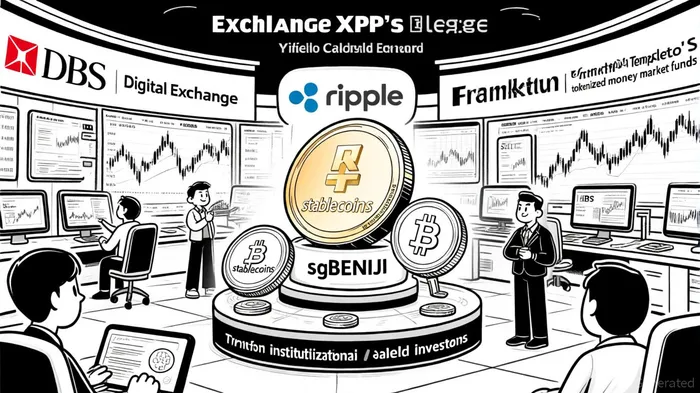
Tokenization—the process of converting real-world assets into digital tokens on a blockchain—has long been touted as a disruptor. However, 2025 marks a pivotal year where institutional adoption has moved from theoretical exploration to operational reality. Ripple's partnership with DBS and Franklin Templeton exemplifies this shift. The trio launched tokenized money market fund solutions, enabling accredited and institutional investors to trade Franklin Templeton's sgBENJI token using Ripple's RLUSD stablecoin on DBS Digital Exchange [2]. This integration allows for real-time portfolio rebalancing while generating yield, a capability previously constrained by the sluggishness of traditional settlement systems [3].
Moreover, DBS plans to leverage sgBENJI tokens as collateral for repurchase agreements and third-party credit facilities, unlocking new liquidity channels for institutional clients [3]. This innovation underscores how tokenization can transform static assets into dynamic, programmable value streams. According to a report by Blockonomi, such solutions reduce counterparty risk and operational friction, making them particularly appealing in a post-crisis financial landscape [2].
Ripple's Vision: A Global Settlement Currency
Central to Ripple's strategy is the positioning of RLUSD, its U.S. dollar-pegged stablecoin, as a global settlement currency. The XRP Ledger's inherent advantages—sub-second finality, negligible transaction costs, and energy efficiency—make it an ideal backbone for institutional-scale tokenization [2]. At Ripple's Apex 2025 event, the company unveiled advancements in tokenized treasuries and institutional-grade financial infrastructure, including Ondo Finance's tokenized U.S. Treasuries on the XRP Ledger [1]. These developments signal growing institutional confidence in blockchain-based solutions, with major asset managers recognizing the XRP Ledger's capacity to handle high-value, low-latency transactions.
The Broader Implications for Asset Management
The integration of tokenized assets into traditional portfolios is not merely a technological upgrade but a paradigm shift. By enabling fractional ownership, 24/7 trading, and programmable smart contracts, tokenization democratizes access to institutional-grade assets while enhancing capital efficiency. As stated by Invezz in a recent analysis, Ripple's partnerships demonstrate how blockchain can address longstanding pain points in asset management, such as illiquidity and high transaction costs [4].
For institutional investors, the benefits are manifold. Tokenized assets like sgBENJI offer a yield-generating alternative to cash reserves, while RLUSD's stability mitigates volatility risks. Furthermore, the ability to use tokens as collateral expands leverage options without sacrificing security. This aligns with broader trends in decentralized finance (DeFi), where programmable money is redefining credit markets and liquidity provision [3].
A Maturing Digital Asset Ecosystem
Ripple's collaborations reflect a maturing digital asset ecosystem where blockchain technology is no longer a niche experiment but a core component of global finance. The XRP Ledger's role in powering real-world use cases—from tokenized treasuries to money market funds—highlights its versatility and scalability. As noted in Ripple's official insights, the Apex 2025 event solidified the XRP Ledger's position as a preferred infrastructure for institutional innovation, with over 50 new partnerships announced during the conference [1].
Conclusion
Ripple's strategic partnerships with DBS and Franklin Templeton are more than incremental advancements—they are a catalyst for institutional adoption of digital assets. By leveraging the XRP Ledger's capabilities, these collaborations address critical inefficiencies in asset management while setting a precedent for future innovations. As tokenization continues to blurBLUR-- the lines between traditional and decentralized finance, Ripple's ecosystem stands as a testament to blockchain's transformative potential. For investors, the message is clear: the future of asset management is tokenized, and Ripple is leading the charge.






Comentarios
Aún no hay comentarios