
Ripple's Strategic Momentum and XRP's Market Implications: Leadership Stability as a Catalyst for Institutional Confidence
In 2025, Ripple (XRP) has emerged as a pivotal player in the global financial infrastructure, driven by CEO Brad Garlinghouse's strategic vision and institutional-grade innovations. The company's leadership stability, regulatory breakthroughs, and market performance have collectively signaled a paradigm shift in institutional confidence, positioning XRPXRP-- as a serious contender in cross-border payments and decentralized finance (DeFi). This analysis explores how Garlinghouse's initiatives, coupled with Ripple's ecosystem expansion, are reshaping investor sentiment and market dynamics.
Strategic Leadership and Ecosystem Expansion
Brad Garlinghouse has positioned Ripple as a bridge between traditional finance and blockchain innovation. At the Apex 2025 conference in Singapore, he outlined a bold vision: capturing 14% of SWIFT's global cross-border payment volume within five years by leveraging XRP's liquidity advantages over messaging-based systems[1]. To realize this, Ripple acquired Hidden Road, a $1.25 billion multi-asset prime broker, to integrate post-trade services like clearing and settlement onto the XRP Ledger[1]. This acquisition, one of crypto's largest M&A deals, underscores Ripple's commitment to institutional-grade infrastructure.
Garlinghouse's strategic alliances further amplify XRP's utility. Partnerships with Finastra and Volante Technologies aim to integrate XRP into the U.S. Federal Reserve's Fedwire system, potentially handling $1 quadrillion in annual transactions[1]. Such moves signal a departure from speculative narratives, emphasizing XRP's role in real-world financial workflows.
Regulatory Clarity and Institutional Adoption
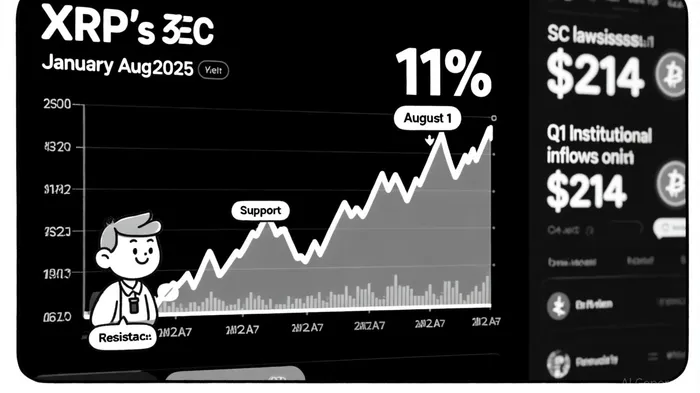
The dismissal of the SEC's lawsuit against Ripple in Q1 2025 marked a watershed moment. By reducing the penalty from $125 million to $50 million and withdrawing its appeal, the SEC provided legal clarity that unlocked $214 million in institutional inflows by the end of the quarter[3]. This regulatory shift, coupled with the U.S. administration's pro-crypto stance, catalyzed the launch of XRP-based investment products. Franklin Templeton filed an S-1 for a U.S. spot XRP ETF, while Brazil's Comissão de Valores Mobiliários approved a dedicated XRP ETF[3].
Garlinghouse's appointment as a White House Crypto Council advisor in February 2025 further solidified Ripple's institutional credibility[3]. This alignment with U.S. policy priorities—such as crypto custody frameworks and stablecoin legislation—has positioned XRP as a strategic asset in the evolving regulatory landscape.
Market Performance and Investor Sentiment
XRP's price trajectory in 2025 reflects institutional confidence. On August 11, the token surged 11% to $3.27, driven by a 208% spike in institutional trading volume to $12.4 billion[1]. Open interest in XRP derivatives rose 15% to $5.9 billion, indicating robust long-term positioning[1]. Technically, XRP has consolidated around key support levels ($3.15–$3.16) and resistance ($3.24–$3.27), with a breakout above $3.30 potentially targeting $4.50–$5.00[5].
Historical backtesting of XRP's price behavior around resistance and support levels from 2022 to 2025 reveals mixed signals for traders relying solely on these technical indicators. For resistance-level breakouts (696 events), the average cumulative excess return was approximately +10% over 30 days, but with a win rate of only 48%—suggesting no statistically significant edge. Similarly, support-level bounces (648 events) yielded a modest +5.7% return over the same period, with a win rate of ~47%, underperforming broader benchmarks. These findings indicate that while resistance and support levels may provide directional guidance, they lack standalone predictive power for XRP's price movements[5].
Institutional adoption is further evidenced by RLUSD, Ripple's stablecoin, which has facilitated cross-margining and collateral management via Hidden Road's integration[3]. Whale transactions exceeding $1 million in June 2025 also signaled growing institutional interest, with analysts projecting XRP could reach $3.20–$4 by year-end[3].
Future Outlook and Strategic Catalysts
Ripple's upcoming XRPL Apex 2025 conference in June 2025 promises to accelerate its institutional footprint. Expected announcements include upgrades to XRP Ledger's sidechains, smart contract functionality, and tokenization frameworks[2]. These developments could enhance XRP's role in asset tokenization and DeFi, aligning with Garlinghouse's vision of expanding the crypto industry from 300 million to billions of users[5].
Long-term price projections hinge on XRP's utility expansion. If ETF approvals and Fedwire integration materialize, XRP could target $10.27 by 2030[4]. However, short-term volatility remains tied to macroeconomic factors and regulatory shifts.
Conclusion
Ripple's strategic momentum, anchored by Garlinghouse's leadership and institutional-grade innovations, has redefined XRP's market narrative. Regulatory clarity, ecosystem expansion, and institutional inflows have created a flywheel effect, driving both price appreciation and real-world adoption. As Ripple bridges traditional finance and blockchain, XRP's trajectory offers a compelling case study in how leadership stability and visionary strategy can unlock institutional confidence in the crypto space.






Comentarios
Aún no hay comentarios