
Ripple's Strategic Expansion and XRP's Path to Institutional Adoption
Strategic Integration: Ripple Prime and XRP Utility
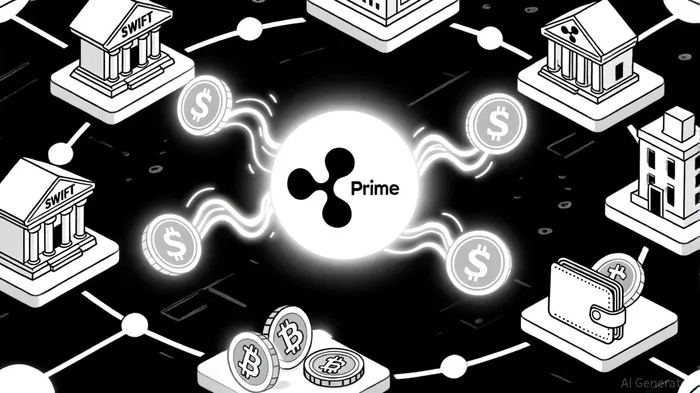
Ripple Prime's rebranding is not merely a reorganization but a strategic recalibration. By embedding XRP into its brokerage products, Ripple has unlocked new utility for the asset. For instance, XRP's role as collateral for derivatives and margin lending has driven demand, with the token's price rising 4.2% to $2.56 in early 2025, supported by reduced whale selling and increased spot outflows, the Coinotag report noted. Meanwhile, RLUSD has seen robust adoption, with over $25 million in transfer volumes, and analysts project it could surpass $30 million as its use in derivative holdings expands, the Coinotag report added.
The acquisition also aligns with Ripple's broader vision of creating a cohesive ecosystem for institutional demand. By combining its existing infrastructure in payments, custody, and stablecoin deployment, Ripple is addressing the fragmented nature of digital asset markets, as Coinotag observed. This synergy is critical for institutions seeking scalable, compliant solutions in a rapidly evolving regulatory landscape.
Regulatory Tailwinds: From Commodity Status to Global Clarity
Regulatory developments in 2025 have further accelerated XRP's institutional adoption. A landmark decision in August 2025 saw the U.S. Securities and Exchange Commission (SEC) reclassify XRP as a commodity, removing a critical barrier to institutional participation, according to a MarketMinute article. This shift has prompted major financial players to explore XRP-based solutions, particularly through Ripple's On-Demand Liquidity (ODL) product, which offers real-time, low-cost cross-border payments, the MarketMinute article added.
Ripple's regulatory momentum extends beyond the U.S. In the European Union, the company is aligning with the Markets in Crypto-Assets (MiCA) framework and has secured an Electronic Money Institution license in Luxembourg, enabling EEA-wide passporting rights for its RLUSD stablecoin, according to a Coinotag analysis. These moves underscore Ripple's commitment to compliance, a non-negotiable requirement for institutional clients.
Institutional Infrastructure: Evernorth and the $1 Billion Treasury
Ripple's institutional ambitions are further bolstered by the launch of Evernorth, a $1 billion SPAC merger with Armada Acquisition Corp II. Evernorth aims to trade on Nasdaq under the ticker XRPN by Q1 2026, positioning XRP as a reserve asset for institutional use in lending, liquidity provisioning, and DeFi yield strategies, according to an OKX analysis. Ripple executives, including CEO Brad Garlinghouse and CTO David Schwartz, are actively advising Evernorth, reinforcing XRP's institutional readiness, a Bitcoin.com report noted.
Simultaneously, Ripple has announced its own $1 billion XRP treasury initiative, competing directly with BitcoinBTC-- and EthereumETH-- in institutional adoption, as a Yahoo Finance report described. This move follows the shelving of a U.S. government-led digital asset treasury, with Ripple stepping in to fill the gap. The timing is strategic: XRP's regulatory resolution with the SEC and its ascent to the top three cryptocurrencies by market cap signal a transformative phase for the asset, the Yahoo Finance piece added.
Global Liquidity Pipelines and Cross-Border Adoption
Institutional adoption is not limited to regulatory clarity-it's also about infrastructure. A network of corporate treasuries, including Evernorth, Trident, and Webus International, is building liquidity pipelines for XRP, using it for cross-border settlements, according to a Timestabloid report. These entities are not speculators but infrastructure builders, reflecting a broader institutional readiness to integrate XRP into global financial systems, Timestabloid noted.
Ripple's enhancements to the XRP Ledger (XRPL) further support this vision. Privacy features like ZK-Rollups and XLS-101 smart contracts are being prioritized to meet institutional demands for data protection while maintaining compliance, as ZyCrypto reported. These upgrades address the final barrier to adoption by major banks, as highlighted by CEO Brad Garlinghouse, ZyCrypto added.
Challenges and Market Realities
Despite these strides, XRP's path to institutional dominance is not without hurdles. In October 2025, the token's price declined by 17%, reflecting broader risk-averse sentiment in the crypto market, as Coinotag noted. Analysts caution that Ripple's SPAC plan and treasury initiatives may take time to translate into price action, as market participants await operational details and regulatory clarity, Coinpedia reported. However, the upcoming SEC decisions on XRP ETF applications could provide a catalyst for sustained growth, the Coinotag analysis added.
Conclusion: A New Era for XRP
Ripple's strategic acquisitions, regulatory tailwinds, and institutional partnerships are converging to position XRP as a cornerstone of global finance. By integrating crypto with traditional systems, enhancing privacy, and securing regulatory approvals, Ripple is addressing the core concerns of institutional investors. While challenges remain, the trajectory is clear: XRP is no longer a speculative asset but a utility-driven instrument poised for long-term adoption.





Comentarios
Aún no hay comentarios