
Ripple's Strategic Expansion and XRP Ecosystem Growth: A New Era for Institutional Exposure
Ripple's 2025 strategic pivot has positioned XRPXRP-- as a cornerstone of institutional-grade blockchain infrastructure, driven by a confluence of regulatory clarity, cross-chain innovation, and diversified investment vehicles. As the firm navigates a post-SEC settlement landscape and expands its global footprint, the XRP ecosystem is witnessing a paradigm shift in how institutional capital accesses and utilizes the asset.
Strategic Partnerships: Bridging Traditional and Digital Finance
Ripple's institutional momentum is anchored by its ability to integrate blockchain solutions into legacy financial systems. In Asia, SBI Ripple Asia's collaboration with Doppler Finance marks a pivotal step in tokenizing real-world assets and creating yield-bearing XRP products. This partnership, facilitated by SBI Digital Markets-a Singapore-regulated custodian-demonstrates Ripple's commitment to institutional-grade security and compliance. Meanwhile, in Europe, AMINA Bank's adoption of Ripple's cross-border payment technology underscores the firm's role in modernizing fiat and stablecoin transactions. By enabling 24/7 settlement and reducing reliance on SWIFT, Ripple is effectively bridging the gap between traditional banking and decentralized finance (DeFi).
Regulatory progress has further accelerated these efforts. The U.S. Office of the Comptroller of the Currency's conditional approval for Ripple to establish a federally regulated trust bank signals a critical milestone in crypto custody and stablecoin management. This development, coupled with the August 2025 SEC settlement, has provided the legal clarity necessary for institutional investors to engage with XRP without regulatory overhang. The settlement itself catalyzed a 11% price surge in XRP, reflecting renewed confidence in the asset's legitimacy.
Market Expansion: Cross-Chain Integration and ETF-Driven Liquidity
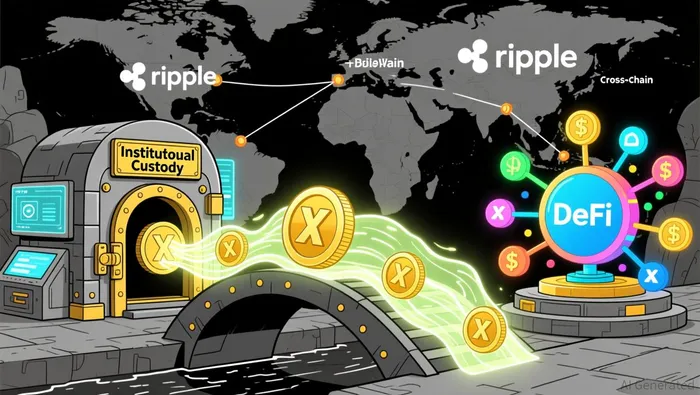
XRP's utility is expanding beyond its native ledger through cross-chain innovations. The launch of wXRP-a wrapped version of XRP on Solana-via Hex Trust and LayerZero's infrastructure has unlocked access to Solana's DeFi ecosystem, enabling institutional liquidity providers to leverage XRP's value while benefiting from Solana's high throughput. This interoperability mirrors Bitcoin's wrapped token strategies, positioning XRP as a multi-chain asset.
Simultaneously, the introduction of U.S. spot XRP ETFs has created a regulated on-ramp for institutional capital. At least nine asset managers filed applications, with inflows exceeding $1 billion. Franklin Templeton's XRPZ ETF, offering a 0.2% fee for the first $5 billion in assets, and Ripple Prime's acquisition of Hidden Road to form a global prime brokerage highlight the ecosystem's structural demand. These ETFs are not merely speculative tools but are replicating Bitcoin's institutional adoption trajectory, with analysts projecting $5–7 billion in inflows by 2026.
Indirect Investment Vehicles: Structured Products and Basket Diversification
Beyond ETFs, institutional exposure to XRP is diversifying through structured products and crypto basket funds. The Amplify XRP Income ETF (XRPM), for instance, combines XRP exposure with a covered-call strategy to generate yield appealing to risk-averse investors. Similarly, crypto basket ETFs that include XRP alongside Bitcoin and Ethereum offer a hedged approach to digital asset allocation, aligning with institutional preferences for diversified portfolios.
Ripple's RLUSD stablecoin further enhances institutional access by serving as collateral in Ripple Prime's prime brokerage to allow institutional desks to leverage RLUSD for margin trading, effectively creating a closed-loop system that ties XRP's utility to traditional financial instruments. Additionally, the 29% reduction in exchange reserves as ETF custodians accumulate XRP mirrors Bitcoin's post-ETF dynamics, suggesting a long-term structural shift in XRP's demand profile.
Challenges and Future Outlook
Despite these advancements, XRP's price remains under pressure, trading in the $1.87–$1.94 range as of December 2025. Short-term technical indicators, such as the death cross, suggest continued volatility, while selling pressure from large holders offsets ETF inflows. However, the underlying infrastructure-spanning cross-chain bridges, regulated custodians, and institutional-grade trading platforms-positions XRP for long-term growth. Analysts project a potential price range of $3.50–$3.80 by 2026, driven by sustained ETF adoption and Ripple's expanding banking license ambitions to establish a federally regulated trust bank.
Conclusion
Ripple's 2025 strategic expansion has redefined XRP's role in the institutional landscape. By harmonizing regulatory compliance, cross-chain innovation, and diversified investment vehicles, the firm is creating a robust ecosystem that appeals to both traditional and digital-native investors. As institutional capital continues to flow into XRP through ETFs, structured products, and hybrid infrastructure, the asset is poised to cement its status as a foundational pillar of the next-generation financial system.






Comentarios
Aún no hay comentarios