
Ripple’s Strategic Expansion with Thunes and Its Implications for XRP Demand
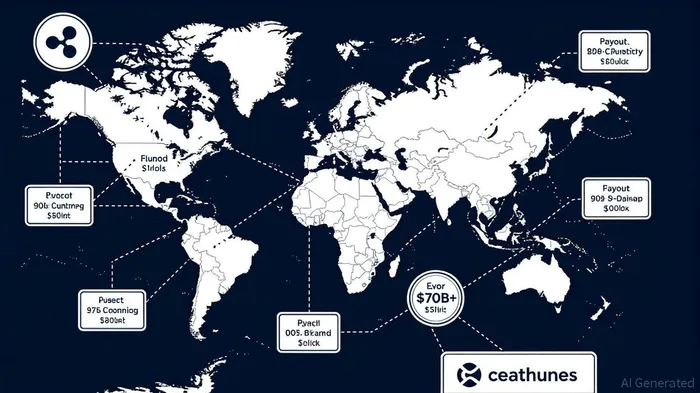
The global cross-border payments landscape is undergoing a seismic shift, driven by the strategic expansion of Ripple and Thunes. Their collaboration, now in its advanced phase, is not just a technological leap but a recalibration of how institutions approach liquidity optimization and compliance. For investors, the implications are clear: XRP’s demand is being turbocharged by institutional adoption, regulatory clarity, and a growing infrastructure that prioritizes speed and cost efficiency.
Strategic Collaboration: Bridging Traditional Finance and Digital Assets
Ripple and Thunes have deepened their partnership to address the inefficiencies of legacy systems like SWIFT. By integrating Ripple’s blockchain-powered solutions into Thunes’ Direct Global Network, the duo is enabling real-time, low-cost cross-border transactions. Ripple’s enterprise customers can now access 90+ payout markets and withdraw funds in new currencies and countries, while Thunes ensures local currency conversions in regions with underdeveloped banking infrastructure [1]. This synergy is critical for markets like Southeast Asia and Africa, where remittances are a lifeline for millions. Fiona Murray of Ripple and Chloe Mayenobe of Thunes have emphasized that this partnership bridges traditional finance and digital assets, creating a scalable solution for underserved regions [4].
The expansion also includes Thunes leveraging Ripple Payments to enhance its SmartX Treasury System, streamlining global money movement and reducing operational friction [2]. With Ripple’s network processing over $70 billion annually and Thunes connecting 4 billion bank accounts and 80 currencies, the combined infrastructure is poised to dominate cross-border corridors [5]. Analysts predict this partnership could double in volume within three years, cementing Ripple’s role as a leader in digital settlements [2].
XRP as the Liquidity Bridge: Efficiency and Cost Optimization
At the heart of this expansion is XRPXRP--, which serves as a bridging asset in Ripple’s On-Demand Liquidity (ODL) service. By converting fiat to XRP, institutions can bypass pre-funded accounts in foreign currencies, reducing transaction costs by up to 70% and settlement times from days to seconds [3]. This is a stark contrast to SWIFT, where intermediaries and currency conversion fees erode profitability.
Quantitative analysis from a 2025 study underscores XRP’s utility in liquidity optimization. A stochastic framework incorporating regime-switching volatility models and jump-diffusion processes revealed that XRP’s behavior diverges from traditional geometric Brownian motion assumptions, necessitating volatility-adaptive strategies for corridor optimization [1]. Monte Carlo simulations outperformed baseline models in predicting settlement success, while XRP’s consensus mechanism—confirming transactions in 3–5 seconds with minimal energy use—further enhances its efficiency [3].
The impact on XRP demand is already evident. In Q2 2025, Ripple’s ODL processed $1.3 trillion in transactions, with SantanderSAN-- reporting a 40% increase in cross-border payments via ODL in Q3 2025 [1]. Whale activity also surged, with large holders accumulating $3.8 billion worth of XRP in 2025, signaling long-term confidence [1].
Regulatory Clarity and Institutional Adoption: A Catalyst for XRP
Post-2025 regulatory changes in the U.S. have been a game-changer. The SEC’s reclassification of XRP as a digital commodity, rather than a security, removed a major barrier to institutional adoption. This shift coincided with a 443.43% year-to-date price surge for XRP, reaching $3.65 in July 2025 [2].
Institutional interest has skyrocketed. The launch of the ProShares Ultra XRP ETF (UXRP) in July 2025 attracted $1.2 billion in inflows within its first month [2]. Over 11 XRP spot ETF applications are now in the pipeline, with a high probability of approvals by year-end 2025, potentially injecting $5–$8 billion in institutional capital [3]. This influx is further amplified by Ripple’s partnerships with Santander and Standard Chartered, which have integrated XRP into their cross-border workflows [2].
Future Outlook: XRP’s Path to Mainstream Utility
The XRP Ledger’s transaction volume surged 500% in Q3 2025, driven by institutional clients and cross-border corridors [1]. Daily active addresses on the XRP Ledger reached 295,000 in August 2025, a testament to its growing utility [1]. With average fees at just $0.0002 and 75% of transactions settling in under five seconds, the XRP Ledger is proving its mettle in a competitive landscape [1].
Looking ahead, the partnership with Thunes and regulatory tailwinds position XRP as a cornerstone of global financial infrastructure. As institutions increasingly prioritize speed, transparency, and cost efficiency, XRP’s role as a liquidity bridge will only expand. For investors, this translates to a compelling case: XRP is not just a speculative asset but a utility token with real-world adoption and institutional backing.
Source:
[1] Ripple, Thunes Join Forces on Cross-Border Push [https://www.pymnts.com/partnerships/2025/thunes-and-ripple-team-to-bolster-cross-border-payments/]
[2] XRP Could Surge Past $3 as US Regulatory Easing Fuels Cross-Border Momentum [https://bravenewcoin.com/insights/xrp-price-prediction-xrp-could-surge-past-3-as-us-regulatory-easing-fuels-cross-border-momentum]
[3] Stochastic Dynamics of Ripple XRP for Cross-Border Settlement Optimization [https://arxiv.org/html/2507.11553v1]
[4] Thunes and Ripple Expand Global Partnership to Transform Cross-Border Payments [https://financialit.net/news/payments/thunes-and-ripple-expand-global-partnership-transform-cross-border-payments]
[5] Ripple–Thunes Deal Targets Faster Payments Across 7 Billion Accounts [https://www.mitrade.com/insights/news/live-news/article-3-1091309-20250903]






Comentarios
Aún no hay comentarios