
Ripple's Strategic Expansion into Prime Brokerage and the Rising Utility of XRP
A New Era for Institutional Trading
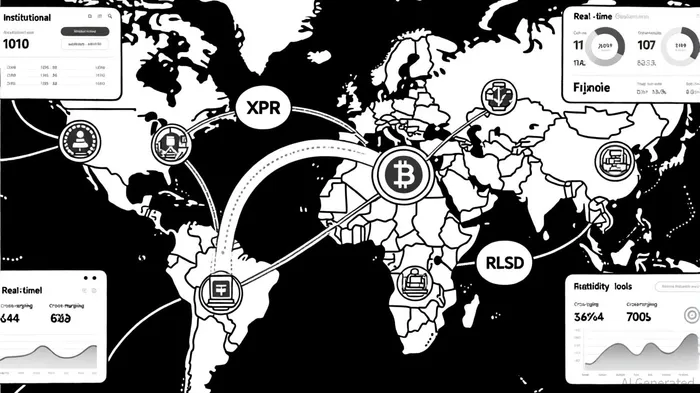
Ripple Prime's launch has already triggered a seismic shift in institutional trading dynamics. According to a CoinDesk report, the platform's business activity has tripled since the acquisition was announced, with over 300 institutional clients now utilizing its services. This growth is underpinned by Ripple's ability to provide cross-margining, real-time risk management, and SOC 2 Type II compliance-features traditionally reserved for legacy prime brokers. Notably, Ripple Prime allows clients to use RLUSD as collateral for derivatives trading, a move the CoinDesk report says introduces a stable, liquid asset into high-volume trading environments.
The integration of XRP into prime brokerage services further amplifies its utility. As stated by Ripple in its official announcement, XRP's role in cross-border transactions is being reinforced through its inclusion in margining and settlement processes, a point Coinotag has highlighted. This development aligns with broader trends in institutional finance, where speed, transparency, and cost efficiency are becoming non-negotiables.
Liquidity Infrastructure and Market Impact
The acquisition's impact on XRP and RLUSD is already measurable. Data from Coinotag reports indicates that XRP's price surged 4.2% to $2.56 following the deal's completion, driven by $292 million in spot outflows and reduced whale selling. Meanwhile, RLUSD's adoption has outpaced major stablecoins: transfer volumes now exceed 25 million, dwarfing USDC's 2.5 million, according to the same Coinotag coverage. This liquidity surge is further bolstered by BNY Mellon's role as RLUSD's primary custodian, a partnership that lends institutional credibility to the stablecoin's asset backing, as reported by CoinDesk.
Ripple's broader strategy to enhance XRP's utility is also gaining traction. The company has expanded its University Blockchain Research Initiative (UBRI), allocating over $1.5 million in RLUSD-funded grants to academic institutions, per Coinotag coverage. This initiative, coupled with a new advisory council led by XRP Ledger co-creator David Schwartz, signals a long-term commitment to research-driven innovation.
The Synergy of Adoption and Infrastructure
The true value of Ripple's expansion lies in its ability to bridge two worlds: institutional finance and blockchain technology. By embedding XRP and RLUSD into prime brokerage workflows, Ripple is addressing critical pain points-such as settlement delays and liquidity fragmentation-while creating a flywheel effect for its native assets. As U.Today highlights, this synergy is attracting attention from traditional players, with SBI CEO Hiroshi Mikitani praising Ripple's "prime time" utility push.
However, challenges remain. Regulatory scrutiny of stablecoins and cross-border transactions could testTST-- Ripple's momentum. Yet, the company's emphasis on compliance-evidenced by Ripple Prime's SOC 2 certification and Bluechip's "A" rating for RLUSD-positions it to navigate these hurdles, according to CoinDesk.
Conclusion
Ripple's foray into prime brokerage is more than a strategic acquisition; it's a reimagining of liquidity infrastructure for the digital age. By leveraging XRP's cross-border capabilities and RLUSD's stability, the company is not only capturing institutional demand but also setting a precedent for how blockchain can enhance traditional financial systems. For investors, the integration of these assets into high-stakes trading environments represents a tangible step toward mainstream adoption-a trend that could redefine the value proposition of both XRP and RLUSD in the years ahead.







Comentarios
Aún no hay comentarios