
Ripple's Strategic Expansion in Japan: A Catalyst for XRP Ledger's Institutional Adoption and Long-Term Utility
Ripple's strategic expansion in Japan has emerged as a pivotal driver for the XRPXRP-- Ledger's (XRPL) institutional adoption, with real-world use cases demonstrating the asset's utility in cross-border payments and financial infrastructure. By forging partnerships with major Japanese financial institutions and leveraging regulatory clarity, Ripple has positioned XRP as a bridge between traditional banking systems and decentralized finance. This analysis evaluates how institutional collaborations are accelerating XRP's adoption and reshaping its long-term value proposition.
Institutional Partnerships: The Cornerstone of XRP's Growth in Japan
Ripple's partnerships with Japanese institutions have been instrumental in scaling XRP's adoption. SBI Holdings, a leading Japanese financial services group, has been a key collaborator, with its CEO Yoshitaka Kitao asserting that "every bank in Japan will use Ripple's XRP by 2025" according to a LinkedIn post. This bold claim aligns with broader industry trends: as of 2025, 80% of Japanese banks are projected to integrate XRP into their systems to streamline cross-border transactions.
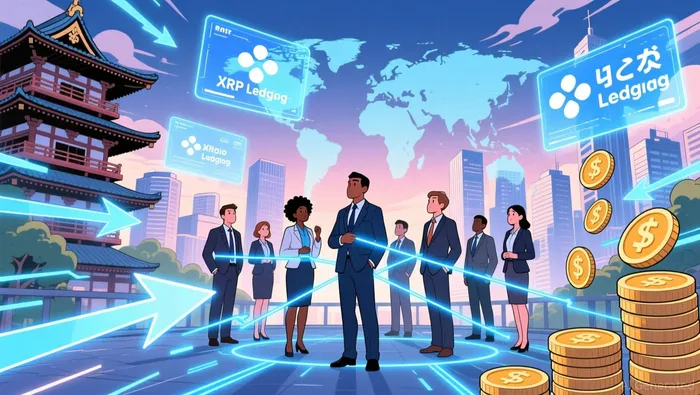 Ripple's collaboration with SBI Holdings extends beyond rhetoric. The joint venture SBI Ripple Asia has already onboarded dozens of Japanese banks onto RippleNet, a global payment network. Additionally, Ripple's partnership with MizuhoMFG-- Bank and SMBC Nikko Securities to launch the Japan Financial Infrastructure Innovation Program (JFIIP) underscores its commitment to fostering innovation. JFIIP provides funding and resources to startups building on the XRP Ledger, focusing on payments, asset tokenization, and credit infrastructure. These initiatives highlight Ripple's dual strategy of engaging established institutions while nurturing a developer ecosystem.
Real-World Use Cases: Measurable Impact on Transaction Efficiency
The practical benefits of XRP adoption are evident in Japan's remittance corridors. SBI Remit, a subsidiary of SBI Holdings, implemented an XRP-based remittance service for Japan-Philippines transactions in 2021, reducing pre-funding costs by up to 70% and accelerating settlement times. This model was later expanded to Vietnam and Indonesia, demonstrating XRP's scalability in high-volume corridors.
Technical advantages further amplify XRP's appeal. The XRP Ledger processes transactions in 3–5 seconds with fees averaging ~$0.0002 per transaction, a stark contrast to traditional systems that often take days and incur higher costs. For instance, cross-border payments between Japan and Southeast Asia-regions with significant migrant worker populations-benefit immensely from XRP's speed and cost efficiency. These outcomes validate XRP's role in addressing inefficiencies in global remittance networks.
Regulatory Clarity and Market Confidence
The 2025 SEC ruling, which clarified that XRP is not a security in open-market transactions, has further bolstered institutional confidence. This regulatory clarity, combined with Japan's proactive stance on blockchain innovation, has created a favorable environment for XRP adoption. Japanese banks, now less constrained by legal uncertainties, are more willing to integrate XRP into their operations.
Moreover, Ripple's work with central banks-such as Bhutan's digital currency pilot and Palau's USD-backed stablecoin-demonstrates the XRP Ledger's adaptability for sovereign digital solutions. These projects reinforce XRP's position as a versatile tool for financial infrastructure, capable of supporting both private and public-sector use cases.
Future Implications and Long-Term Utility
The institutional adoption of XRP in Japan is not merely a short-term trend but a structural shift in global finance. By 2025, Japan's financial sector could serve as a blueprint for how traditional institutions integrate blockchain technology. The XRP Ledger's energy efficiency-consuming 99.99% less energy per transaction than Bitcoin-also aligns with ESG (Environmental, Social, Governance) priorities, making it attractive to sustainability-focused investors.
Looking ahead, Ripple's partnerships and technological enhancements-such as EthereumETH-- compatibility and lending tools-position XRP to compete with other digital assets in institutional portfolios. As more banks adopt XRP for cross-border payments, its utility will extend beyond remittances to include asset tokenization and decentralized credit systems, further diversifying its value proposition.
Conclusion
Ripple's strategic expansion in Japan, driven by institutional partnerships and real-world use cases, has solidified XRP's role as a critical component of modern financial infrastructure. The measurable cost and time reductions achieved by Japanese banks, coupled with regulatory clarity, underscore XRP's long-term utility. As adoption accelerates, XRP is poised to bridge traditional finance and Web3, offering investors a unique opportunity to participate in the evolution of global payments.







Comentarios
Aún no hay comentarios