
Ripple's Strategic Expansion in Europe: A Paradigm Shift in Cross-Border Payments
The global payments landscape is undergoing a seismic shift, driven by the convergence of blockchain technology and institutional-grade compliance. At the forefront of this transformation is Ripple, whose recent foray into Europe-marked-by a landmark partnership with AMINA Bank-signals a pivotal moment in the evolution of cross-border payments. As the European crypto banking market accelerates, Ripple's regulated, blockchain-integrated infrastructure is positioning itself as a critical player in a sector poised for exponential growth.
Strategic Partnerships: Bridging Traditional and Digital Finance
Ripple's collaboration with AMINA Bank, a Swiss crypto bank regulated by FINMA, represents the first major European adoption of its licensed end-to-end payments solution. This partnership enables AMINA Bank's clients to execute cross-border transactions with unprecedented speed, cost efficiency, and transparency, leveraging Ripple's infrastructure to bridge traditional banking systems with blockchain networks. 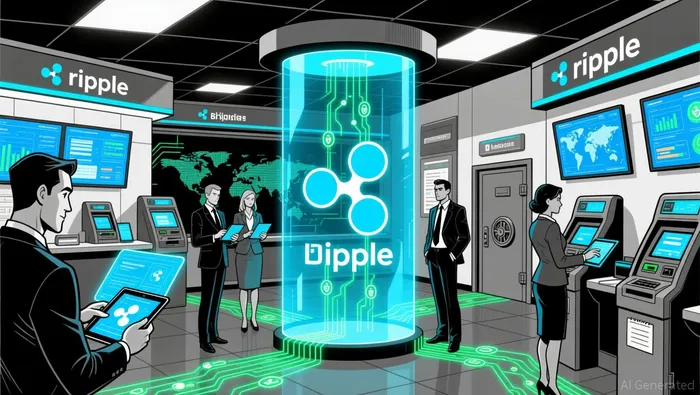 By integrating Ripple's stablecoin, Ripple USD (RLUSD), AMINA Bank further solidifies its role as a bridge between fiat and digital assets, offering a compliant on-ramp for institutions seeking to navigate the complexities of crypto adoption.
This move is emblematic of Ripple's broader strategy to expand its global footprint. With Ripple Payments now operational in regulated markets like Switzerland, the company is demonstrating its ability to meet the stringent compliance demands of European regulators while delivering scalable solutions for cross-border flows. According to reports, for investors, this signals a maturation of Ripple's value proposition-from a speculative asset to a foundational infrastructure provider in institutional finance.
Regulatory Compliance: A Cornerstone of Credibility
Europe's regulatory environment, particularly the Markets in Crypto-Assets (MiCA) framework, has imposed significant hurdles on crypto service providers. However, Ripple's recent regulatory milestones-most notably the settlement of its long-standing case with the U.S. Securities and Exchange Commission (SEC) and the introduction of the GENIUS Act-have provided much-needed clarity for payment stablecoins like RLUSD. These developments are critical for institutional adoption, as they reduce legal ambiguity and align Ripple's offerings with the evolving compliance standards of European markets.
The European Economic Area (EEA) has seen a surge in crypto transaction volumes, peaking at $234 billion in December 2024. Yet, the MiCA framework's grandfathering rules have led to the potential loss of 75% of Europe's 3,167 virtual asset service providers (VASPs) by June 2025. Ripple's ability to navigate these challenges-through its licensed infrastructure and strategic partnerships-positions it as a rare entity capable of thriving in a highly regulated environment. For investors, this underscores the company's resilience and adaptability in a market where compliance is non-negotiable.
Market Growth: A $35.36 Billion Opportunity by 2033
The European crypto banking market is projected to grow from $10.14 billion in 2025 to $35.36 billion by 2033, driven by digital transformation, open banking, and institutional adoption. This growth is further fueled by the expansion of blockchain technology into sectors like finance, supply chain, and healthcare, as well as the rise of decentralized finance (DeFi) platforms. Ripple's entry into this market aligns with a structural shift: cross-border payments, which account for over 90% of daily FX markets and process more than $95 billion in transaction volume, are increasingly being reimagined through blockchain-based solutions.
Key competitors in this space include traditional banks digitizing their offerings and fintechs specializing in embedded finance. However, Ripple's unique value proposition-combining institutional-grade compliance with blockchain efficiency-sets it apart. Its recent acquisitions, including GTreasury, Palisade, and Rail, have further strengthened its institutional capabilities, enabling it to offer a comprehensive stablecoin solution.
Challenges and Risks
Despite its momentum, Ripple faces challenges in transitioning XRPXRP-- from a speculative token to a core component of financial infrastructure. While the market is beginning to price in the possibility of XRP becoming a utility asset in settlement systems, widespread adoption by major institutions remains limited. Additionally, the ECB's digital euro project-a CBDC initiative aimed at complementing cash-could introduce new competition in the cross-border payments space. However, Ripple's focus on interoperability (e.g., XRP's integration into the SolanaSOL-- blockchain as a wrapped asset via Hex Trust and LayerZero) suggests a strategy to coexist with, rather than compete against, emerging CBDCs.
Conclusion: A High-Conviction Investment
Ripple's strategic expansion in Europe-anchored by its partnership with AMINA Bank and bolstered by regulatory clarity-positions it as a key player in the next phase of cross-border payments. With the European crypto banking market set to grow at a compound annual rate of 16.9% through 2033, Ripple's regulated infrastructure offers a compelling value proposition for investors seeking exposure to a sector at the intersection of blockchain innovation and institutional finance. While challenges remain, the company's ability to adapt to regulatory demands and scale its solutions in a competitive landscape makes it a high-conviction investment in a market primed for disruption.







Comentarios
Aún no hay comentarios