
Ripple's Strategic Expansion in Europe: A Catalyst for Blockchain Payments Growth
Ripple's strategic expansion in Europe has positioned it as a formidable player in the blockchain payments sector, with institutional adoption and regulatory progress creating a compelling investment narrative. As the European fintech blockchain market grows at a projected 8.66% CAGR, Ripple's partnerships, compliance tools, and cross-border payment solutions are reshaping the landscape. This analysis explores how Ripple's institutional traction in regulated markets could drive long-term value for investors.
Strategic Partnerships and Regulatory Clarity: A Dual Catalyst
Ripple's collaboration with AMINA Bank marks a pivotal milestone in its European strategy. As the first European bank to adopt Ripple's licensed end-to-end payments solution, AMINA Bank now enables clients to execute near real-time cross-border transactions using Ripple Payments and stablecoins like Ripple USD (RLUSD). 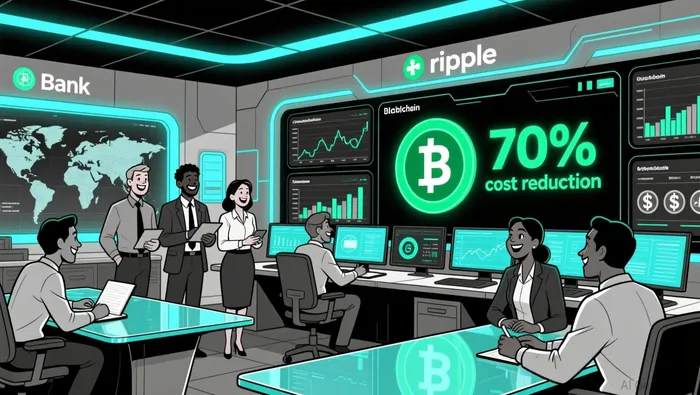 This integration bridges blockchain and traditional banking systems, addressing friction in fiat-to-crypto conversions and reducing costs by up to 70% compared to legacy systems.
Regulatory clarity has further accelerated Ripple's institutional adoption. The company's recent acquisition of a national trust bank charter in the U.S. allows it to engage in custody, settlement, and asset management under federal oversight. This development aligns with a broader regulatory shift toward integrating digital assets into traditional finance, as seen in the EU's Markets in Crypto-Assets (MiCA) framework. While MiCA enforcement in Q4 2025 intensified oversight of stablecoins, it also reinforced institutional confidence in Ripple's compliance infrastructure.
Financial Performance and Market Share: A Growing Ecosystem
Ripple's financial performance in 2025 reflects its expanding influence. XRP's price surged past $2.50 in early 2025, driven by the SEC's dismissal of its case and the launch of XRPXRP-- ETFs like XRPI and XRPR. These ETFs generated $164 million in inflows on their opening day, with assets under management reaching $628 million by November 2025. Analysts project XRP could reach $5 by year-end, fueled by declining exchange balances and rising on-chain activity.
Institutional adoption metrics underscore Ripple's market potential. Over 43.4% of XRP's circulating supply is held in institutional wallets, and Ripple's On-Demand Liquidity (ODL) service processed $1.3 trillion in cross-border payments in 2025. The XRP Ledger's efficiency-processing 75% of transactions in under five seconds-positions it as a scalable alternative to SWIFT. While SWIFT dominates with 11,000+ institutions, Ripple's ODL offers faster, lower-cost settlements, capturing 14% of SWIFT's $150 trillion transaction volume within five years.
Competitive Positioning: Disrupting Legacy Systems
Ripple's competitive edge lies in its ability to challenge SWIFT and other blockchain solutions. Unlike SWIFT's multi-day processing times, Ripple's ODL enables real-time settlements at a cost of ~$0.0002 per transaction. This efficiency is critical for high-cost corridors, such as remittances to Africa via Onafriq, where Ripple's technology reduces fees by 50%. Additionally, Ripple's RLUSD stablecoin, backed by regulated reserves, offers institutional clients a transparent liquidity option.
However, challenges persist. SWIFT's network effect and innovations like SWIFT gpi remain formidable. Regulatory fragmentation in Europe, despite MiCA's progress, also creates compliance hurdles. Yet, Ripple's acquisition of Hidden Road to form Ripple Prime-a crypto-owned global prime brokerage-has tripled liquidity post-2025, further solidifying its institutional infrastructure.
Investment Outlook: A High-Conviction Play
Ripple's strategic expansion in Europe and global partnerships with 300+ institutions position it as a high-conviction investment. Analysts at Token Metrics highlight XRP's outperformance against altcoins in 2025, driven by real-world adoption and regulatory clarity. With $8 billion in projected institutional inflows by 2026 and a potential $10 price target by 2027, XRP's valuation could reflect its role as a global payments infrastructure.
For investors, the key risks include regulatory setbacks and competition from CBDCs. However, Ripple's compliance tools, such as restricted account access and suspicious activity monitoring, make it more attractive to regulated institutions than peers. As the cross-border payments market grows to $320 trillion by 2032, Ripple's ability to capture a meaningful share could drive exponential returns.
Conclusion
Ripple's strategic expansion in Europe, bolstered by institutional partnerships and regulatory progress, is a catalyst for blockchain payments growth. With XRP's utility in cross-border transactions, stablecoin integration, and ETF-driven institutional adoption, the company is well-positioned to disrupt legacy systems and capitalize on the $190 billion European cross-border payments market. For investors seeking exposure to the future of fintech, Ripple represents a compelling long-term opportunity.






Comentarios
Aún no hay comentarios