
Ripple's Strategic Expansion in the EU and the Implications for Stablecoin Growth: Institutional Adoption and Regulatory Alignment as Catalysts for XRP and RLUSD
Ripple's strategic expansion into the European Union (EU) has emerged as a pivotal development in the crypto and stablecoin landscape, driven by a dual focus on regulatory alignment and institutional adoption. As the EU's Markets in Crypto-Assets (MiCA) framework solidifies the region's position as a global regulatory leader, Ripple is leveraging this environment to scale its RLUSD stablecoin and XRP-based infrastructure, positioning itself at the intersection of compliance and innovation.
Regulatory Alignment: MiCA as a Catalyst for Expansion
Ripple's entry into the EU is anchored by its pursuit of an Electronic Money Institution (EMI) license in Luxembourg, a jurisdiction renowned for its robust financial infrastructure and MiCA compliance. By establishing Ripple Payments Europe S.A., the company is aligning with MiCA's passporting rights, which allow licensed entities to operate across the 30 European Economic Area (EEA) countries through its BBVA agreement. This regulatory clarity is critical for Ripple's RLUSD stablecoin, which requires adherence to MiCA's reserve requirements-such as holding 60% of reserves across multiple institutions-to ensure stability and trust, as outlined in the euro-backed stablecoin launch.
Luxembourg's role as a hub is further amplified by Ripple's collaboration with a global custodian that supports compliance with MiCA's stringent reserve management rules in its BNY Mellon partnership. This alignment not only mitigates regulatory risks but also signals to institutions that Ripple's offerings are built on a foundation of trust and transparency. As Cassie Craddock, Ripple's Managing Director for the UK and Europe, noted, MiCA's framework is fostering a "new era of institutional confidence" in digital assets.
Institutional Partnerships: Scaling RLUSD's Utility
Ripple's institutional partnerships are instrumental in driving RLUSD's adoption. The stablecoin, which operates on the XRPXRP-- Ledger and EthereumETH-- while maintaining a 1:1 peg to the U.S. dollar under RLUSD explained , is being integrated into core financial workflows. For instance, Bank of America has incorporated RLUSD into its internal payments system, marking a significant step toward mainstream adoption. Similarly, Franklin Templeton's collaboration with Ripple enables institutional investors to tokenize assets like the sgBENJI token, offering 24/7 liquidity and collateral opportunities, as detailed in the EURØP announcement.
In Europe, partnerships with BBVA and Schuman Financial are expanding RLUSD's reach. BBVA, leveraging Ripple's custody technology, now offers institutional-grade digital asset services in Spain, including BitcoinBTC-- and Ether custody. This move, facilitated by MiCA's regulatory clarity, allows BBVA to provide secure, scalable solutions to its retail customers while maintaining compliance with European standards. Meanwhile, Schuman Financial's EURØP stablecoin-fully backed by euros and audited by KPMG-has become the first MiCA-compliant euro stablecoin on the XRP Ledger. These partnerships underscore Ripple's ability to bridge traditional finance and blockchain innovation.
XRP Ledger: Enabling Institutional-Grade Infrastructure
The XRP Ledger's evolution into an institutional-grade platform is another cornerstone of Ripple's strategy. Features like Automated Market Makers (AMMs), Decentralized Identity (DID), and protocol-native price oracles are enhancing liquidity, compliance, and security for tokenized assets. This infrastructure supports cross-border payments, real-world asset (RWA) tokenization, and DeFi use cases, aligning with the needs of institutions seeking efficient, compliant solutions.
For example, Ripple's collaboration with BlackRock and VanEck via Securitize has enabled the instant exchange of tokenized fund shares for RLUSD, bypassing traditional banking hours and offering continuous liquidity. Such innovations are critical for attracting institutional clients who prioritize operational efficiency and regulatory certainty.
Implications for XRP and RLUSD
Ripple's EU expansion and regulatory alignment are creating a flywheel effect for XRP and RLUSD. As RLUSD's market capitalization surged to $800 million in 2025-a 441% increase year-over-year-the stablecoin's growth is directly tied to its institutional adoption and MiCA compliance. Meanwhile, XRP's role as the backbone of Ripple's infrastructure is being reinforced by partnerships with global banks and the XRP Ledger's technical advancements.
The broader implications are clear: Ripple is positioning itself as a bridge between traditional finance and the digital asset ecosystem. By securing regulatory approval in key markets like Luxembourg and aligning with institutions such as BBVA and Société Générale, Ripple is not only mitigating risks but also accelerating the adoption of stablecoins and blockchain-based solutions.
Conclusion
Ripple's strategic expansion in the EU exemplifies how regulatory alignment and institutional partnerships can catalyze the growth of stablecoins and digital assets. As MiCA's framework continues to shape the European market, Ripple's focus on compliance, innovation, and institutional collaboration positions XRP and RLUSD as key players in the next phase of financial infrastructure. For investors, this represents a compelling case study in how regulatory foresight and strategic execution can drive long-term value in the crypto space.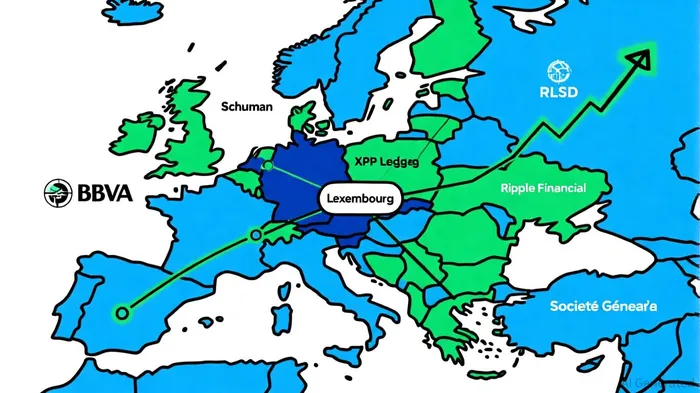






Comentarios
Aún no hay comentarios