
Ripple's Strategic Expansion into Enterprise Finance via GTreasury and Solvexia
The financial technology landscape is undergoing a seismic shift as blockchain-driven solutions redefine enterprise finance. At the forefront of this transformation is Ripple, whose strategic acquisitions of GTreasury and Solvexia position it as a dominant player in the high-growth, defensible market of blockchain-based treasury automation. By integrating cutting-edge automation, compliance frameworks, and cross-border payment infrastructure, Ripple is not merely adapting to industry trends-it is actively shaping the future of enterprise financial operations.
A Market in Exponential Growth
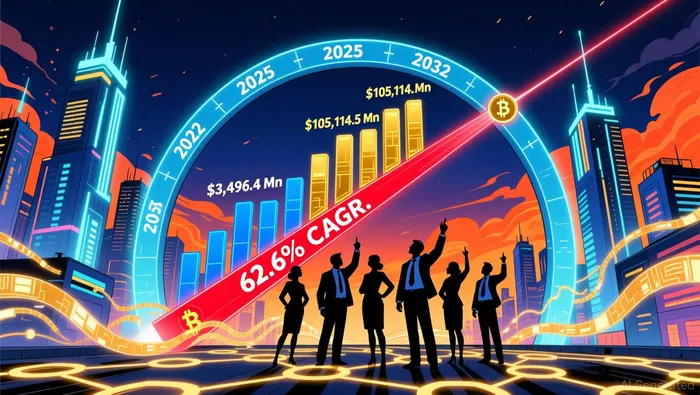
Blockchain-driven treasury automation is emerging as a critical component of modern finance, driven by the need for secure, transparent, and efficient systems. According to a report by Coherent Market Insights, the global blockchain technology market was valued at USD 3,496.4 Mn in 2025 and is projected to reach USD 105,114.5 Mn by 2032, growing at a staggering compound annual growth rate (CAGR) of 62.6%. This surge is fueled by the BFSI sector's adoption of blockchain to address pain points such as slow cross-border payments, compliance bottlenecks, and fraud vulnerabilities as detailed in a Zeeve analysis.
The payment segment alone is expected to dominate the blockchain market in 2025, as institutions seek faster, more secure transaction processing according to market research. Meanwhile, the integration of artificial intelligence (AI) with blockchain is accelerating efficiency gains, with AI-driven platforms optimizing fraud detection and transaction processing as reported by Coherent Market Insights. For instance, 98% of CFOs reported investing in digitization or automation initiatives in 2025, underscoring the urgency to reduce manual errors and operational costs based on Solvexia's 2025 data.
Ripple's Strategic Acquisitions: GTreasury and Solvexia
Ripple's acquisition of GTreasury in October 2025 for $1 billion marked a pivotal step into corporate treasury solutions as announced by GTreasury. GTreasury, already a leader in risk management, foreign exchange (FX), and compliance, now operates as a Ripple Solution, offering enterprises real-time visibility into financial operations according to their press release. However, the true catalyst for Ripple's expansion came with GTreasury's subsequent acquisition of Solvexia, a no-code financial automation platform, in 2026 as reported by Pymnts.
Solvexia's capabilities in reconciliation, data management, and analytics have been seamlessly integrated into GTreasury's platform, enabling end-to-end automation across payment gateways, banking systems, ERPs, and internal records as detailed in the acquisition announcement. This integration eliminates manual, spreadsheet-driven processes that introduce fraud risks and audit exposure, replacing them with near-perfect accuracy and transparency as highlighted in market analysis. For example, the combined platform can detect fraudulent fund flows and verify intercompany settlements in real time, while embedded governance controls reduce operational risk according to Pymnts reporting.
The strategic alignment of these acquisitions with Ripple's broader vision is evident. By combining GTreasury's compliance expertise with Solvexia's automation, Ripple is addressing the dual demands of regulatory compliance and operational efficiency. As stated by a LinkedIn analysis, this move strengthens Ripple's push into end-to-end financial operations, including reporting, controls, and automation.
Competitive Positioning and Market Defensibility
Ripple's dominance in this space is further reinforced by the competitive dynamics of the financial automation industry. While Solvexia previously faced competition from platforms like Osfin, FloQast, Trintech, and AutoRek according to industry analysis, Ripple's integration of Solvexia into its ecosystem creates a formidable barrier to entry. The combined platform's ability to handle both fiat and digital asset transactions, coupled with AI-driven governance, positions it as a one-stop solution for enterprises navigating the complexities of modern finance as reported by Pymnts.
Moreover, Ripple's focus on blockchain-driven treasury automation aligns with broader industry trends. The BFSI sector's blockchain market, valued at $6.98 billion in 2024, is projected to grow at a CAGR of 52.9%, reaching $58.2 billion by 2029 according to Zeeve research. This growth is driven by innovations such as tokenized deposit systems, stablecoins, and smart contracts, which enable real-time settlements and reduce cross-border transaction costs as detailed in the same analysis. Ripple's platform is uniquely positioned to capitalize on these trends, offering enterprises a scalable infrastructure for both traditional and digital financial operations.
Regulatory tailwinds further bolster Ripple's defensibility. The European Union's Markets in Crypto-Assets (MiCA) framework and anticipated U.S. regulatory clarity are fostering institutional adoption of blockchain solutions according to Zeeve. Additionally, the tokenization of real-world assets-such as digital gold and money market funds-is projected to reach $600 billion by 2030, a space where Ripple's integrated platform can provide critical infrastructure as projected by BPM.
The Investment Thesis
Ripple's strategic expansion into enterprise finance represents a high-conviction play on a market poised for exponential growth. By acquiring GTreasury and Solvexia, Ripple has created a defensible moat in blockchain-driven treasury automation, addressing critical pain points in compliance, fraud detection, and operational efficiency. The platform's ability to handle both fiat and digital assets positions it at the intersection of traditional finance and the emerging tokenized economy, a space projected to grow into a multi-trillion-dollar market.
For investors, the implications are clear: Ripple is not merely a fintech company but a foundational infrastructure provider for the next era of finance. As institutions increasingly adopt blockchain to optimize liquidity, reduce costs, and enhance transparency, Ripple's integrated solutions will become indispensable. With a CAGR of over 60% in the blockchain market and a regulatory environment that is becoming more favorable, the company is well-positioned to capture significant market share in the coming decade.







Comentarios
Aún no hay comentarios