
Ripple's Strategic Expansion into Crypto Custody and the Emerging Wallet Infrastructure Opportunity
Ripple's 2025 $4 billion investment spree has redefined the institutional crypto landscape, with its acquisition of Palisade marking a pivotal step in building a unified custody and payments ecosystem. By integrating Palisade's multiparty computation (MPC) wallet technology and multi-chain capabilities, Ripple is positioning itself as a one-stop provider for secure, compliant digital asset management. This institutional-grade infrastructure not only serves banks and corporates but also creates a fertile ground for retail-focused wallet solutions like Best Wallet ($BEST) to thrive. As the crypto economy scales, the interplay between institutional and retail infrastructure is becoming a critical growth driver, with high-utility wallet tokens poised to benefit from Ripple's strategic push.
Institutional Custody as the Foundation for Mass Adoption
Ripple's acquisition of Palisade underscores its commitment to solving the "last mile" challenge in crypto adoption: secure, scalable custody. Palisade's MPC-based key management system eliminates single points of failure, enabling institutions to store and transact digital assets without relying on third-party custodians, as reported by NewsBTC. This aligns with Ripple's broader vision of bridging traditional finance and DeFi, as seen in its prior purchases of Hidden Road (liquidity solutions) and GTreasury (corporate treasury tools), according to Coinotag.
The integration of Palisade's cross-chain capabilities-spanning XRPL, EthereumETH--, and Solana-into Ripple Payments and Custody platforms is particularly significant. It allows enterprises to execute real-time settlements, automated fund sweeps, and subscription billing while maintaining compliance with evolving regulatory frameworks, as highlighted by the NewsBTC report. For example, the report notes that Ripple's institutional clients, including BBVA and Societe Generale–FORGE, now have access to a unified infrastructure that supports both fiat and digital asset operations. This institutional adoption creates a network effect, driving demand for interoperable wallet solutions that cater to both enterprise and retail users.
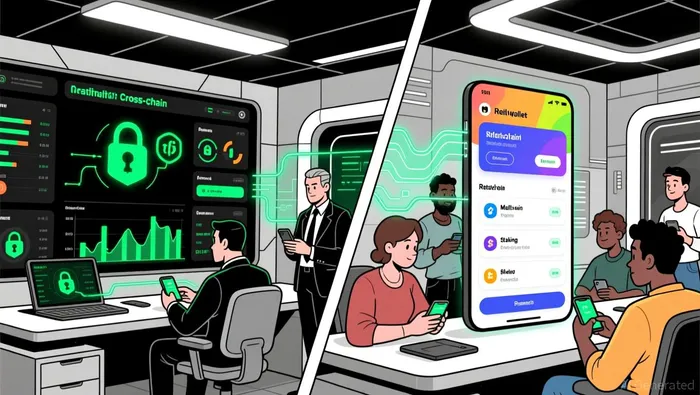
The Retail Wallet Opportunity: $BEST and the Democratization of DeFi
While Ripple's institutional focus is clear, its ecosystem indirectly fuels growth for retail-centric projects like Best Wallet ($BEST). Best Wallet, a multi-chain wallet with a 78% APY staking yield, has raised $16.8 million and is projected to reach $0.07 by 2030, according to the NewsBTC report. Its zero-trust architecture and MPC-powered custody mirror Palisade's institutional-grade security, but with a user-friendly interface tailored for DeFi and NFT enthusiasts.
The key to $BEST's potential lies in its alignment with Ripple's infrastructure. As institutional clients adopt Ripple's custody solutions, they create a demand for retail wallets that offer similar security and interoperability. Best Wallet's cross-chain support for Ethereum, BNB Chain, and SolanaSOL-- positions it to capture this demand, particularly as DeFi protocols and NFT platforms expand, the NewsBTC analysis suggests. Analysts predict $BEST could hit $0.035 by late 2025 and $0.051 by 2026, driven by its staking incentives and growing ecosystem partnerships.
Strategic Synergies and Market Implications
Ripple's $4B investment strategy is not just about acquisitions-it's about building a cohesive infrastructure that spans custody, liquidity, and payments. Palisade's integration into Ripple Payments enhances scalability for use cases like automated treasury operations, while projects like Best Wallet fill the retail gap by offering accessible, secure tools for everyday users, the NewsBTC coverage argues. This dual-layer approach-institutional and retail-creates a flywheel effect: as enterprises adopt Ripple's solutions, they validate the underlying technology, accelerating consumer trust and adoption.
For investors, the implications are clear. High-utility wallet tokens like $BEST are positioned to benefit from Ripple's institutional momentum, as they serve as the retail-facing counterpart to institutional custody infrastructure. With crypto adoption now a priority for corporates and regulators alike, the wallet infrastructure market is entering a phase of explosive growth.






Comentarios
Aún no hay comentarios