
Ripple's Strategic Case for Staying Private and Its Implications for Crypto-Traditional Finance Convergence
The post-2023 regulatory environment for private crypto firms has been marked by a pivotal shift in U.S. Securities and Exchange Commission (SEC) enforcement and policy priorities. With the departure of Chair Gary Gensler and the appointment of Chair Paul Atkins, the SEC has moved from an aggressive enforcement stance to a more innovation-friendly framework, characterized by no-action letters, dismissed cases, and the creation of specialized units like the Crypto Task Force and Cyber and Emerging Technologies Unit (CETU) according to Georgetown Law analysis. This regulatory clarity has enabled firms like Ripple to refine their strategies for long-term value retention and integration into traditional finance.
Ripple's Strategic Rationale for Staying Private
Ripple's decision to remain private post-2023 is rooted in its ability to execute a multi-pronged strategy that leverages regulatory certainty and technological advantages. After resolving its protracted legal battle with the SEC, Ripple secured a critical precedent: the court's affirmation that XRP is not a security for public exchange sales. This settlement not only removed regulatory ambiguity but also catalyzed a surge in XRPXRP-- liquidity and institutional adoption. By staying private, Ripple has avoided the short-term pressures of public market expectations, allowing it to focus on building a comprehensive digital asset infrastructure.
Central to this strategy is Ripple's $4 billion investment in acquisitions and partnerships to create a "one-stop shop" for institutional clients. The $1.25 billion acquisition of Hidden Road, a fintech firm offering institutional market access and custody solutions, and the $1 billion acquisition of GTreasury, a corporate treasury management platform, exemplify Ripple's ambition to bridge crypto and traditional finance. These moves enable Ripple to offer unified services such as real-time cross-border payments, stablecoin-backed collateral, and treasury optimization, aligning with the growing demand for blockchain-based solutions in corporate finance.
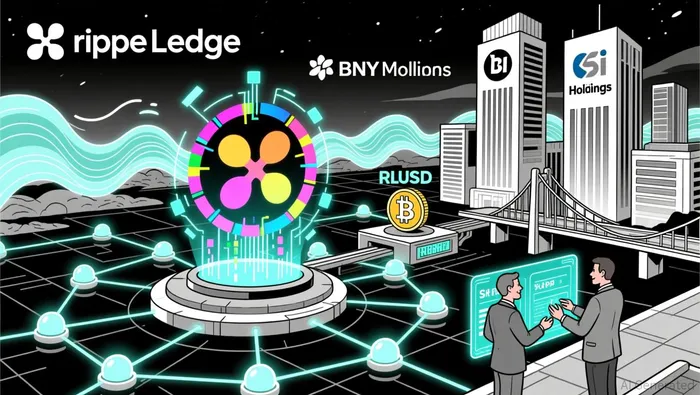
Ripple's launch of RLUSD, a U.S. dollar-backed stablecoin in partnership with BNY Mellon, further underscores its integration into traditional systems. By leveraging BNY Mellon's banking infrastructure, Ripple has positioned RLUSD as a tool for institutional clients seeking stable, programmable value transfer. Additionally, Ripple's pursuit of a U.S. banking charter and a Federal Reserve account could enable it to hold stablecoin reserves directly at the Fed, reducing counterparty risks and enhancing operational efficiency.
Comparative Analysis: Ripple vs. Coinbase and Kraken
While Ripple's strategy emphasizes infrastructure and institutional integration, Coinbase and Kraken have adopted complementary approaches. Coinbase, for instance, has prioritized institutional expansion through the $2.9 billion acquisition of Deribit, a leading crypto options exchange, to dominate global derivatives markets. This move has solidified Coinbase's position as a custodian for 81% of U.S. crypto ETF assets by mid-2025, leveraging recurring revenue from institutional clients. Kraken, meanwhile, has diversified into traditional derivatives and stock trading via the acquisition of NinjaTrader and Small Exchange, while expanding its custody and staking services according to Forge Global analysis.
Ripple's focus on building a full-stack financial infrastructure distinguishes it from its peers. While Coinbase and Kraken have concentrated on expanding trading and custody services, Ripple's acquisitions of Hidden Road and GTreasury directly address corporate treasury needs, enabling real-time cross-border settlements and liquidity management. This approach aligns with the rise of Digital Asset Treasury Companies (DATCOs), a new class of firms that treat crypto as a core operating asset rather than a sidecar allocation.
Regulatory Clarity and Sector-Wide Trends
The SEC's post-2023 regulatory shifts have been instrumental in enabling private crypto firms to integrate with traditional finance. The repeal of Staff Accounting Bulletin 121, which previously discouraged institutional participation in crypto, and the joint SEC-CFTC statement allowing spot BitcoinBTC-- and EtherETH-- ETF listings, have created a more hospitable environment for innovation. These developments have spurred venture capital investment in enterprise-oriented crypto projects and accelerated institutional adoption, with major banks like JPMorgan and US Bank launching crypto-native products.
Ripple's strategic alignment with these trends is evident in its partnerships with SBI Holdings for cross-border remittances in Asia and its exploration of central bank digital currency (CBDC) pilot projects according to LinkedIn analysis. By addressing institutional concerns such as custody (via the $200 million acquisition of Metaco) and cross-border payments (via Rail), Ripple has mitigated key barriers to adoption.
Long-Term Value Retention and Growth Potential
Ripple's long-term value retention hinges on its ability to scale its infrastructure while navigating regulatory fragmentation across regions. Despite challenges in harmonizing compliance standards in the U.S., EU, and Asia, Ripple's technological advantages-such as the XRP Ledger's fast transaction speeds (~3–5 seconds) and low fees-position it as a preferred solution for real-time settlements. The company's $500 million funding round and strategic focus on enterprise-grade tools like decentralized exchanges and automated market makers further reinforce its growth potential.
In contrast, public exchanges like Coinbase and Kraken face distinct challenges. While Coinbase's public market status provides access to capital, it also subjects the firm to heightened scrutiny and volatility. Kraken's aggressive diversification into traditional derivatives and stock trading, meanwhile, exposes it to regulatory risks in a rapidly evolving landscape.
Conclusion
Ripple's strategic decision to remain private has enabled it to capitalize on post-SEC clarity by building a robust infrastructure for crypto-traditional finance convergence. By prioritizing institutional integration, technological innovation, and regulatory alignment, Ripple has positioned itself as a leader in the emerging DATCO sector. As the SEC continues to refine its approach to digital assets, firms like Ripple that balance innovation with compliance are likely to drive the next phase of growth in the crypto ecosystem.






Comentarios
Aún no hay comentarios