
Ripple's RLUSD and XRP Ledger: A Disruptive Force in Global Payment Infrastructure
In the race to modernize global financial infrastructure, Ripple's RLUSD stablecoin and XRPXRP-- Ledger are emerging as a formidable duo. By combining a regulated, dollar-backed digital asset with a blockchain engineered for speed and efficiency, Ripple is not just challenging legacy systems like SWIFT-it's redefining what's possible in real-time, low-cost financial settlements. For investors, this represents a rare intersection of technological innovation, institutional adoption, and regulatory progress.
RLUSD: Bridging the Gap Between Crypto and Traditional Finance
Launched in late 2024, Ripple's RLUSD stablecoin has already achieved a market cap of over $1.3 billion, with transaction volume surging 210% in 30 days to exceed $4 billion. This rapid adoption is driven by strategic partnerships with major players like MastercardMA--, WebBank, and Gemini. Notably, Ripple is piloting RLUSD to settle credit card transactions on the XRP Ledger-a first-of-its-kind initiative involving a regulated U.S. bank using a public blockchain for fiat settlements.
The stablecoin's multi-chain deployment on both the XRP Ledger and EthereumETH-- further amplifies its utility. By leveraging the XRP Ledger's low-cost, high-speed settlement and Ethereum's deep liquidity pools, RLUSD caters to institutional needs for scalability and compliance according to market analysis. Ripple's President, Monica Long, has highlighted growing adoption in corporate treasuries and cross-border payments, positioning RLUSD as a "regulated, dollar-backed digital asset" that bridges speculative crypto markets with operational finance.
XRP Ledger: The Backbone of a New Financial Ecosystem
Underpinning RLUSD's success is the XRP Ledger itself, a blockchain designed for efficiency. With transaction settlement times of 3–5 seconds and fees averaging just $0.0002 per transaction, the XRP Ledger outperforms traditional systems by orders of magnitude. Its capacity to handle 1,500 transactions per second, combined with energy efficiency 100,000 times greater than BitcoinBTC--, makes it an attractive solution for institutions seeking to cut costs and reduce environmental impact.
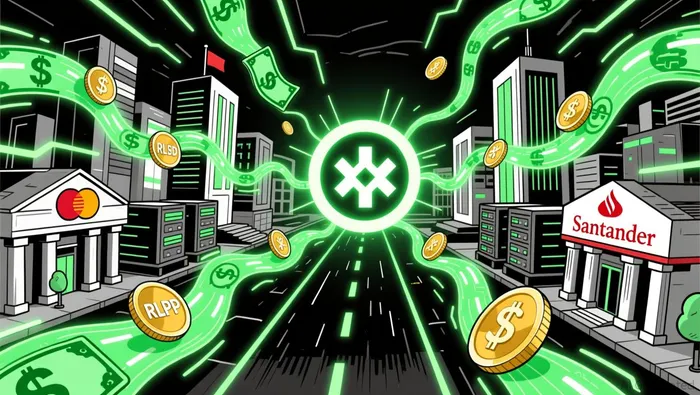
Regulatory clarity has further accelerated adoption. The resolution of Ripple's SEC lawsuit in 2025-establishing that secondary XRP sales are not securities-has unlocked institutional access to XRP, with major banks like Santander and SBI Holdings integrating it into their payment systems. This legal certainty, coupled with projected onchain transaction volume exceeding $3 trillion in 2025, underscores the XRP Ledger's role as a foundational layer for global finance.
Synergy: RLUSD and XRP as a Bridge to the Future
The interplay between RLUSD and XRP is where the disruption truly takes shape. By using RLUSD for fiat settlements and XRP as a bridge asset in multi-currency transactions, Ripple is creating a seamless, cost-effective infrastructure for cross-border payments. Analysts note that RLUSD's regulated framework gives it a competitive edge over unbacked stablecoins, while XRP's low fees and speed make it ideal for liquidity management.
For example, Gemini's integration of RLUSD into its credit card program allows users to earn cashback in stablecoins, demonstrating how these tools can attract retail and institutional users alike. Meanwhile, Ripple's pilot with Mastercard signals a shift toward blockchain-based settlement in everyday financial services-a move that could reduce reliance on intermediaries and democratize access to global markets.
The Investment Case: From Speculation to Operational Value
For investors, the key takeaway is clear: Ripple's ecosystem is transitioning from speculative hype to operational reality. With over 300 banks already using RippleNet and RLUSD driving increased XRP demand, the network effect is accelerating. As transaction volumes grow and use cases expand-from corporate treasuries to consumer finance-the XRP Ledger's role in enabling real-time settlements will become increasingly critical.
Moreover, the environmental and cost advantages of the XRP Ledger position it to compete with traditional systems in an era where sustainability and efficiency are paramount. For institutions, this means lower operational costs and faster execution; for investors, it means exposure to a technology that's not just solving problems but reshaping entire industries.
Conclusion
Ripple's RLUSD and XRP Ledger are more than just tools-they're catalysts for a new era of financial infrastructure. By combining a regulated stablecoin with a high-performance blockchain, Ripple is addressing the pain points of legacy systems while unlocking new opportunities for institutional and retail participants. As adoption accelerates and regulatory frameworks solidify, the investment potential in this ecosystem becomes increasingly compelling. For those looking to bet on the future of real-time, low-cost financial settlements, Ripple's offerings are no longer on the periphery-they're at the center of the action.







Comentarios
Aún no hay comentarios