
Ripple's Regulatory Push and Its Implications for the Future of Crypto Markets
The resolution of the U.S. Securities and Exchange Commission (SEC) lawsuit against Ripple Labs in August 2025 marked a watershed moment for the cryptocurrency industry. After five years of legal uncertainty, the case concluded with a $50 million settlement, dissolving the injunction against Ripple and clarifying the legal status of XRPXRP-- in specific contexts. This regulatory clarity has since catalyzed a surge in institutional adoption, reshaping XRP's valuation trajectory and signaling a broader shift in how digital assets are classified and integrated into traditional financial systems.
Regulatory Clarity: A Legal Framework for Digital Assets
The court's 2023 ruling that XRP sales on public exchanges did not constitute securities transactions laid the groundwork for the 2025 settlement. This distinction-differentiating between public and institutional sales-established a nuanced framework for evaluating digital assets under U.S. securities law. As legal analysts at Katten Muchin Rosenman state, the case set a precedent for future regulatory decisions, emphasizing the importance of a token's use case and distribution model in determining its classification.
The settlement also reflected a strategic pivot by the SEC under Chairman Paul Atkins, who prioritized "Project Crypto" to modernize regulations for digital assets. This shift signaled to market participants that the SEC was moving toward a more structured, innovation-friendly approach, reducing the risk of arbitrary enforcement that had previously stifled institutional participation.
Institutional Adoption: A New Era for XRP 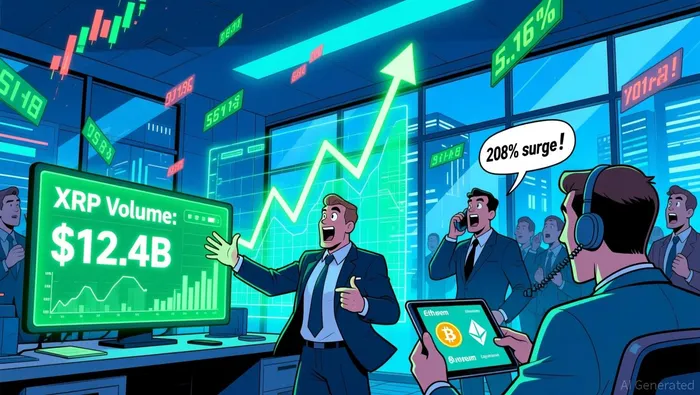
The removal of legal barriers immediately spurred institutional interest. By late 2025, institutional trading volumes for XRP surged 208% to $12.4 billion, driven by the launch of XRP spot ETFs. These products attracted $1.07 billion in net inflows during their first month, with continued steady investment of $483 million in December 2025 alone. Notably, this demand persisted even as XRP's price declined 15% during the same period, underscoring institutional confidence in XRP's utility as a cross-border payment solution.
Comparative data highlights XRP's unique position. While BitcoinBTC-- retained dominance in total inflows ($26.98 billion in 2025), XRP's inflow velocity outpaced both Bitcoin and EthereumETH--. XRP's $3.69 billion in 2025 inflows represented a 500% increase from 2024, effectively turning over its entire market cap-a stark contrast to Bitcoin's 19% and Ethereum's 49% inflow-to-AUM ratios. This trend reflects a strategic diversification by institutions seeking exposure to digital assets with clear utility, such as XRP's role in facilitating real-time cross-border transactions.
Valuation Growth: From Legal Uncertainty to Market Optimism
The regulatory resolution directly impacted XRP's valuation. In the 24 hours following the settlement, XRP surged 12% to $3.30-$3.33, with its market capitalization reaching $178 billion by August 2025. Analysts at European Business Magazine note that XRP's institutional adoption story has positioned it as a "true institutional alt major," competing with SolanaSOL-- in terms of inflow velocity and strategic allocation. Price forecasts for 2026 remain bullish, with most models predicting a range of $3 to $6, and some suggesting upside potential beyond $10 if adoption accelerates. This optimism is underpinned by XRP's infrastructure utility-its blockchain processes transactions in 3-5 seconds with minimal fees, making it a preferred solution for financial institutions seeking efficiency in cross-border payments.
Broader Implications for Crypto Markets
Ripple's case underscores the transformative power of regulatory clarity. By resolving a five-year legal standoff, the SEC inadvertently created a blueprint for how other digital assets might navigate U.S. regulations. As CoinCub analysts observe, the distinction between public and institutional sales could influence future rulings, enabling a more tailored regulatory approach that balances investor protection with innovation.
Moreover, the success of XRP ETFs demonstrates that institutional demand for crypto is no longer confined to Bitcoin and Ethereum. With five XRP ETF issuers now active, the market is witnessing a diversification of crypto portfolios, driven by tokens with clear use cases and regulatory certainty. This trend could accelerate as other jurisdictions follow the U.S. example, fostering a more mature and institutional-grade crypto ecosystem.
Conclusion
Ripple's regulatory resolution in 2025 has redefined the landscape for digital assets, proving that clarity and structured frameworks can unlock institutional capital and drive valuation growth. For XRP, the settlement not only removed a cloud of uncertainty but also validated its role as a utility-driven asset. As the crypto market evolves, the lessons from Ripple's case will likely shape how regulators, investors, and innovators approach the next wave of digital assets-prioritizing utility, transparency, and legal alignment.







Comentarios
Aún no hay comentarios