
Ripple's Leadership Transition and Implications for XRP Ecosystem Growth
The recent leadership transition at Ripple, marked by David Schwartz's shift from Chief Technology Officer (CTO) to CTO Emeritus and board membership, underscores a critical juncture for the XRPXRP-- Ledger (XRPL) ecosystem. This move, while signaling the end of Schwartz's 13-year tenure, reflects a strategic approach to succession planning that aligns with broader trends in blockchain firms. By examining Ripple's internal transition alongside industry-wide practices, we can assess how such continuity efforts position XRP for sustained growth in 2026 and beyond.
Strategic Continuity in Ripple's Leadership Transition
David Schwartz's departure from daily operations, coupled with his continued involvement as CTO Emeritus, exemplifies a nuanced approach to succession planning. Schwartz, a co-architect of the XRP Ledger, emphasized his commitment to advancing the XRPL ecosystem through research and governance, even as he steps back to prioritize personal pursuits. This transition ensures that Ripple retains the technical vision of its founding team while empowering Dennis Jarosch, Senior Vice President of Engineering, to lead operational execution. Jarosch's promotion, a hallmark of internal succession, mitigates the risks of knowledge gaps and institutional memory loss-common challenges in fast-evolving blockchain firms according to community discussion.
Ripple's strategy mirrors broader industry trends where companies prioritize mentorship and gradual leadership handoffs. For instance, DeFi protocols often implement "Governance Apprentice" systems to train community members in decentralized governance, while Web3 firms use rotational leadership roles to diversify expertise as research shows. By appointing Jarosch-a long-time Ripple engineer with deep familiarity with XRPL-Ripple avoids the disruptive "cold start" risks associated with external hires, ensuring technical continuity in a sector where innovation cycles are rapid and competitive pressures are intense .
Ripple's 2025 Strategic Moves: Compliant Execution and Ecosystem Expansion
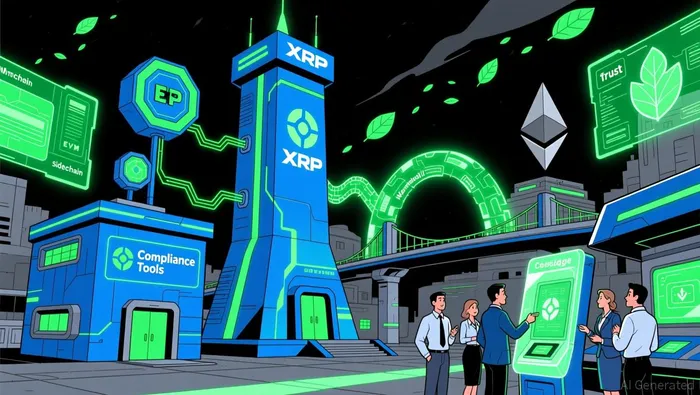
The leadership transition coincides with Ripple's aggressive push to position the XRP Ledger as a compliant infrastructure for institutional clients. Key upgrades in 2025, including enhanced compliance tools, institutional lending capabilities, and an EthereumETH-- Virtual Machine (EVM) sidechain, reflect a deliberate pivot toward regulated financial ecosystems. These developments align with the broader industry shift toward "compliant execution," where blockchain platforms integrate regulatory frameworks to attract banks and enterprises.
Notably, Ripple's launch of RLUSD, its stablecoin on the XRP Ledger, has demonstrated the platform's scalability and reliability in handling large-scale financial transactions. This success, combined with cross-chain integrations like WormholeW--, has expanded XRPL's interoperability, enabling seamless asset transfers across ecosystems. Such strategic moves not only reinforce institutional confidence but also create a flywheel effect: as more enterprises adopt XRPL, the network's utility and XRP's demand grow in tandem according to industry analysis.
Comparative Insights: Succession Planning in Blockchain Firms
Ripple's approach to succession planning contrasts with strategies in DeFi and Web3 firms, where decentralized governance models often rely on token-weighted voting or community-driven leadership. For example, a Layer-1 protocol might implement a "Core Contributor Fast-Track" to groom developers for leadership roles, while a DeFi DAO could use governance apprentices to train delegates in risk assessment as industry reports indicate. These models prioritize decentralization but risk fragmentation if not paired with clear technical direction-a challenge Ripple avoids by retaining Schwartz's strategic oversight.
The importance of technical continuity is further highlighted by case studies in digital asset succession. Blockchain-based solutions for estate planning, such as smart contracts for automated inheritance, emphasize the need for robust governance frameworks to prevent asset loss according to scientific research. Ripple's transition, by contrast, ensures that critical technical knowledge remains embedded within the organization, reducing the risk of operational disruptions that could erode investor trust.
XRP's Performance and Institutional Adoption Post-Transition
The leadership change has already catalyzed positive momentum for XRP. Post-settlement, the token has delivered strong returns across 30-, 90-, and 180-day horizons, driven by increased institutional participation. USD-to-XRP trading volume surged by over 300% on platforms like Coinbase, signaling genuine demand from new market participants. This growth is underpinned by Ripple's pursuit of a U.S. banking charter and its focus on real-world asset tokenization, which expand XRP's utility beyond cross-border payments according to industry analysis.
Moreover, Ripple's strategic alignment with regulatory clarity-such as the U.S. CLARITY Act-positions it to navigate evolving legal landscapes more effectively than competitors as industry insights suggest. As institutional investors seek compliant digital assets, Ripple's emphasis on regulatory compliance and technical innovation creates a compelling value proposition for XRP adoption.
Conclusion: A Model for Blockchain Succession
Ripple's leadership transition and strategic initiatives illustrate a blueprint for sustainable growth in the blockchain sector. By blending internal succession with technical continuity, Ripple mitigates the risks of disruptive leadership changes while maintaining its competitive edge. The XRP Ledger's evolution into a compliant, interoperable infrastructure further cements its role in enterprise finance, supported by institutional demand and regulatory alignment.
For investors, the key takeaway is clear: Ripple's strategic continuity and ecosystem-focused innovation position XRP as a critical player in the next phase of blockchain adoption. As the industry matures, firms that prioritize structured succession planning-like Ripple-will likely outperform those reliant on volatile external hires or decentralized governance without centralized technical direction.






Comentarios
Aún no hay comentarios