
Ripple's Institutional Breakthrough: BlackRock, VanEck, and XRP's Path to Global Payments Dominance
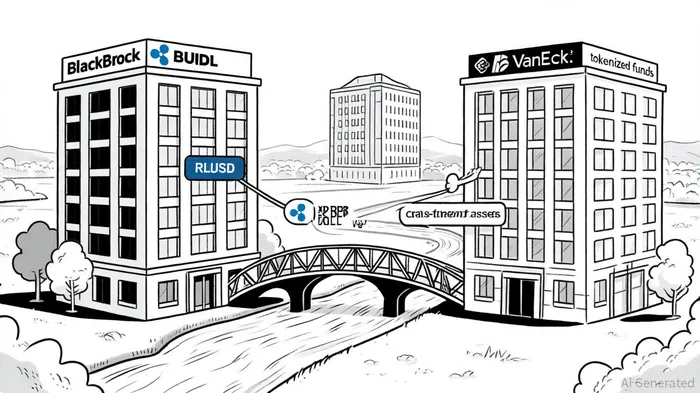
In 2025, Ripple has cemented its position as a bridge between traditional finance and blockchain through strategic partnerships with BlackRockBLK-- and VanEck. These collaborations, centered on the integration of Ripple's stablecoin RLUSD into institutional-grade tokenized money-market funds, mark a pivotal shift in how global payments and asset settlement are conceptualized. For investors, this represents not just a validation of XRP's utility but a glimpse into a future where blockchain infrastructure underpins mainstream financial systems.
Institutional Adoption: RLUSD as a Liquidity Catalyst
Ripple's stablecoin, RLUSD, has been integrated into BlackRock's USD Institutional Digital Liquidity Fund (BUIDL) and VanEck's Treasury Fund (VBILL) via a smart contract on Securitize's platform. This integration allows investors to redeem shares in these tokenized funds for RLUSD 24/7, creating a seamless on-chain liquidity mechanism[1]. By acting as a settlement layer for real-world assets (RWAs), RLUSD is positioned to enable institutional investors to deploy capital in decentralized finance (DeFi) strategies while maintaining exposure to traditional treasuries[2].
The significance of this move lies in its regulatory alignment. RLUSD is fully backed 1:1 with liquid reserves under a New York DFS Trust Company Charter, ensuring institutional-grade stability[3]. This compliance-driven approach has attracted over $4 billion in tokenized assets under SEC oversight, marking a first for a regulated platform leveraging a stablecoin for real-time settlements[4]. As stated by Ripple's SVP of Stablecoins, Jack McDonald, this development is a “natural progression in bridging traditional finance and crypto,” underscoring the growing trust in blockchain-based liquidity solutions[5].
XRP's Role in Cross-Border Payments: Efficiency and Scalability
While RLUSD addresses liquidity within institutional portfolios, XRPXRP-- itself remains central to Ripple's cross-border payment strategy. Ripple's On-Demand Liquidity (ODL) service uses XRP as a bridge currency, enabling instant settlements in high-volume corridors. By automating foreign exchange conversions and eliminating the need for pre-funded accounts, ODL reduces operational costs for banks by up to 60% and accelerates transaction times to 3–5 seconds[6].
This efficiency is critical in the $27 trillion cross-border payments market, where traditional systems like SWIFT remain slow and opaque. Ripple's XRP Ledger (XRPL), with its Byzantine Fault Tolerance (BFT) mechanisms and sub-second finality, offers a compelling alternative. According to a report by The Currency Analytics, XRP's role in this space has drawn attention from U.S. policymakers, with discussions about a strategic cryptocurrency reserve including XRP[7].
Expanding the XRPL Ecosystem: DeFi and Institutional Infrastructure
Ripple's ambitions extend beyond payments. The XRP Ledger is evolving into a full-stack financial infrastructure platform, with Version 3.0.0 set to introduce a native lending protocol. This protocol will enable pooled lending and underwritten credit at the ledger level, allowing institutions to access low-cost capital while adhering to KYC/AML standards[8]. Complemented by compliance tools like Credentials and Deep Freeze, the XRPL is becoming a trusted environment for institutional DeFi applications[9].
Ripple's acquisition of Rail and Hidden Road further solidifies its role as a full-stack financial services firm, integrating lending, payments, stablecoins, and brokerage services under one ecosystem[10]. These moves, combined with the 2025 SEC settlement that provided regulatory clarity for XRP, have spurred institutional interest in both XRP and RLUSD[11].
Investment Implications: A Convergence of Trends
For investors, Ripple's partnerships with BlackRock and VanEck signal a convergence of three megatrends: institutional adoption of blockchain, the tokenization of real-world assets, and the demand for efficient cross-border payment solutions. RLUSD's integration into tokenized funds has already driven its market capitalization past $700 million, demonstrating its utility as a programmable liquidity asset[12]. Meanwhile, XRP's role in ODL and the XRPL's institutional-grade features position it to capture a significant share of the global payments market.
However, challenges remain. Regulatory scrutiny, competition from stablecoins and central bank digital currencies (CBDCs), and macroeconomic headwinds could temper growth. Yet, Ripple's focus on compliance and its strategic alignment with financial incumbents suggest a durable path forward.
Conclusion
Ripple's strategic alliances with BlackRock and VanEck are not merely incremental—they represent a fundamental reimagining of how liquidity, settlement, and cross-border payments operate in a hybrid financial system. By anchoring RLUSD in institutional portfolios and leveraging XRP's speed and efficiency, Ripple is building a bridge that could redefine global finance. For investors, the question is no longer whether blockchain will disrupt traditional systems but how quickly institutions will adopt solutions like Ripple's.





Comentarios
Aún no hay comentarios