
The Ripple Effects of Chinese Miner Exodus and Exchange Volatility on Crypto Market Stability
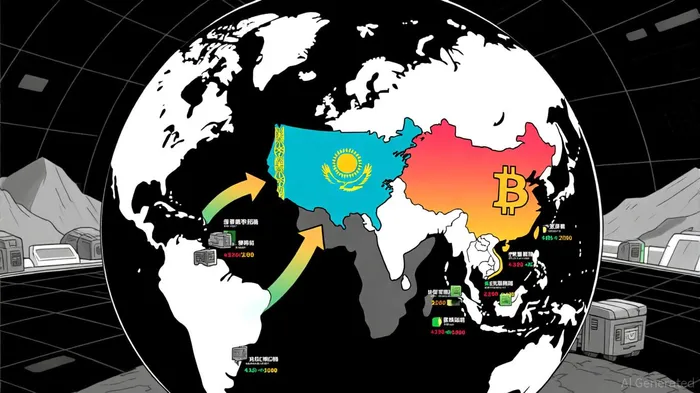
The 2025 BitcoinBTC-- market is defined by a collision of geopolitical upheaval and operational fragility, as the exodus of Chinese miners and exchange volatility reshape institutional investment frameworks. This analysis unpacks how these forces—rooted in hash rate instability, energy cost shifts, and U.S.-China trade tensions—are redefining risk paradigms for institutional players.
Hash Rate Redistribution and Energy Cost Dynamics
The exodus of Chinese Bitcoin miners, which historically controlled 75% of global operations, has triggered a seismic shift in hash rate distribution. By 2025, the U.S. leads with 37.8% of the global hashrate, followed by Kazakhstan (12%) and Russia (10.5%) [1]. This migration, however, was not without turbulence: the network's hashrate plummeted by 50% in 2022 before stabilizing at 831 EH/s in May 2025—a 77% increase from the 2024 low [2].
Energy costs remain a critical determinant of mining profitability, with electricity accounting for 48–52% of operational expenses in 2025 (down from 70% in 2020) [3]. Regions like Oman and the UAE have leveraged government-backed subsidies to secure electricity at $0.035–$0.07/kWh, while U.S. operations face higher costs exceeding $0.10/kWh [4]. This divergence has accelerated mining consolidation in low-cost regions, with 68% of global operations now powered by renewables [3].
Geopolitical Tensions and Supply Chain Vulnerabilities
The U.S.-China trade war has further complicated the mining landscape. Chinese giants like Bitmain and MicroBT, which dominate 95% of the global hardware market, are relocating production to the U.S. to circumvent tariffs [5]. While this shift aims to secure access to the American market—where 30% of global mining occurs—it raises national security concerns. U.S. infrastructure is now intertwined with Chinese-made mining rigs, creating potential choke points for network stability [5].
Meanwhile, logistical bottlenecks persist in China, where millions of mining machines remain stuck in Sichuan due to legal and regulatory hurdles [6]. This gridlock has forced miners to adopt hybrid strategies: some Chinese firms are rebranding as “digital infrastructure providers,” diversifying into AI data centers and energy solutions to offset mining losses [7].
Exchange Volatility and Institutional Risk Mitigation
Bitcoin's price volatility in 2025 has been exacerbated by macroeconomic pressures and geopolitical uncertainty. Following U.S. President Donald Trump's inauguration, Bitcoin surged to $109,000 but corrected sharply as investors fretted over delayed Federal Reserve rate cuts [8]. Despite this turbulence, institutional demand has surged: year-to-date inflows into crypto investment products hit $27 billion by July 2025, with total assets under management reaching $220 billion [9].
Institutions are responding with advanced risk frameworks. For instance, 72% of institutional investors now employ governance models tailored to crypto assets, while 74% allocate budgets to cybersecurity measures like zero-trust architectures [10]. Stablecoins, now valued at $232 billion, have also become a focal point, with 42% of institutions limiting exposure to lower-tier exchanges to mitigate counterparty risk [10].
Institutional Investment Strategies in a Fractured Landscape
The interplay of hash rate instability and geopolitical risks has driven institutional innovation. MicroStrategy's aggressive accumulation of 580,955 BTC—averaging $106,495 per unit—reflects a broader trend of corporate treasuries treating Bitcoin as a strategic reserve asset [11]. Similarly, the U.S. government's creation of a “Cryptocurrency Asset Strategic Reserve” under the Trump administration has incentivized traditional financial players like BlackRock to adopt vertical integration and hedging strategies [12].
Renewable energy-powered mining operations are also gaining traction. Texas-based miners now achieve 85% renewable energy supply, aligning with institutional demand for ESG-compliant infrastructure [12]. This shift is critical as energy costs and geopolitical dependencies remain intertwined: for example, Chinese miners operating in Central Asia rely on low-cost hydroelectricity, while U.S. firms grapple with natural gas price fluctuations [4].
Conclusion: A New Equilibrium in Institutional Bitcoin Investing
The 2025 crypto market is a microcosm of broader geopolitical and operational risks. Chinese miner exodus has fragmented the hashrate, while U.S.-China tensions have exposed supply chain vulnerabilities. Exchange volatility, meanwhile, has forced institutions to adopt sophisticated risk management tools. Yet, these challenges have also catalyzed innovation—renewable energy integration, institutional-grade custody solutions, and strategic diversification are reshaping Bitcoin's narrative from speculative asset to institutional cornerstone.
As the U.S. seeks to reduce reliance on Chinese technology and China's own Bitcoin strategy remains opaque, the coming years will test the resilience of global crypto infrastructure. For institutions, the key lies in balancing exposure to these risks with the long-term potential of a decentralized, energy-efficient, and geopolitically diversified Bitcoin network.






Comentarios
Aún no hay comentarios