
Ripple and Absa's Crypto Custody Expansion in Africa: Unlocking Strategic Investment Opportunities in Emerging Market Blockchain Infrastructure
The partnership between Ripple and Absa Bank marks a pivotal moment in Africa's blockchain infrastructure evolution. By deploying institutional-grade crypto custody solutions across the continent, Ripple-a global leader in blockchain payment infrastructure-is notNOT-- only addressing a critical gap in secure digital asset management but also aligning with Africa's surging demand for scalable, compliant financial technology. For investors, this collaboration represents a strategic entry point into a market poised for exponential growth, driven by regulatory clarity, venture capital inflows, and the urgent need for financial inclusion.
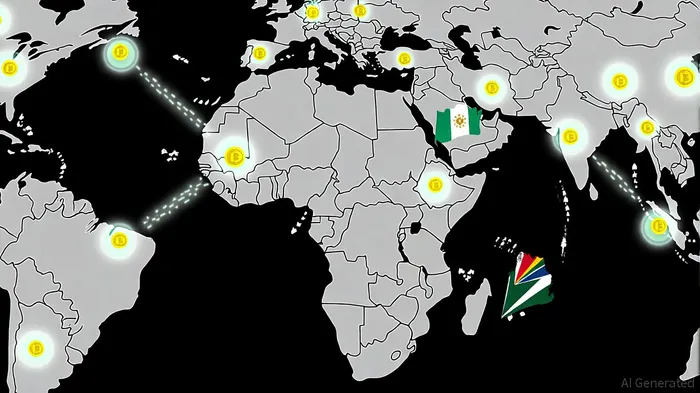
Market Dynamics: A $25B+ Ecosystem in Motion
Africa's blockchain landscape in 2025 is defined by its dual role as a problem-solving tool and a profit engine. According to the African Blockchain Report 2025, blockchain adoption is accelerating across sectors, from cross-border payments to agricultural supply chains, with Sub-Saharan Africa alone processing $25 billion in monthly crypto transactions by early 2025. This growth is underpinned by venture capital inflows: blockchain ventures accounted for 7.4% of the continent's total venture funding in 2024, a 30% increase from the prior year, according to Forbes Africa.
Stablecoins, in particular, are reshaping economic activity. For instance, tokenized stablecoins are enabling real-time settlements in agriculture, where blockchain tracks the origin of crops and facilitates instant payments to smallholder farmers, the Absa African Blockchain Report finds. Ripple's RLUSD stablecoin, now operational in Africa, further amplifies this trend, as noted in a Ripple press release.
Regulatory Clarity: A Foundation for Institutional Confidence
Africa's regulatory environment in 2025 is no longer a barrier but a catalyst. South Africa, a regional leader, has established a robust framework under the Financial Sector Conduct Authority (FSCA) and Financial Intelligence Centre (FIC), ensuring anti-money laundering (AML) compliance while fostering innovation, according to an eTraverse guide. Ghana's impending Virtual Asset Providers Act, set to launch in September 2025, will formalize licensing for crypto platforms, while Mauritius's alignment with FATF standards has already positioned it as a global compliance hub, as reported by Pulse Ghana.
These developments are critical for institutional adoption. Absa's partnership with Ripple leverages these regulatory advancements to offer custody services that meet global compliance standards, a necessity for attracting foreign capital. As Ripple CEO Brad Garlinghouse noted in a recent press release, "Africa's regulatory momentum is unlocking a new era of trust in digital assets," Ecoinimist reported.
Competitive Landscape: DeFi, BaaS, and the Rise of SMEs
The competitive landscape is equally compelling. Decentralized finance (DeFi) platforms are proliferating, offering uncollateralized lending and yield-generating protocols to underserved populations, Mobility Foresights notes. Meanwhile, blockchain-as-a-Service (BaaS) models are democratizing access, allowing SMEs to deploy solutions without heavy upfront costs, as Forbes Africa reported.
Seychelles has emerged as a blockchain funding hub, attracting 40% of the continent's venture capital in 2025, the Absa report finds. However, the real story lies in partnerships. Ripple's collaboration with Absa is emblematic of a broader trend: institutional players are co-opting blockchain startups to scale solutions. For example, Absa's integration of Ripple's custody tech mirrors similar partnerships in Europe and Asia, where institutional demand for secure storage has driven adoption, as detailed in a CoinSpeaker article.
Strategic Investment Opportunities
For investors, the Ripple-Absa partnership highlights three key opportunities:
Infrastructure-as-a-Service (IaaS) Providers: Companies offering custody, settlement, and compliance tools for African institutions are set to benefit from regulatory tailwinds. Ripple's expansion into Africa could catalyze a wave of follow-on investments in similar infrastructure providers.
Tokenized Asset Platforms: The tokenization of real-world assets (RWAs)-from land titles to agricultural commodities-is gaining traction. Startups enabling this transition, such as those leveraging blockchain for land certification, are positioned for high-growth returns.
Cross-Border Payment Networks: With Africa's diaspora remittances exceeding $100 billion annually, blockchain-based solutions that reduce transaction costs (currently averaging 8-12% in Africa) will dominate. Ripple's RLUSD and similar stablecoins are prime candidates for adoption.
Conclusion: A Tipping Point for Africa's Blockchain Ecosystem
Ripple and Absa's custody expansion is more than a partnership-it's a signal of Africa's emergence as a blockchain innovation hub. With regulatory frameworks maturing, venture capital flowing, and use cases proliferating, the continent is no longer a peripheral player in the global digital finance arena. For investors, the imperative is clear: engage early in infrastructure that bridges Africa's financial gaps while capturing the continent's latent economic potential.







Comentarios
Aún no hay comentarios