
Ripple's $40 Billion Comeback: How Regulatory Clarity and Institutional Adoption Are Fueling XRP's Resurgence
The crypto world has long watched Ripple's legal battle with the SEC as a make-or-break moment for XRP's future. After seven years of litigation, the case concluded in August 2025 with a $125 million settlement, a far cry from the SEC's initial $2 billion demand. This resolution not only ended a protracted legal saga but also created a regulatory framework that could redefine how tokens are classified in the U.S. The implications? A seismic shift in institutional adoption, market dynamics, and Ripple's path to reclaiming a $40 billion valuation.
Regulatory Clarity: The Foundation for XRP's Rebound
The court's final ruling established a critical precedent: XRPXRP-- sold on public exchanges is not a security, but institutional sales remain subject to securities laws according to Gibson Dunn. This distinction, first hinted at in 2023, became the cornerstone of Ripple's defense and the SEC's eventual compromise. By removing years of regulatory ambiguity, the settlement allowed XRP to re-list on major U.S. exchanges and paved the way for the launch of XRP ETFs.
According to a report by Gibson Dunn, the ruling "provided a clear framework for evaluating tokens under U.S. securities law," offering a blueprint for future regulatory decisions. This clarity is particularly significant for institutions, which had previously avoided XRP due to legal risks. Now, with a defined regulatory boundary, asset managers can confidently allocate capital to XRP without fear of enforcement actions.
Institutional Adoption: From Speculation to Strategy
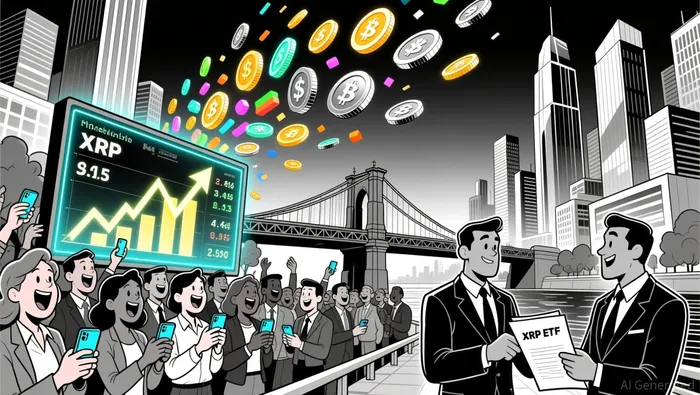
The post-ruling period saw XRP ETFs surge in popularity, attracting over $1.3 billion in inflows within 50 days. Franklin Templeton and Grayscale, two of the industry's heavyweights, launched XRP ETFs that mirrored the structure of BitcoinBTC-- ETFs, offering regulated exposure to a broader range of investors. This shift from speculative retail interest to institutional-grade products is a hallmark of maturing markets.
Moreover, institutions are now deploying sophisticated options strategies on XRP-such as covered calls and collars-to generate yield and hedge risk, a tactic previously reserved for Bitcoin. This mirrors the playbook of traditional asset classes, signaling that XRP is no longer seen as a fringe asset but as a legitimate component of diversified portfolios.
Ripple's strategic acquisitions further bolster its institutional appeal. The $1.25 billion purchase of Hidden Road and $1 billion acquisition of GTreasury in 2025 enabled the launch of Ripple Prime, a global prime brokerage service. These moves position Ripple as a full-service financial infrastructure provider, extending beyond XRP to offer custody, trading, and stablecoin solutions. The RLUSD stablecoin, launched in late 2024, now boasts a $1.3 billion market cap, demonstrating demand for Ripple's broader financial ecosystem.
The Road to $40 Billion: Valuation Drivers
To understand Ripple's valuation potential, consider the metrics driving its growth. XRP's market cap surged to a third-place position in 2025, with the token hitting an all-time high of $3.65. At this price, XRP's market cap alone would need to reach approximately $100 billion to justify a $40 billion company valuation (assuming a 40% ownership stake in XRP). While ambitious, this is achievable given current trends.
Analysts project that XRP ETFs could attract $5–7 billion in inflows by 2026, a figure that would significantly boost demand for the token. Additionally, Ripple's expanding financial services-particularly RLUSD and Ripple Prime-open new revenue streams. If RLUSD captures even a fraction of the $100 billion stablecoin market, or if Ripple Prime secures institutional clients comparable to traditional prime brokers, the company's valuation could scale rapidly.
Risks and Realities
No analysis is complete without addressing risks. While the SEC settlement is a win, it does not eliminate all regulatory scrutiny. Ripple must avoid future violations of registration provisions, and global regulators-particularly in the EU and Asia-could impose their own hurdles. Additionally, XRP's price remains volatile, and macroeconomic factors (e.g., interest rates, inflation) could dampen institutional inflows.
However, the post-2025 landscape is markedly different from the pre-litigation era. The legal resolution has created a "safe harbor" for XRP, while Ripple's diversified business model reduces reliance on token price alone. This combination of regulatory clarity and institutional infrastructure makes a $40 billion valuation not just plausible, but increasingly probable.
Conclusion
Ripple's journey from legal uncertainty to regulatory clarity has unlocked a new chapter in its history. By resolving the SEC case, the company has not only cleared the path for XRP's institutional adoption but also established itself as a critical player in the global financial infrastructure. With ETFs, stablecoins, and prime brokerage services driving growth, Ripple is well-positioned to reclaim its place among the crypto industry's elite. For investors, the question is no longer if XRP can reach new heights-but how quickly.






Comentarios
Aún no hay comentarios