
Ripple's $1 Billion XRP Treasury Initiative: A Catalyst for Institutional Adoption and Utility-Driven Valuation
In October 2025, Ripple's strategic pivot toward institutional adoption and utility-driven valuation has positioned XRPXRP-- as a formidable contender in the digital asset landscape. The August 2025 SEC settlement, which affirmed XRP's status as a non-security in secondary transactions, removed a critical regulatory barrier, unlocking a surge in institutional interest, according to a CoinEdition analysis. This legal clarity, combined with Ripple's $1 billion Digital Asset Treasury (DAT) initiative, has created a unique confluence of demand generation, liquidity enhancement, and real-world utility that could redefine XRP's role in global finance.
The DAT Initiative: From Supply Control to Demand Creation
Ripple's DAT initiative, funded through a Special Purpose Acquisition Company (SPAC), marks a strategic shift from managing XRP's supply to actively generating demand. By committing 4.74 billion of its liquid XRP holdings-valued at nearly $11 billion-to the DAT, Ripple has established itself as the largest institutional holder of XRP, as OKX explains. This move creates a permanent buyer of XRP, stabilizing its price and signaling corporate confidence in the token's long-term value. At current prices, the $1 billion reserve equates to approximately 435 million XRP, or 0.75% of the 60 billion in circulation, as OKX notes.
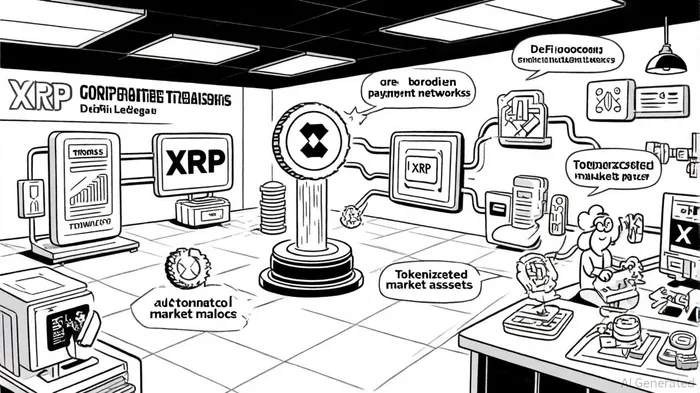
The DAT's impact extends beyond price stabilization. By integrating XRP into corporate treasuries, Ripple is fostering a new asset class for institutional investors. For example, Trident Digital and Webus International have launched XRP treasury programs worth $500 million and $300 million, respectively, using the token for staking, DeFi lending, and cross-border payments, according to a CoinEdition report. These initiatives highlight XRP's growing utility as a functional reserve asset, competing directly with BitcoinBTC-- and EthereumETH-- in institutional portfolios, the CoinEdition piece suggests.
Institutional Adoption: XRP as the Backbone of Corporate Finance
Ripple's acquisition of GTreasury in 2025 further underscores its ambition to embed XRP into corporate financial workflows. GTreasury's integration of XRP and its stablecoin RLUSD enables real-time cross-border payments and tokenized asset management, addressing pain points in traditional treasury systems, as OKX explains. This is particularly significant in markets where SWIFT and other legacy systems face inefficiencies, such as high costs and slow settlement times.
The XRP Ledger (XRPL) has also emerged as a top-tier platform for institutional DeFi. With over $1 billion in monthly stablecoin volume and top-10 real-world asset (RWA) activity, XRPL's features-such as automated market makers (AMMs), asset tokenization, and on-chain oracles-are attracting institutional-grade liquidity, according to a Ripple report. For instance, OndoONDO-- Finance's tokenized U.S. Treasuries on XRPL allow Qualified Purchasers to access 24/7 liquidity, a capability that traditional markets lack, CoinEdition noted. These developments position XRP as a bridge between decentralized finance and corporate treasury management.
Utility-Driven Valuation: XRP's Competitive Edge
XRP's valuation is increasingly driven by its utility rather than speculative hype. Unlike Bitcoin's energy-intensive proof-of-work model or Ethereum's gas-driven transaction fees, XRP's fixed supply of 100 billion tokens and energy-efficient consensus mechanism make it a scalable, sustainable solution for institutional use cases, according to a Traders Union analysis. Its ability to settle cross-border payments in seconds at a fraction of the cost of traditional systems has made it a preferred asset for high-volume corridors, CoinEdition observed.
The token's price performance since the SEC settlement also reflects this utility-driven narrative. XRP surged to $3.40 in July 2025, with a market cap of $172 billion, driven by demand from ETFs, futures contracts, and corporate treasuries, CoinEdition reported. Analysts project further growth if spot ETFs gain approval, with price targets ranging from $4–$5 in the near term to $8–$10 over five years, the CoinEdition piece reported. This optimism is bolstered by XRP's role in Ripple's broader ecosystem, including RLUSD and tokenized assets, which enhance its liquidity and use cases, OKX notes.
Challenges and the Road Ahead
Despite these gains, XRP faces headwinds. Regulatory uncertainty in regions like Europe and Asia could slow adoption, while competition from stablecoins and CBDCs remains fierce, Traders Union's analysis suggests. Additionally, XRP's smaller developer community compared to Ethereum may hinder long-term innovation unless Ripple accelerates ecosystem growth, CoinEdition cautioned.
However, Ripple's DAT initiative and institutional partnerships suggest a clear path forward. By creating consistent demand and demonstrating XRP's utility in real-world applications, Ripple is building a foundation for sustained adoption. The token's integration into corporate treasuries, DeFi protocols, and cross-border payment networks could cement its role as a core component of global financial infrastructure.






Comentarios
Aún no hay comentarios