
Ripauno Port & Rail Terminal's Phase 3 Expansion: A Strategic Nexus for U.S.-Latin American Energy and Logistics Synergies
The Ripauno Port & Rail Terminal's Phase 3 Expansion, located on the Delaware River in New Jersey, represents a pivotal infrastructure investment that aligns with broader global and regional logistics trends, particularly in Latin America. As the U.S. Northeast refines its role in global energy trade, Repauno's $400 million expansion-funded through a combination of $300 million in New Jersey EDA Dock and Wharf Facility Revenue Bonds and $100 million in taxable term loans-positions the terminal to become a critical node in North American energy corridors, according to a Panabee report. This development is not isolated; it mirrors Latin America's surging investments in port and logistics infrastructure, where countries like Brazil, Chile, and Peru are modernizing facilities to meet rising trade demands, as outlined in the AMI report.
Strategic Infrastructure for Energy Export Growth
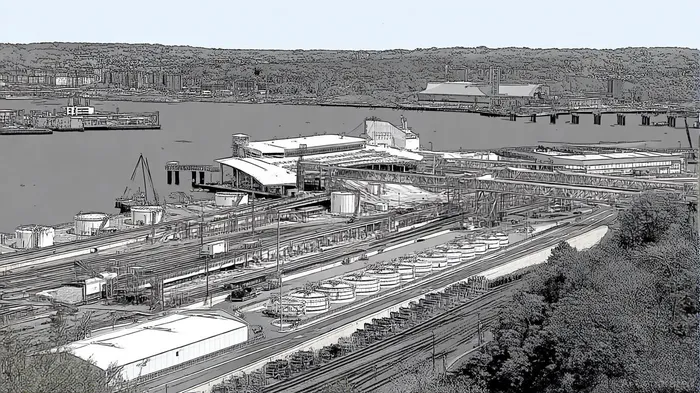
Repauno's expansion includes the construction of two underground granite caverns, each capable of storing over 600,000 barrels of liquefied petroleum gas (LPG), and a new cryogenic storage tank to handle bulk liquid products, according to Repauno's website. These upgrades will increase the terminal's export capacity from 24 million barrels per day (Mb/d) to 96 Mb/d by late 2026, directly challenging Energy Transfer's Marcus Hook facility in the Northeast LPG market, according to an East Daley analysis. The project's scale is underscored by its multimodal connectivity: direct rail access to CSXCSX-- and Norfolk Southern, deep-water dock capabilities for very large gas carriers (VLGCs), and proximity to major highways like I-95, enabling efficient distribution to 40% of the U.S. population within a day's drive, as Repauno notes.
This infrastructure aligns with Latin America's own energy export ambitions. For instance, Mexico's proposed $54.3 billion LNG export terminal buildout and Argentina's 30 mtpa Argentina GNL Terminal-both reliant on U.S. shale gas-highlight the region's pivot toward LNG and LPG exports, according to the Global Energy Monitor report. Repauno's enhanced capacity to handle LPG could serve as a complementary hub for these Latin American projects, facilitating the movement of energy products to global markets.
Latin American Logistics Trends and Cross-Regional Synergies
Latin America's logistics infrastructure is undergoing a transformation driven by deep-water port development, green energy initiatives, and trade corridor modernization. Brazil's Porto Central, for example, is set to become the largest container terminal on South America's East Coast, while Chile's Magallanes region is fast-tracking green hydrogen port concessions, as AMI highlights. These projects reflect a regional focus on integrating sustainable energy and advanced logistics to compete in global markets-a trajectory mirrored by Repauno's emphasis on cryogenic storage and efficient transloading systems.
The terminal's expansion also resonates with Latin America's push for regional trade resilience. Peru's Chancay Port, a $1.3 billion deep-water facility, and Mexico's Interoceanic Corridor-designed to complement the Panama Canal-demonstrate how infrastructure investments are redefining trade routes and reducing dependency on traditional bottlenecks, according to a Latin American Cargo analysis. Repauno's strategic location on the Delaware River, with access to both Atlantic and inland markets, could similarly enhance U.S. Northeast logistics resilience, supporting nearshoring and friendshoring initiatives that prioritize regional supply chain efficiency.
Investment Implications and Geopolitical Context
The geopolitical landscape further amplifies the significance of Repauno's expansion. As U.S. tariffs reshape Latin American trade patterns, countries like Argentina and Mexico are diversifying their export partnerships, often pivoting toward Asian and European markets, as Americas Quarterly reports. U.S. infrastructure projects like Repauno's, however, offer a counterbalance by reinforcing North American energy and logistics integration. The terminal's secured 20 Mb/d contract with Range Resources-set to begin in January 2027-illustrates the commercial viability of such projects in a competitive, shifting market, as reported by East Daley.
Moreover, the U.S. Port Infrastructure Development Program (PIDP), which has allocated $580 million for port upgrades in 2025, underscores a national commitment to modernizing logistics hubs, according to a Bloominglobal report. This aligns with Latin America's own infrastructure funding trends, where private and public partnerships are accelerating port and railway projects to meet trade demands, as AMI has noted. For investors, Repauno's expansion exemplifies how strategic infrastructure investments can bridge U.S. and Latin American markets, leveraging geographic and operational synergies.
Conclusion
Repauno Port & Rail Terminal's Phase 3 Expansion is more than a regional infrastructure project-it is a strategic asset in the evolving landscape of North American and Latin American logistics. By enhancing energy export capacity, embracing multimodal connectivity, and aligning with global sustainability trends, Repauno mirrors the transformative investments seen across Latin America. For investors, this project underscores the growing importance of integrated, resilient logistics networks in an era of shifting trade dynamics and energy transitions.





Comentarios
Aún no hay comentarios