
Riot Platforms' Bitcoin Production Decline and Strategic Expansion Amid Volatility: Assessing Long-Term Operational Strength Versus Short-Term Headwinds in the Bitcoin Mining Sector
The BitcoinBTC-- mining sector in 2025 is a study in contrasts: a bull market has driven revenue growth and profitability for industry leaders, yet operational costs, regulatory pressures, and price volatility continue to testTST-- resilience. Riot PlatformsRIOT-- (RIOT) sits at the center of this dynamic, balancing a 52% increase in global network hash rate costs against aggressive expansion and a diversified revenue strategy. As the company reported Q3 2025 earnings, producing 1,406 Bitcoin at an average cost of $46,324 per unit-up from $35,376 in 2024-the question arises: Is Riot's strategic pivot toward infrastructure expansion and AI-driven diversification enough to offset near-term headwinds?
Financial Performance: Profitability Amid Rising Costs
Riot's Q3 2025 results highlight a stark turnaround, with net income of $104.5 million compared to a $154.4 million loss in Q3 2024. This improvement stems from Bitcoin Mining revenue surging to $180.2 million, driven by higher Bitcoin prices and operational leverage. However, the average mining cost per Bitcoin rose significantly, reflecting a 52% increase in the global network hash rate- a sector-wide challenge as miners compete for limited energy resources. While RiotRIOT-- partially offset these costs through a 147% increase in power credits, the margin compression underscores the fragility of relying solely on Bitcoin mining for profitability.
Strategic Expansion: Building for the Long Game
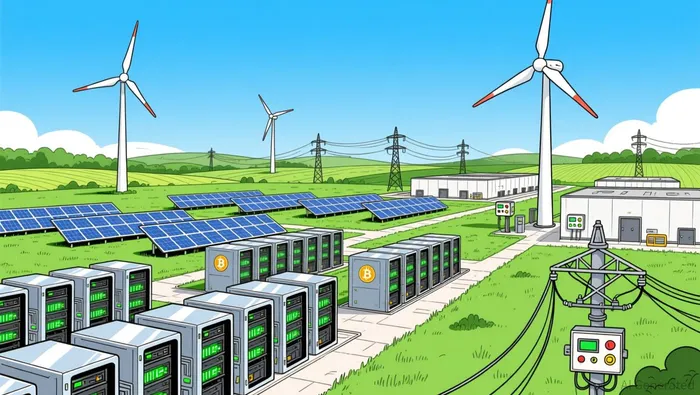
Riot's long-term vision is anchored in infrastructure. The company recently initiated core and shell development for two buildings at its Corsicana Data Center campus, adding 112 MW of critical IT capacity. This expansion aligns with Riot's broader strategy to leverage its 19,287 Bitcoin treasury-valued at $2.2 billion-to fund growth without diluting shareholders. By securing power through demand response programs and grid partnerships, Riot aims to reduce energy costs, a critical differentiator in an industry where energy efficiency determines survival.
Industry Context: Divergent Strategies, Converging Goals
Riot's approach contrasts sharply with peers like Marathon Digital (MARA), which adheres to a "100% HODL" policy, retaining all mined Bitcoin in treasury while raising capital through equity and debt. Marathon's 70% gross margin versus Riot's 60% margin illustrates the trade-offs between liquidity and asset accumulation. Meanwhile, smaller players like Argo Blockchain (ARBK) struggle with declining revenues and operational inefficiencies, highlighting the widening gap between industry leaders and laggards.
Riot's diversification into AI and high-performance computing (HPC) further strengthens its position. By exploring AI-focused cloud joint ventures, the company is positioning itself to capitalize on the growing demand for compute power- a market projected to outpace Bitcoin's cyclical volatility. This dual-income model-mining plus AI/HPC-mirrors strategies adopted by CoreWeave and Bitfarms, who are leveraging existing infrastructure to stabilize cash flows.
Sector-Wide Challenges: Regulatory, Energy, and Volatility
Despite Riot's strengths, the sector faces systemic risks. Regulatory pressures are intensifying, with jurisdictions mandating emissions reporting and carbon offset initiatives for large-scale operations- according to industry analysis. Energy costs remain a wildcard, as post-halving dynamics and rising hash rates squeeze margins. For context, the 2024 halving reduced block rewards by 50%, forcing miners to adopt efficiency measures like long-term PPAs and AI-driven optimization .
Market volatility compounds these challenges. Bitcoin's price swings in late 2025-exemplified by Strategy Inc.'s $2.2 billion unrealized loss-highlight the risks of holding large Bitcoin treasuries . While Riot's treasury provides a buffer, its decision to sell nearly all mined Bitcoin for liquidity exposes it to price fluctuations. This contrasts with Marathon's HODL strategy, which locks in value but limits immediate cash flow.
Conclusion: Operational Strength vs. Short-Term Risks
Riot Platforms' Q3 2025 results demonstrate a company navigating a complex landscape with agility. Its strategic expansion into AI/HPC, combined with energy-efficient infrastructure, positions it to weather sector-wide headwinds. However, rising mining costs and Bitcoin's volatility remain critical risks. Investors must weigh Riot's long-term operational strengths-its diversified revenue streams, power optimization, and treasury scale-against the near-term uncertainties of regulatory shifts and energy markets.
For now, Riot's balance sheet and strategic foresight suggest a resilient player in a sector poised for consolidation. As the industry evolves, the ability to adapt-like Riot's pivot toward AI-may prove more valuable than Bitcoin's price alone.







Comentarios
Aún no hay comentarios