
Riot Platforms' Bitcoin Liquidation and Strategic Pivot to AI: A New Frontier for Energy-Driven Tech Infrastructure
The year 2025 marked a seismic shift in the cryptocurrency and tech infrastructure landscape, as Riot PlatformsRIOT-- executed one of the largest BitcoinBTC-- liquidations in its history- selling $161.6 million worth of BTC in December and an additional $37 million in November, totaling $200 million. This move, driven by deteriorating hashprice economics and broader industry challenges, signals a strategic pivot from volatile crypto asset ownership to AI-driven data center monetization. For investors, this transition raises critical questions: How does Riot's repurposing of energy-efficient mining infrastructure into AI infrastructure compare to traditional crypto mining in terms of ROI? And what does this shift mean for the long-term value of energy-rich regions like Texas in the tech infrastructure ecosystem?
The Strategic Rationale: From Bitcoin to AI
Riot's decision to liquidate its Bitcoin holdings reflects a broader industry trend. As hashprice margins collapsed in 2025, Bitcoin mining became increasingly unprofitable for firms lacking access to ultra-low-cost energy or advanced automation. Meanwhile, AI and high-performance computing (HPC) workloads surged in demand, driven by generative AI's explosion and the need for scalable, energy-efficient compute infrastructure. Riot's leadership now frames Bitcoin mining as a "means to access low-cost power" rather than an end goal, a stark departure from its earlier "hodl" strategy.
This pivot is not merely reactive. By repurposing its energy-efficient data centers-originally built for Bitcoin mining-into AI infrastructure, RiotRIOT-- is leveraging its existing assets to capture higher-margin opportunities. The Corsicana, Texas, data center project, for instance, is designed to reach 112 megawatts of critical IT capacity by Q1 2027, with a long-term vision of scaling to 1 gigawatt. This aligns with a global trend: data center investment hit a record $61 billion in 2025, with AI workloads accounting for 73% of large-load power requests in Texas alone.
Financial Viability: AI vs. Crypto Mining in Energy-Rich Regions
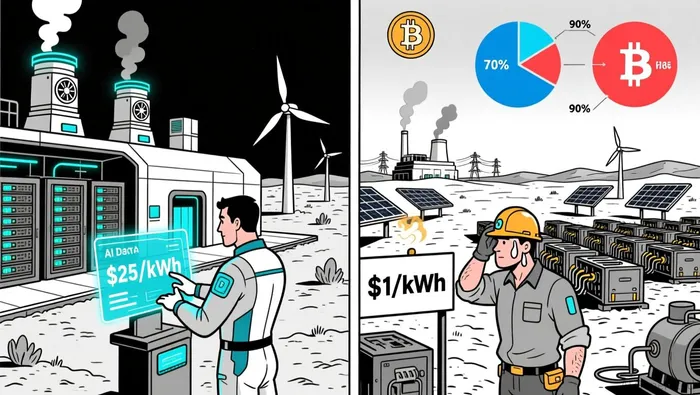
The economics of AI data centers versus crypto mining in energy-rich regions like Texas are stark. According to industry analysis, AI facilities generate approximately $25 per kilowatt-hour in revenue, compared to Bitcoin's $1 per kilowatt-hour. This 25x disparity underscores why firms like Riot are prioritizing AI infrastructure. For context, converting a 100-megawatt mining site to AI hosting requires an estimated $3 billion in upfront investment for GPUs and cooling systems, but the payoff is multi-year contracts with hyperscalers like Microsoft and Amazon, which could generate over $1 billion in annual revenue.
Texas, in particular, is emerging as a critical hub for this transition. The state's access to low-cost energy, including renewables and natural gas, combined with its deregulated grid, makes it ideal for energy-intensive operations. However, challenges persist: the Texas grid faces capacity constraints, as renewable energy sources like solar and batteries cannot meet the constant power demands of AI workloads. This creates a unique symbiosis-while AI data centers require stable, high-capacity power, Bitcoin miners, with their grid-flexible demand-response capabilities, could complement AI infrastructure by stabilizing the grid.
Riot's Financial Performance and Analyst Projections
Riot's Q3 2025 results highlight the company's accelerating transition. The firm reported record revenue of $180.2 million, with net income of $104.5 million and adjusted EBITDA of $197.2 million. These figures were driven by a 84% increase in Bitcoin mining revenue to $590 million for the full year, but the real story lies in its AI infrastructure bets. Analysts project Riot's full-year 2025 revenue to rise 76% to $662 million, with the company trading at a competitive valuation of $3.3 million per 2027 Available MW-well below the peer median of $4.9 million. This suggests a potential re-rating once Riot secures co-location leases for its Corsicana campus, which could unlock significant value.
Long-Term Implications: Energy-Driven Tech Infrastructure
Riot's pivot exemplifies a broader industry realignment. As crypto markets remain volatile, firms with access to energy-rich regions and scalable infrastructure are repositioning themselves as "energy-driven tech infrastructure" players. This shift is reshaping regional economies, creating high-tech jobs, and redefining the digital infrastructure landscape. For investors, the key takeaway is clear: the long-term value of companies like Riot lies not in their crypto holdings but in their ability to monetize energy-efficient, AI-ready infrastructure in regions where power costs are low and demand for compute is insatiable.
In the coming years, the success of Riot's Corsicana project-and its ability to secure multi-year AI workloads-will determine whether it becomes a model for the industry or a cautionary tale. For now, the data suggests that the company is well-positioned to capitalize on the AI boom, provided it can navigate the capital-intensive transition and grid constraints. As the line between crypto mining and AI infrastructure blurs, the winners will be those who treat energy as a strategic asset rather than a cost.







Comentarios
Aún no hay comentarios