
RioCan REIT: Undervalued Retail Powerhouse Trading at a 26% Discount to NAV
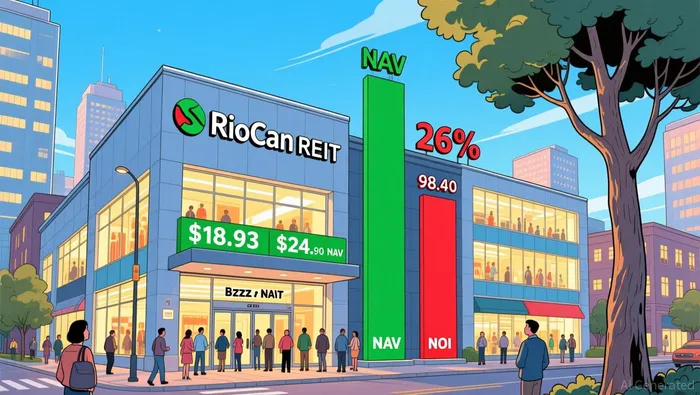
The real estate investment trust sector has long been a fertile ground for value investors, and RioCan REIT (REI.UN) stands out as a compelling case study in undervaluation. As of November 26, 2025, the REIT trades at a 26% discount to its net asset value (NAV) of $24.90 per unit, a figure derived from its Q3 2025 earnings report. This discount, coupled with a robust capital recycling strategy and resilient retail fundamentals, positions RioCan as a prime candidate for investors seeking mispriced assets with durable growth potential.
A Discount That Defies the Numbers
The 26% discount to NAV is striking, particularly given RioCan's operational performance. In Q3 2025, the REIT reported a 4.6% year-over-year increase in commercial same-property net operating income (NOI), driven by its core retail assets. Retail occupancy rates reached 98.4%, underscoring the enduring demand for physical retail spaces anchored by necessity-based tenants. Yet, despite these metrics, the market price of $18.93 per unit on November 26, 2025 lacks the intrinsic value, lags far behind the intrinsic value suggested by its asset base.
This disconnect is not merely a function of market sentiment. RioCan has actively worked to narrow the gap. Since the start of 2025, the REIT has spent $99.4 million to repurchase and cancel 5.5 million units at a weighted average price of $17.99 per unit. These buybacks, executed at a significant discount to NAV, signal management's confidence in the REIT's long-term value proposition.
Capital Recycling: A Strategic Catalyst
RioCan's capital recycling efforts further amplify its appeal. By November 6, 2025, the REIT had completed $349.9 million in asset dispositions, a key component of its strategy to redeploy capital into higher-yielding opportunities as reported in the press release. This approach not only optimizes the portfolio but also creates a buffer against macroeconomic headwinds. For value investors, the ability to monetize underperforming assets while maintaining a high-occupancy, diversified retail portfolio is a rare combination.
The REIT's capital structure also benefits from its disciplined approach to debt. With a focus on fixed-rate financing and a leverage ratio that remains within conservative limits, RioCan is well-positioned to navigate interest rate volatility-a critical consideration in today's environment according to company materials.
The 26% discount to NAV represents a margin of safety for patient investors. Historical precedent suggests that REITs trading at such discounts often see re-rating when fundamentals align with valuations. RioCan's recent performance-marked by consistent distribution growth including its November 2025 payout of 9.65 cents per unit-further strengthens the case for a reversion to the mean.
Critically, the discount is not a reflection of operational weakness. The REIT's retail portfolio, concentrated in high-traffic urban centers, benefits from sticky tenant relationships and a focus on essential services. As noted in its Q3 earnings call, RioCan's management emphasized the "durable growth" potential of its retail assets, even in a shifting retail landscape as detailed in the earnings transcript.
Risks and Considerations
While the discount is enticing, investors must weigh the risks. The REIT's heavy reliance on retail exposes it to sector-specific challenges, such as e-commerce disruption. However, RioCan's focus on necessity-driven tenants (grocery-anchored centers, for example) mitigates this risk. Additionally, the REIT's development pipeline and adaptive reuse projects provide a growth tailwind as highlighted in the investor materials.
Conclusion
RioCan REIT's 26% discount to NAV, combined with its capital recycling prowess and resilient retail fundamentals, presents a compelling value opportunity. For investors who can look beyond short-term volatility, the REIT offers a rare blend of undervaluation, operational strength, and strategic agility. As the market recalibrates, RioCan's disciplined approach to capital allocation and asset management may well drive a meaningful re-rating.







Comentarios
Aún no hay comentarios