
Rio Tinto's Lithium Gambit: Securing EV Dominance Through the Salares Altoandinos Project
The global race to secure lithium supply chains has entered a new phase, and Rio TintoRIO-- is positioning itself as a kingmaker. The mining giant's strategic partnership with Chile's state-owned Empresa Nacional de Minería (ENAMI) to develop the Salares Altoandinos Lithium Project is more than a corporate deal—it's a bold move to corner one of the most critical resources for the electric vehicle (EV) revolution. With demand for lithium carbonate equivalent (LCE) expected to skyrocket in the coming decade, this partnership could redefine Rio Tinto's role in shaping the energy transition.
The Lithium Triangle's New Power Player
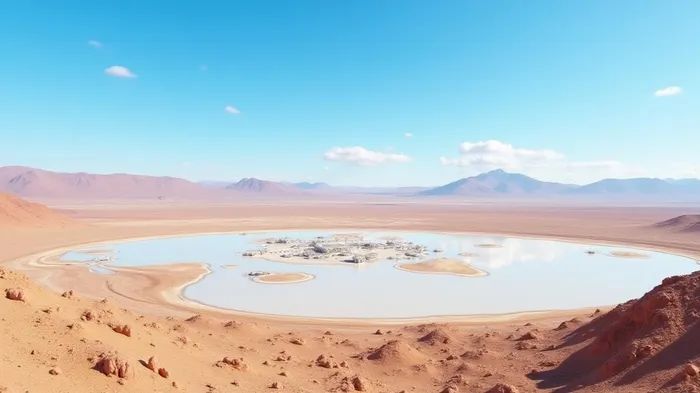
The Salares Altoandinos project sits at the heart of South America's “Lithium Triangle,” a region spanning Argentina, Bolivia, and Chile that holds over 50% of the world's known lithium reserves. Rio Tinto's 51% stake in the venture—valued at $425 million in initial cash and technology contributions—gives it control of a deposit containing 15 million metric tons of LCE, with a target to produce 75,000 tons annually once fully operational. This scale alone places Rio Tinto among the top lithium producers globally, but the project's true power lies in its timing and technology.
Spot prices for lithium carbonate have dropped 80% from 2022 peaks, but long-term demand is projected to grow at 10%+ CAGR through 2040.
Why This Deal Matters for EV Supply Chains
The EV boom has created a paradox: lithium prices are depressed today due to overproduction and weak battery demand, but analysts predict a supply crunch by 2030 as EV adoption accelerates. Rio Tinto's Salares Altoandinos project is a bet on that crunch. By locking in a project with $3 billion in total planned investment—split between Rio Tinto and ENAMI—the company is securing a foothold in a resource that will underpin everything from EV batteries to grid storage systems.
But the project's real edge isn't just its size. Rio Tinto's proprietary Direct Lithium Extraction (DLE) technology, already proven at its Rincon plant in Argentina, eliminates the need for traditional brine evaporation ponds. This slashes production time from years to months while reducing freshwater use by up to 70%. In a region where water scarcity is a existential threat, this innovation could be the difference between regulatory approval and project cancellation.
A Play on Geopolitics and Sustainability
Chile's lithium reserves are a geopolitical battleground. The country has moved to nationalize its lithium industry, and Salares Altoandinos' partnership with ENAMI—a state-owned entity—ensures Rio Tinto avoids the “foreign miner” stigma that has derailed projects elsewhere. Meanwhile, the DLE tech's environmental profile aligns with the EU's critical raw materials strategy and Tesla's push for “green lithium” sourcing.
This isn't just about lithium; it's about securing a seat at the table as automakers and battery giants like Tesla, CATL, and BYD ramp up production. With Salares Altoandinos and its sister project, the Salar de Maricunga venture with Codelco, Rio Tinto is now in control of Chile's two largest undeveloped lithium deposits—a dual play that could supply ~150,000 tons of lithium annually by 2032.
Risks and the Case for Immediate Investment
Critics will point to risks: regulatory delays, low lithium prices, and the project's 2032 start date. But these are temporary hurdles. Rio Tinto's balance sheet—bolstered by iron ore and aluminum profits—can weather near-term volatility. Meanwhile, the DLE tech's cost advantages could make the project profitable even at today's depressed prices.
RIO's shares have lagged peers like BHP and Vale, but its lithium pipeline could unlock value as EV demand surges.
Investors who act now gain exposure to a company that's not just a lithium player but a full-stack energy transition enabler. Rio Tinto's lithium projects complement its copper and aluminum businesses, creating cross-synergies for EV infrastructure. With the market undervaluing lithium assets and Salares Altoandinos' production timeline aligned with peak EV demand, this is a rare opportunity to buy future growth at a discount.
Final Analysis: Buy Rio Tinto for the EV Decade
The EV market is transitioning from hype to reality, and lithium is its lifeblood. Rio Tinto's Salares Altoandinos project isn't just a lithium mine—it's a strategic asset that combines scale, technology, and geopolitical savvy. For investors willing to look past today's lithium price slump, this partnership represents a chance to own a piece of the infrastructure that will power the next decade of mobility.
Action Item: Consider adding Rio Tinto (RIO) to your portfolio. The stock's current valuation leaves room for upside as lithium demand—and the world's reliance on Rio's projects—explodes by 2030. The lithium race is on, and the finish line favors the bold.





Comentarios
Aún no hay comentarios