
Rio Tinto’s Leadership Transition Paves the Way for Green Growth
As Rio TintoRIO-- prepares for its first CEO transition in four years, investors face a critical question: Can the world’s second-largest iron ore producer sustain its momentum in the energy transition era under new leadership? The answer hinges on the board’s rigorous succession process, the strategic clarity of its shift toward high-demand commodities, and the execution risks lurking in its complex operations. For those willing to look past near-term uncertainty, the path forward appears ripe with opportunities.
Stausholm’s Legacy: A Pivot to Green Metals
Jakob Stausholm’s tenure as CEO, which began in 2021, was defined by a sharp pivot toward commodities central to the energy transition—copper and lithium. Under his leadership, Rio Tinto slashed its exposure to thermal coal, reduced its carbon footprint by 20% since 2018, and invested $12 billion in projects aligned with green energy demands. This strategic realignment is now paying dividends: copper prices have surged 60% since 2020, while lithium prices hit record highs in 2023, driven by EV battery demand.
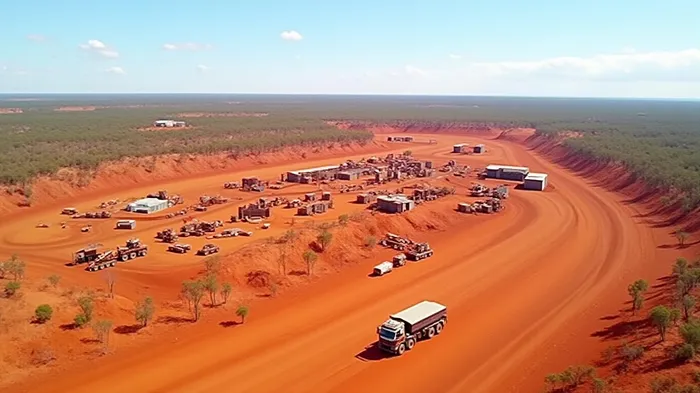
The board’s decision to retain Stausholm until a successor is named—ensuring continuity during the transition—suggests confidence in his framework. Dominic Barton, Rio Tinto’s chair, emphasized that the search for a new CEO will prioritize candidates capable of “enhancing operational performance to fully realize [the company’s] assets’ potential.” This focus underscores the priority of executing on existing projects, such as the $4.4 billion Koodaideri iron ore mine in Australia, which is set to boost production by 10% by 2026.
The Succession Process: A Test of Governance
The board’s structured approach to leadership succession—led by the Nominations Committee—stands out in an industry where abrupt changes often spook investors. Internal candidates like Simon Trott, head of Rio Tinto’s iron ore division, are viewed as strong contenders due to their operational expertise. Trott’s track record in improving margins at the company’s Australian iron ore operations, which account for 30% of global supply, would signal continuity in execution.
Yet risks remain. A misstep in selecting a leader overly focused on short-term profits could undermine the long-term vision for green metals. Conversely, a CEO overly ambitious on ESG initiatives might face backlash from shareholders prioritizing returns. Investors should monitor whether the board prioritizes candidates with a hybrid skill set—proven operational excellence and strategic foresight in energy transition markets.
Growth vs. Execution: Navigating the Near-Term
The company’s operational execution is the near-term linchpin. While Stausholm stabilized stakeholder relations—particularly with Indigenous communities after the 2020 Juukan Gorge disaster—the new CEO must deliver on promises like the $1 billion desalination plant in Western Australia to address water usage concerns. Delays in such projects could reignite regulatory and reputational risks.
Meanwhile, global macroeconomic headwinds, including China’s cooling steel demand and potential copper oversupply in 2026, pose near-term pressures. However, Rio Tinto’s cost discipline—operating margins have expanded to 50% in 2024—buffers it against volatility.
The Bull Case: Positioning for Energy Transition Gains
The bull case hinges on Rio Tinto’s unparalleled scale in green metals. By 2030, global copper demand is projected to triple to meet EV and renewable energy targets, while lithium demand could grow tenfold. Rio Tinto’s portfolio—14% of global copper reserves and a 50% stake in Chile’s lithium-rich Salar de Maricunga—positions it to capture this surge.
Crucially, the company’s free cash flow of $14 billion in 2024 provides a war chest for acquisitions or joint ventures in critical minerals. With a dividend yield of 4.5% and a P/E ratio of 12x—below its five-year average—the stock offers both income and growth exposure at a discount.
Investment Thesis: Buy with a 2-3 Year Horizon
The transition to a new CEO is a risk, but Rio Tinto’s governance and strategic alignment with energy transition tailwinds outweigh short-term uncertainty. Investors should view dips below $70/share—a 20% discount to its 2023 peak—as buying opportunities.
The medium-term upside is compelling: a successful CEO transition, coupled with rising copper prices and asset optimization, could push Rio Tinto’s valuation closer to its 2021 peak. For investors seeking exposure to the energy transition without the volatility of pure-play EV stocks, Rio Tinto’s blend of stability and growth potential is unmatched.
Final Call: BUY Rio Tinto (RIO) with a 2-year investment horizon. Monitor CEO selection timelines and copper price trends closely.





Comentarios
Aún no hay comentarios