
RideNow Group: A Distressed Asset or a Mispriced Turnaround?
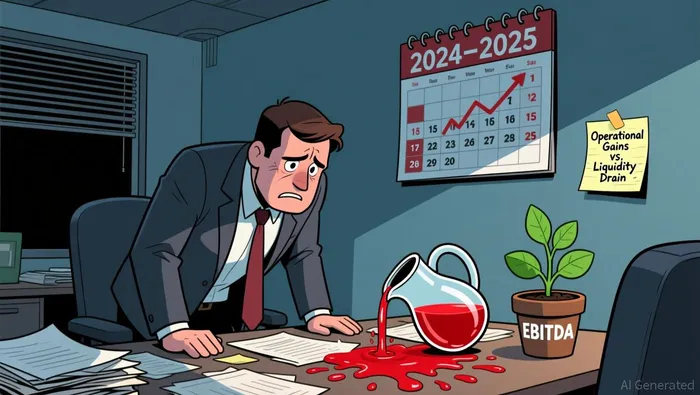
Operational Gains, Liquidity Woes
RideNow's Powersports division, which accounts for nearly all of its revenue, showed resilience in Q3 2025. Adjusted EBITDA surged by 80.9% to $12.3 million, driven by a 6.9% increase in gross profit and a gross profit per unit (GPU) of $5,183, according to RideNow's Q3 2025 results. These metrics suggest that the company's cost-cutting measures-such as a 4.4% reduction in consolidated SG&A expenses-are beginning to bear fruit. Management also highlighted strategic moves, including the opening of a new multi-brand store in Fort Worth, Texas, as part of its "aircraft carrier" strategy to create high-traffic retail hubs, according to the earnings call transcript.
Yet these gains are overshadowed by a liquidity crisis. Unrestricted cash plummeted by 58.5% year-over-year to $35.4 million, while nine-month operating cash flow contracted to $15.5 million from $68.6 million in the same period in 2024, as noted in the StockTitan report. The company's decision to extend its term debt to September 2027 and reduce annual interest expenses by $3.4 million offers temporary relief but does not address the root issue: declining cash generation. As one analyst noted, "RideNow's ability to service its debt hinges on whether its Powersports margins can sustain these gains while the Transportation Services segment stabilizes," an analyst said in the company investor release.
Valuation Disconnect: A Tale of Two Narratives
The stock's recent 1.83% rise following the earnings report reflects investor optimism about RideNow's strategic initiatives (see the earnings call transcript). However, the absence of clear valuation metrics-such as P/E or P/EBITDA ratios-complicates the risk-reward analysis. What is known is that the company reported a net loss of $4.1 million in Q3 2025, a 63.4% improvement from $11.2 million in the same quarter of 2024, according to the PR Newswire release. This narrowing of losses suggests that the Powersports segment's profitability could offset weaknesses in other areas, but it also raises questions about the sustainability of these gains.
For value investors, the key is to assess whether the current valuation reflects a temporary setback or a permanent impairment. RideNow's market capitalization, while not disclosed in the latest reports, is likely trading at a significant discount to its enterprise value, given the cash flow challenges. This creates a classic risk-reward asymmetry: a small improvement in liquidity or a rebound in the Transportation Services segment could unlock value, but a further deterioration in cash reserves could force asset sales or restructuring.
The Path Forward: A High-Stakes Gamble
RideNow's management has staked its future on operational efficiency and disciplined inventory management. The opening of "aircraft carrier" stores, for instance, is a bold bet that larger, multi-brand locations will drive customer traffic and cross-selling. Yet these initiatives require capital, which the company is increasingly ill-equipped to provide without external financing.
The coming quarters will be critical. If RideNowRDNW-- can convert its Powersports margin gains into consistent cash flow and stabilize its Transportation Services segment, the stock could see a re-rating. Conversely, if liquidity pressures force a debt restructuring or covenant violations, the company could face a downward spiral. As of now, the market appears to be pricing in the former scenario-a cautious optimism that may or may not be justified.
Conclusion
RideNow Group embodies the quintessential value investing dilemma: a business with pockets of strength but systemic vulnerabilities. The Powersports segment's profitability and management's strategic initiatives offer a glimmer of hope, but they are not enough to offset the liquidity crisis. For investors, the current valuation may reflect a distressed asset-a company with a viable core business but a cash-flow problem-rather than a distressed business with fundamentally flawed economics. However, the margin for error is razor-thin. In the absence of robust valuation metrics and full-year results, the risk-reward asymmetry tilts toward caution.





Comentarios
Aún no hay comentarios