
Richards Packaging Income Fund's CAD 0.11 Dividend: A Strategic Indicator for Income Investors?
In a low-interest-rate environment where traditional fixed-income assets struggle to deliver meaningful returns, income investors are increasingly turning to dividend-paying equities and income funds to bolster their portfolios. The Richards Packaging Income Fund (RPKIF) has emerged as a focal point for such investors, offering a monthly dividend of CAD 0.11 per share (annualized at CAD 0.97, or a 3.93% yield) [2]. But is this yield sustainable, and does it represent a compelling opportunity in today's market?
Dividend Sustainability: A Closer Look at the Fundamentals
RPKIF's dividend history reveals a consistent payout frequency since 2021, with monthly distributions averaging CAD 0.07943 in August 2025 [2]. Financial metrics suggest the fund is well-positioned to maintain this cadence. A debt-to-equity ratio of 0.58 and an interest coverage ratio of 16.80 indicate robust leverage management and ample capacity to service debt [2]. Additionally, the fund's return on equity (ROE) of 12.27% and return on invested capital (ROIC) of 9.47% underscore its operational efficiency [2].
However, recent earnings trends raise questions. In 2024, RPKIF reported a 4.26% decline in revenue to CAD 407.78 million and a 7.84% drop in earnings to CAD 35.85 million compared to 2023 [3]. While these figures suggest short-term headwinds, the fund's trailing price-to-earnings (PE) ratio of 15.00 and forward PE of 11.68 imply the market may be discounting these challenges [2]. Investors must weigh whether the fund's management can reverse these trends or if the dividend remains vulnerable to further earnings compression.
Yield Attractiveness in a Low-Rate World
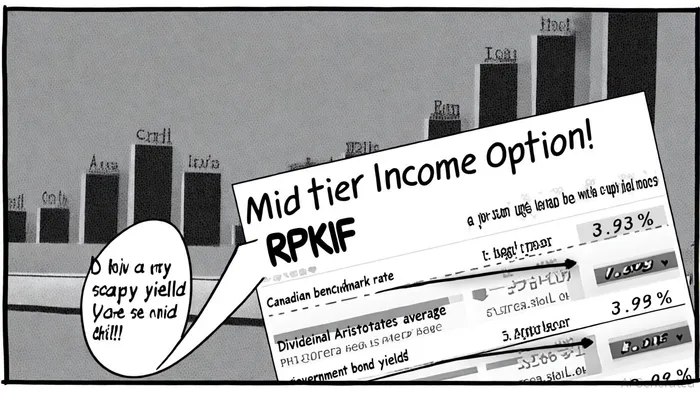
RPKIF's 3.93% yield stands out in a landscape where Canadian benchmark interest rates hover near 2.50% [3]. The Bank of Canada's anticipated rate cuts—projected to reach 2.25% by October 2025 and potentially 0.50% by 2027—further amplify the fund's appeal [4]. For context, the 2025 Canadian Dividend Aristocrats average a 4.06% yield, making RPKIF's offering competitive but slightly below the elite tier [1].
Comparisons to bond yields also favor RPKIF. Government of Canada bonds yield 2.72% for 1- to 3-year maturities and 3.82% for 10-year bonds [2]. While the fund's yield exceeds these benchmarks, its equity nature introduces volatility risks that fixed-income assets lack. For income-focused investors willing to tolerate moderate equity exposure, RPKIF's yield appears attractive, particularly as the Bank of Canada's easing cycle reduces bond returns.
Strategic Considerations for Income Investors
The key question for investors is whether RPKIF's yield is sustainable amid its recent earnings declines. While the fund's strong balance sheet and high interest coverage ratio provide a buffer, the 7.84% drop in 2024 earnings signals potential fragility. Management's ability to navigate industry-specific challenges—such as U.S. tariffs impacting Canadian exports—will be critical [3].
For those prioritizing yield over growth, RPKIF's monthly payouts and current yield offer a compelling alternative to bonds and GICs. However, investors should monitor the October 29, 2025, earnings report [2] for clues about the fund's trajectory. If earnings stabilize or rebound, the dividend could remain intact; if not, a cut may loom.
Conclusion
RPKIF's CAD 0.11 monthly dividend represents a strategic indicator for income investors navigating a low-rate environment. Its yield outperforms traditional fixed-income assets and holds its own against the broader income fund market. Yet, sustainability hinges on the fund's ability to reverse its earnings decline and adapt to macroeconomic headwinds. For investors with a moderate risk tolerance and a focus on income, RPKIF warrants careful consideration—but not without a watchful eye on its financial health.







Comentarios
Aún no hay comentarios