
The Rial's Plunge and the Rise of Alternatives: Navigating Iran's Currency Crisis with Global Safe-Haven Assets
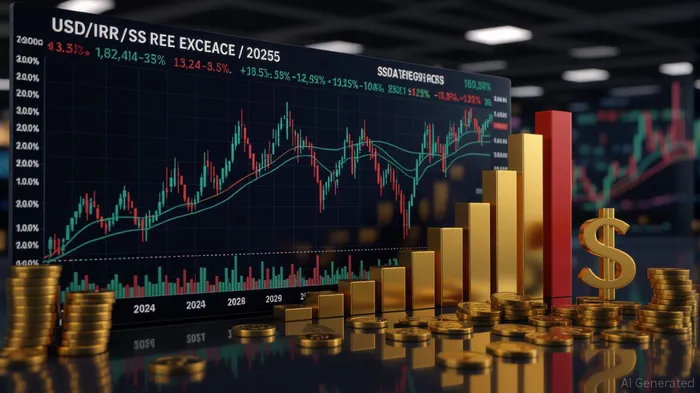
Iran’s currency crisis has reached a boiling point. By late 2025, the U.S. dollar had surged to 93,850 tomans in the free market, a stark contrast to the artificially low official rate of 72,053 tomans. This multi-rate system, a legacy of decades of mismanagement, has eroded public trust and exacerbated capital flight. Meanwhile, inflation hit 38.3% in 2025—the highest in the Middle East and North Africa—driven by U.S. sanctions, supply chain disruptions, and the government’s failure to stabilize the rial [1]. The Central Bank’s attempts to freeze gold trading and restrict cryptocurrency transactions have proven futile, as the currency’s structural weaknesses persist [2].
In such a volatile environment, investors are increasingly turning to safe-haven assets. Gold, for instance, has surged to record highs in 2025, serving as a hedge against inflation and geopolitical uncertainty. During the Israel-Iran conflict in June 2025, gold gained 8.98% over 12 months, outperforming the U.S. dollar, which saw a -5.5% drop in the year following the crisis [2]. The Swiss Franc, meanwhile, has maintained its reputation as a reliable refuge. Historically, the USD/CHF pair appreciates by an average of 0.85% monthly during conflicts, reflecting Switzerland’s political neutrality and robust financial system [3].
Emerging markets are also offering alternatives. The Japanese Yen (JPY) has gained traction as a safe-haven currency, particularly as the Bank of Japan normalizes monetary policy and carry trades unwind [4]. Additionally, U.S. Treasury Inflation-Protected Securities (TIPS) and long-dated government bonds have provided inflation protection, while oil-linked currencies like the Canadian Dollar (CAD) and Norwegian Krone (NOK) have acted as hedges against energy market disruptions [6].
The U.S. dollar’s dominance as a safe-haven asset is waning. During the 2025 Israel-Iran escalation, the dollar’s appreciation was modest compared to historical precedents, such as the 2006 Israel-Lebanon War. Investors are questioning its reliability amid concerns over U.S. fiscal health and the weaponization of the dollar through sanctions [1]. This shift has prompted a reallocation of capital toward alternative assets, including digital currencies like BitcoinBTC--, which gained 0.42% during the conflict—though its dual identity as a risk and safe-haven asset remains event-specific [2].
Emerging market debt has also shown resilience. In Q2 2025, EM local and hard currency bonds posted positive returns despite trade tensions and geopolitical risks. The MSCIMSCI-- Emerging Markets IMI Index rose 12.7% in the quarter, outperforming global benchmarks, as a weaker dollar and high real yields attracted investors [5]. This trend underscores a broader realignment of global capital, with central banks diversifying reserves and exploring alternatives to the dollar [1].
For investors navigating Iran’s crisis, the lesson is clear: diversification is key. While traditional assets like gold and the Swiss Franc remain relevant, the 2025 landscape demands a multi-layered approach. Combining uncorrelated havens—such as gold for long-term stability, the Swiss Franc for currency hedging, and EM bonds for yield—can mitigate single-asset volatility. As Iran’s economy teeters on the brink, the global market’s response offers a blueprint for resilience.
Source:
[1] Iran's Currency Crisis: The Legacy of Four Decades of Multi-Rate Policies, [https://www.ncr-iran.org/en/news/economy/irans-currency-crisis-the-legacy-of-four-decades-of-multi-rate-policies/]
[2] The performance of safe haven assets during ... - DIY Investor, [https://www.diyinvestor.net/the-performance-of-safe-haven-assets-during-geopolitical-conflicts/]
[3] Surging Safe-Haven Assets Amid Israel-Iran Tensions, [https://www.ainvest.com/news/surging-safe-haven-assets-israel-iran-tensions-strategic-allocation-opportunities-2506/]
[4] Safe havens in 2025? It's a complicated relationship, [https://www.troweprice.com/en/us/insights/safe-havens-in-2025-its-a-complicated-relationship]
[5] Emerging Market Debt Market Commentary: Q2 2025, [https://www.ssga.com/us/en/institutional/insights/emerging-market-debt-commentary-q2-2025]
[6] Emerging Market Debt Commentary: July 2025, [https://www.ssga.com/nz/en_gb/institutional/insights/emerging-market-debt-commentary-july-2025]






Comentarios
Aún no hay comentarios