
Rheinmetall's NVL Acquisition: A Strategic Catalyst for Germany's Defense Renaissance and Investor Gains
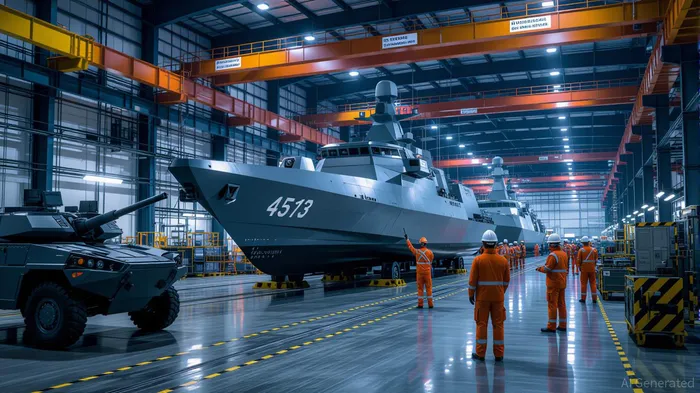
Rheinmetall AG's reported acquisition of Naval Vessels Lürssen (NVL), the military shipbuilding arm of the Lürssen Group, marks a pivotal moment in the evolution of Germany's defense industrial base. This move, which bridges a critical gap in Rheinmetall's portfolio by adding naval shipbuilding capabilities, is not merely a corporate transaction—it is a strategic recalibration of the company's role in a rapidly transforming European defense landscape. For investors, the acquisition represents a compelling opportunity to capitalize on a sector poised for sustained growth, driven by geopolitical volatility, surging defense budgets, and a push for European self-reliance.
Strategic Rationale: Filling the Naval Gap
Rheinmetall has long dominated land-based military systems, including armored vehicles, artillery, and ammunition. However, its absence in naval shipbuilding left a glaring hole in its offerings. By acquiring NVL, the company gains immediate access to expertise in constructing corvettes, frigates, and submarines—platforms critical to modern naval warfare. This integration aligns with CEO Armin Papperger's vision of a “comprehensive defense ecosystem,” where Rheinmetall can deliver end-to-end solutions across land, air, and sea.
The timing is fortuitous. European defense spending has surged in 2025, with Germany committing to meet the 2% of GDP defense spending benchmark. The European Union's push to reduce reliance on U.S. suppliers has further accelerated demand for localized, multi-domain capabilities. NVL's established infrastructure in Hamburg, Wilhelmshaven, and Wolgast provides Rheinmetall with a ready-made entry into a capital-intensive sector, bypassing the need for costly R&D and infrastructure development.
Financial Strength and Market Tailwinds
Rheinmetall's robust financial position underpins the acquisition's viability. The company's Q1 2025 results highlight its strength: Group sales rose 46% to €2.3 billion, with defense-related sales growing 73%. The defense segment now accounts for over 80% of total sales, with operating margins reaching 11.3%. A record €63 billion order backlog as of March 2025—up from €40 billion the previous year—underscores the company's long-term revenue visibility.
The acquisition is expected to amplify these metrics. Naval shipbuilding offers high-margin, long-term contracts with stable cash flows from maintenance and upgrades. Analysts project that the deal could unlock €10–15 billion in incremental revenue over the next decade, driven by demand for naval platforms in the Baltic and Black Sea regions. For context, the global defense market is projected to exceed €500 billion annually by 2030, with naval systems accounting for a growing share.
Geopolitical and Industrial Trends
The acquisition aligns with broader European defense consolidation trends. Companies like Thyssenkrupp and Leonardo are restructuring to compete in a more integrated, capital-intensive market. By acquiring NVL, Rheinmetall positions itself as a dominant player in a fragmented naval sector, leveraging its relationships with NATO and European governments to secure long-term contracts.
Geopolitical dynamics further reinforce the move. The war in Ukraine has heightened demand for naval capabilities to secure supply lines and deter aggression. Germany's €120 billion defense modernization plan, including investments in corvettes and frigates, provides a direct revenue stream for Rheinmetall. The company's ability to integrate advanced technologies—such as automated weapons systems and drones—into naval platforms could create cross-selling opportunities, enhancing margins and customer stickiness.
Risks and Integration Challenges
While the acquisition is strategically sound, challenges remain. Naval shipbuilding is complex, with long project timelines and high upfront costs. Integrating Lürssen's shipyards into Rheinmetall's existing operations may require cultural and operational adjustments. However, these risks are mitigated by the sector's long-term growth prospects and Rheinmetall's strong balance sheet, which includes €2 billion in credit capacity and a net debt-to-equity ratio of 0.5.
Investment Implications
For investors, the NVL acquisition represents a high-conviction opportunity. Rheinmetall's stock has surged 204.8% in the past year, reflecting strong investor confidence. Analysts at Simply Wall St argue the stock is undervalued by 63.6%, while others project a 35% annual growth rate in the Vehicle Systems segment through 2027. The acquisition could further justify a re-rating of the company's valuation multiple, aligning it with global peers like BAE Systems or Raytheon Technologies.
Conclusion: A Strategic Bet on the Future
Rheinmetall's acquisition of NVL is more than a corporate expansion—it is a strategic bet on the future of European defense. By filling its naval gap, the company positions itself to capitalize on a sector with long-term growth, high margins, and geopolitical tailwinds. For investors, this move offers a rare combination of near-term momentum and long-term value creation. As Europe's defense industrial base continues to evolve, Rheinmetall's ability to deliver integrated, multi-domain solutions will likely cement its status as a global defense leader—and a compelling investment.
Investment Advice: Given the company's strong financials, strategic alignment with European defense priorities, and the high-margin nature of naval shipbuilding, investors with a long-term horizon should consider adding Rheinmetall to their portfolios. However, monitor integration progress and geopolitical developments, as these could impact execution risks.







Comentarios
Aún no hay comentarios