
Rheinmetall: Why the Market's Short-Term Pain May Signal Long-Term Gain
Financial Resilience Amid Sectoral Shifts
Rheinmetall's first-half 2025 financial results underscore its ability to adapt to a rapidly evolving defense sector. , , according to Rheinmetall's H1 2025 report. , reflecting disciplined cost management and pricing power in a market starved of critical components like propellant powder and artillery ammunition. The same report highlights the segment's robust profitability and backlog strength.
While the civil business-encompassing automotive and industrial technologies-remains under pressure due to global supply chain disruptions, Rheinmetall's pivot to defense has cushioned its overall performance. This shift aligns with broader European trends, as governments accelerate spending to meet NATO's 2035 5% GDP defense target, according to a Goldman Sachs analysis. For investors, the company's ability to leverage its industrial expertise in high-demand defense sectors suggests a durable competitive edge.
Strategic Expansion: Anchoring Europe's Eastern Flank
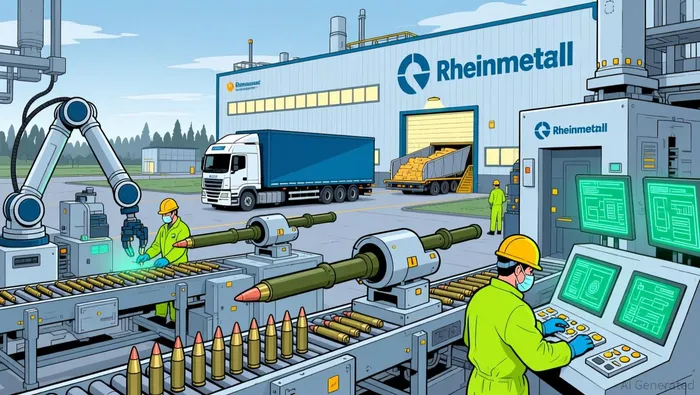
Rheinmetall's recent investments in Romania and Lithuania exemplify its forward-looking strategy. In November 2025, , , as reported in an Avionews report. This project directly addresses a critical bottleneck in the defense supply chain, as propellant powder is indispensable for modern artillery systems.
Simultaneously, , managed by Rheinmetall Defence Lietuva, Uab, marks the largest defense investment in the Baltic nation's history, according to the Avionews report. These moves are not merely geographic diversification but a calculated effort to strengthen NATO's eastern flank. By localizing production in politically stable, strategically vital regions, Rheinmetall reduces exposure to geopolitical risks while aligning with European defense autonomy goals.
Sectoral Tailwinds: AI, AI, and Strategic Autonomy
The European defense sector is undergoing a technological renaissance, and Rheinmetall is well-positioned to benefit. The EU's /Readiness 2030 program, launched in March 2025, , , surveillance, and advanced analytics, according to an Oxan analysis. Startups like Germany's Helsing and Finland's Iceye are pioneering AI-driven reconnaissance systems, while Rheinmetall's focus on artillery and logistics infrastructure complements these innovations.
Moreover, regulatory reforms such as the are streamlining procurement processes, enabling faster deployment of systems like Rheinmetall's 155mm ammunition, as noted in the Oxan analysis. As European nations seek to reduce reliance on U.S. suppliers, the company's emphasis on local production and European supply chains will likely enhance its market share.
Navigating Challenges: Short-Term Pain, Long-Term Gain
Despite its strengths, Rheinmetall faces near-term challenges. The U.S. military's "adjustment" of troop deployments in Europe-though not a reduction-has created uncertainty for defense contractors reliant on transatlantic partnerships. Additionally, the EU's fragmented capital markets and slower innovation cycles compared to the U.S. and China remain hurdles, a point also raised in the Goldman Sachs analysis.
However, these risks are being mitigated by Rheinmetall's dual strategy: scaling production in Eastern Europe while investing in R&D for next-generation systems. , even as civil sector headwinds persist. For patient investors, the company's current valuation-discounted relative to peers like Leonardo (LDO.MI) and Safran (SAF.PA)-presents an attractive entry point.
Conclusion: A Case for Strategic Timing
Rheinmetall's short-term struggles in the civil sector and macroeconomic volatility may tempt investors to overlook its long-term potential. Yet, the company's financial discipline, strategic investments, and alignment with European defense megatrends suggest a compelling growth trajectory. As NATO's eastern flank solidifies and AI-driven warfare reshapes the industry, Rheinmetall's focus on critical infrastructure and localized production will likely yield outsized returns. For those willing to weather near-term turbulence, the market's pain may indeed signal a golden opportunity.







Comentarios
Aún no hay comentarios