
RH's Q2 Earnings and Trade Policy Challenges: A Test of Long-Term Resilience
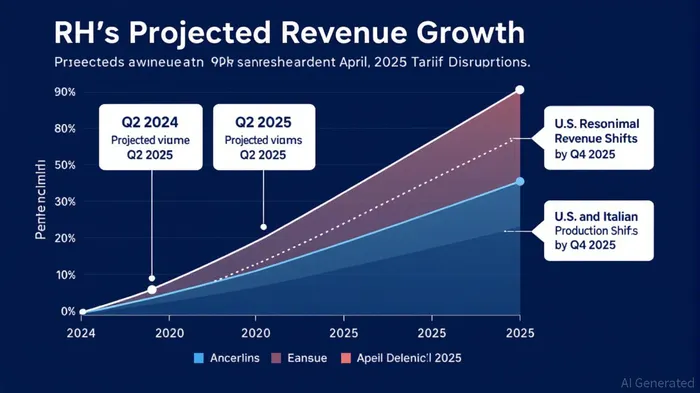
RH's upcoming Q2 fiscal 2025 earnings report, scheduled for September 11, 2025, arrives amid a complex macroeconomic backdrop. While analysts project robust year-over-year growth—EPS of $3.22 and revenue of $905.36 million[2]—the company's ability to navigate trade policy risks will define its long-term resilience. Recent management commentary and strategic shifts underscore a proactive approach to mitigating tariff-driven disruptions, but questions remain about the sustainability of these efforts.
Tariff Headwinds and Q2 Performance
The April 2025 announcement of “significant and unexpected tariffs”[3] has cast a shadow over RH's near-term prospects. Management estimates these policies reduced Q2 revenue by 6 percentage points, a blow attributed to disrupted global shipments. This aligns with broader industry trends, where sudden trade policy shifts disproportionately affect luxury goods reliant on international supply chains. However, RH's guidance for FY25 remains unchanged, assuming current tariffs persist[3], signaling confidence in its mitigation strategies.
Strategic Reorientation: Diversifying Sourcing and Production
RH's response to tariff risks centers on reshoring production and diversifying supplier relationships. By Q4 2025, the company aims to source 52% of upholstered furniture domestically (North Carolina) and 21% from Italy[3], a stark departure from its historically China-centric model. This pivot leverages RH's scale to absorb incremental costs, with vendors reportedly sharing the burden of tariff expenses[3]. Such strategies mirror those of peers in the luxury sector, where vertical integration and regional production hubs are increasingly viewed as competitive advantages.
Analyst Optimism and Price Target Hikes
Despite near-term headwinds, Wall Street remains cautiously optimistic. Wells Fargo's Zachary Fadem raised his price target to $295, citing RH's “disciplined approach to margin preservation”[2], while Telsey Advisory Group's Cristina Fernandez maintains an Outperform rating with a $255 target[2]. These upgrades reflect confidence in RH's ability to balance cost pressures with premium pricing power, a critical dynamic for a brand synonymous with high-margin, design-driven products.
Long-Term Resilience: A Work in Progress
RH's long-term investment appeal hinges on its capacity to execute its sourcing strategy without compromising operational efficiency. While shifting production to the U.S. and Italy reduces exposure to China-specific risks, it also introduces new challenges, such as labor costs and logistical complexity. The company's success will depend on its ability to maintain design innovation and customer loyalty amid these transitions. Additionally, the assumption that current tariffs remain unchanged[3] introduces a wildcard; any escalation in trade tensions could strain margins despite RH's proactive measures.
Conclusion
RH's Q2 earnings report will serve as a critical inflection pointIPCX--. A beat on revenue and EPS expectations would validate its strategic recalibration, while a miss could reignite skepticism about its trade policy preparedness. For long-term investors, the key takeaway is RH's commitment to structural resilience: by diversifying production and leveraging vendor partnerships, the company is positioning itself to thrive in an era of geopolitical uncertainty. However, execution risks and evolving trade dynamics will remain watchpoints.





Comentarios
Aún no hay comentarios