
Rezolve AI's Institutional Momentum and Undervaluation: A Mispriced AI Stock in a Maturing Market?
In the rapidly evolving AI sector, institutional investors are increasingly acting as barometers for identifying undervalued opportunities. Rezolve AIRZLV-- (NASDAQ: RZLV), a pure-play AI company focused on retail, has emerged as a compelling case study. Despite its explosive growth and strategic positioning, the stock appears to trade at a discount to its intrinsic value—a disconnect that institutional activity and financial engineering suggest is unsustainable.
Institutional Backing: A Signal of Confidence
Rezolve AI's recent financial maneuvers have drawn significant institutional attention. The company executed a $59 million debt-to-equity conversion, secured a $15 million growth capital raise, and accessed a new $30 million loan facility[2]. These actions not only fortified its balance sheet but also signaled to the market that management and investors alike view the company's long-term potential as underappreciated. Such capital structure adjustments are often precursors to value realization, particularly in sectors where growth metrics outpace traditional valuation models.
Strategic partnerships further amplify this narrative. RezolveRZLV-- AI's alliances with tech giants like MicrosoftMSFT-- and Google[3], as well as TetherUSDT--, underscore its role as a critical infrastructure provider in AI-driven retail. These relationships are not merely symbolic; they represent institutional validation of Rezolve's technology and its ability to scale. For context, Microsoft's Azure AI ecosystem has become a cornerstone for enterprise AI adoption, and Rezolve's integration into this framework positions it to capture a growing share of the $1.5 trillion global retail AI market[1].
Undervaluation in a Maturing Market
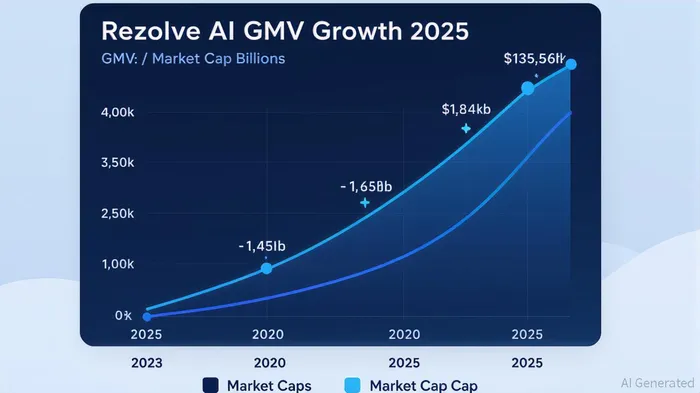
The AI sector is maturing, with investors shifting focus from speculative bets to companies with tangible revenue streams and operational scalability. Rezolve AI's gross merchandise value (GMV) surpassed $50 billion in early 2025[2], a metric that dwarfs many of its peers. Yet its market capitalization remains modest relative to its GMV, suggesting a mispricing. This discrepancy is not uncommon in high-growth sectors, where Wall Street often lags in assigning fair value to disruptive models.
Institutional ownership trends reinforce this thesis. While specific ownership percentages are not publicly disclosed (as Rezolve AI is a relatively new public entity), the company's recent capital raises were oversubscribed by institutional investors[2]. This demand reflects a broader recognition that Rezolve's AI-driven retail solutions—such as its “brain” suite for customer engagement and operational efficiency—are becoming table stakes for modern retailers. With over 50 major enterprises now live on its platform[2], Rezolve's network effects are accelerating, creating a flywheel of data and adoption that could drive exponential growth.
The Road Ahead: Balancing Risk and Reward
Critics may argue that Rezolve AI's reliance on debt and equity financing introduces financial risk. However, the company's $30 million loan facility[2] provides flexibility to fund innovation and customer acquisition without diluting existing shareholders. Moreover, its partnerships with Tether—a digital asset issuer—hint at a broader strategy to integrate AI with real-time payment solutions, a move that could unlock new revenue streams in 2025.
For value-conscious investors, the key question is whether the market will eventually correct its undervaluation of Rezolve AI. Historical precedent suggests that institutional momentum often precedes price discovery in niche sectors. As AI adoption in retail becomes ubiquitous, Rezolve's first-mover advantage and institutional backing could catalyze a re-rating of its stock.
Conclusion
Rezolve AI embodies the classic case of a mispriced growth stock in a maturing market. Its institutional financing, strategic alliances, and explosive GMV growth collectively paint a picture of a company poised to outperform its valuation. While risks remain—particularly in the AI sector's regulatory and competitive landscape—the alignment of institutional capital with Rezolve's strategic roadmap suggests that the market's current skepticism may soon be replaced by recognition of its true potential.





Comentarios
Aún no hay comentarios