
Rexel's Share Buyback Strategy: A Strategic Catalyst for Shareholder Value in 2025
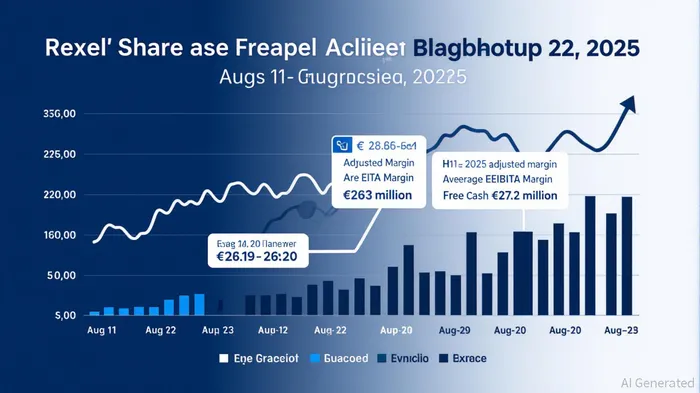
Rexel’s aggressive share repurchase program in late August 2025 has emerged as a pivotal element of its capital allocation strategy, signaling both confidence in its intrinsic value and a commitment to enhancing shareholder returns. The company executed two distinct buyback campaigns: 163,986 shares repurchased at an average price of €26.19–26.20 between August 11 and August 15, and 171,490 shares at €27.68 from August 18 to August 22 [1]. These actions, aligned with the CEO’s “Accelerate '28” strategy, underscore Rexel’s focus on digital transformation and AI-driven efficiency while returning capital to shareholders [2].
Market Perception and Strategic Signaling
The buybacks have been widely interpreted as a vote of confidence in Rexel’s financial health and undervaluation. The timing coincided with strong H1 2025 results, including 1.6% sales growth to €9.78 billion and a 5.8% adjusted EBITA margin [1]. Analysts view the repurchases as a strategic move to signal resilience amid macroeconomic headwinds, with CEO Guillaume Texier explicitly linking the program to long-term value creation [2]. The market responded positively, with Rexel’s stock price rising 20.97% over the preceding 52 weeks, reflecting investor optimism about the company’s ability to balance growth investments with shareholder returns [3].
Earnings Per Share (EPS) Impact
The reduction in outstanding shares is expected to directly boost Rexel’s EPS. Analysts estimate a 4% EPS growth from the buybacks, driven by the retirement of 335,476 shares (totaling €9.1 million in value) [4]. This aligns with Rexel’s H1 2025 free cash flow of €127.2 million, which provides the liquidity to sustain such initiatives without compromising operational flexibility [1]. However, the company’s payout ratio of 143% raises concerns about the long-term sustainability of its high-yield buyback program, particularly if cash flow volatility persists [4].
Capital Structure and Leverage Considerations
Rexel’s debt-to-equity ratio remains a focal point for investors. As of June 30, 2025, the ratio stood at 0.94, with net debt increasing to €3.078 billion year-on-year [5]. While this reflects a moderate level of leverage, the discrepancy between sources (ranging from 65.6% to 94.02%) highlights varying methodologies or reporting periods [5]. The company’s liquidity buffer of €16.8 million and its ability to extend its Senior Credit Agreement to 2030 suggest disciplined debt management [1]. Nevertheless, the increased net debt underscores the need for continued operational efficiency to maintain credit ratings and investor trust.
Conclusion
Rexel’s August 2025 buybacks represent a calculated effort to optimize capital structure, enhance EPS, and reinforce market confidence. While the strategy aligns with its “Accelerate '28” vision, investors must weigh the benefits of near-term EPS growth against the risks of elevated leverage and a high payout ratio. For those with a long-term horizon, Rexel’s disciplined approach to shareholder returns and digital transformation positions it as a compelling, albeit cautiously optimistic, investment opportunity.
Source:
[1] Rexel's Share Buyback Activity and Strategic Implications,
https://www.ainvest.com/news/rexel-share-buyback-activity-strategic-implications-shareholder-2508/
[2] Rexel's Recent Share Purchases: Key Insights and Impact,
https://investorshangout.com/rexels-recent-share-purchases-key-insights-and-impact-372142-/
[3] Rexel's Share Buyback Activity and Strategic Implications,
https://www.ainvest.com/news/rexel-share-buyback-activity-strategic-implications-shareholder-2508/
[4] Share Buybacks in Key European Industrials and ...,
https://www.ainvest.com/news/share-buybacks-key-european-industrials-consumer-stocks-strategic-market-signals-2508/
[5] Rexel (ENXTPA:RXL) - Stock Analysis,
https://simplywall.st/stocks/fr/capital-goods/epa-rxl/rexel-shares







Comentarios
Aún no hay comentarios