
Rex-Osprey's ETF Filing and Its Potential Disruption to Cardano's Market Recovery
The cryptocurrency market in 2025 is witnessing a seismic shift as traditional financial products, particularly exchange-traded funds (ETFs), begin to redefine the value propositions of altcoins. At the forefront of this transformation is REX-Osprey, a fintech duo that filed 21 altcoin ETF applications with the U.S. Securities and Exchange Commission (SEC) in October 2025, covering assets like CardanoADA-- (ADA), SuiSUI-- (SUI), and Hype (HYPE), according to a REX-Osprey press release. These filings, which incorporate staking rewards and offshore compliance structures, have the potential to catalyze or dilute Cardano's market recovery, depending on how institutional capital and regulatory dynamics unfold.
REX-Osprey's ETF Structure and Regulatory Hurdles
REX-Osprey's ETF suite leverages innovative features such as staking, allowing investors to earn rewards while maintaining exposure to token price movements. By routing assets through Cayman Islands subsidiaries and allocating up to 40% of holdings to non-U.S. exchange-traded products, the firm aims to navigate U.S. regulatory complexities while offering global diversification, according to Currency Analytics. As of October 2025, these ETFs have already surpassed $500 million in combined assets under management (AUM), signaling robust investor appetite for crypto exposure through traditional vehicles, a point first highlighted in the REX-Osprey press release.
However, the SEC's recent government shutdown has frozen processing of these filings, delaying approvals for 16 ETFs with October 2025 statutory deadlines, according to a FinOracle report. This regulatory limbo creates uncertainty, as the SEC's resumption of operations will determine whether these products launch as planned or face further delays. Analysts note that the SEC's streamlined generic listing standards for commodity-based trusts could reduce approval timelines to 60–75 days for qualifying products, but the staking component remains under scrutiny for compliance with investor protection mandates, as discussed by Crypto Impact Hub.
Cardano's Market Recovery and ETF-Driven Catalysts
Cardano (ADA) has emerged as a focal point for altcoin ETF optimism. Prediction markets assign a 91% probability of approval for a Cardano spot ETF by October 26, 2025, driven by institutional interest in its real-world asset (RWA) tokenization capabilities and protocol upgrades like Hydra (layer-2 scaling) and Ouroboros Leios (consensus optimization), per a CoinEdition report. Technically, ADA's futures open interest has surged to $2.5 billion-a four-year high-while on-chain data suggests bullish positioning, with a short-term price target of $1.86 and long-term projections of 260–360% gains, according to a CoinMarketCap prediction.
The potential approval of a Cardano ETF could replicate the inflows seen with BitcoinBTC-- and EthereumETH-- ETFs, which attracted $37 billion and $2.4 billion in August 2025, respectively, per ETF.com data. By offering regulated access to ADAADA--, REX-Osprey's ETFs could unlock institutional capital, reduce retail-driven volatility, and enhance liquidity-a critical factor for altcoins historically prone to speculative swings, as noted in a Walbi analysis. For instance, the first Solana ETF, with $41 million in AUM, already demonstrates how structured products can stabilize altcoin markets, according to Digital Finance News.
Historical Precedents: Catalysis vs. Dilution
The historical impact of crypto ETFs on altcoins reveals a dual-edged dynamic. On one hand, Bitcoin and Ethereum ETFs have legitimized digital assets, drawing $167 billion in institutional inflows by May 2025 and establishing a regulatory blueprint for altcoins, as discussed in a Monolith post on Medium. On the other, the proliferation of altcoin ETFs risks diluting market momentum if inflows are spread too thinly. For example, while XRP's ETF is projected to attract $8 billion in institutional capital, smaller altcoins may struggle to compete without unique utility or scalability-a concern also raised by the Crypto Impact Hub analysis.
REX-Osprey's focus on staking and offshore compliance could mitigate this risk by differentiating its offerings. Staking features, which generate yield for investors, align with Cardano's proof-of-stake consensus model and could enhance ADA's appeal compared to non-staking alternatives. Meanwhile, the use of Cayman subsidiaries ensures compliance with U.S. tax rules, addressing a key barrier for institutional adoption, as noted earlier in the REX-Osprey press release.
Conclusion: A Tipping Point for Altcoin Legitimacy
REX-Osprey's ETF filings represent a pivotal moment for Cardano and the broader altcoin market. If the SEC resumes operations and approves these products, Cardano could benefit from a surge in institutional capital, mirroring Bitcoin's ETF-driven rally. However, the success of these ETFs will depend on their ability to balance innovation (e.g., staking) with regulatory clarity. For investors, the coming months will test whether traditional financial products can catalyze altcoin recovery or dilute their value propositions in a crowded market. 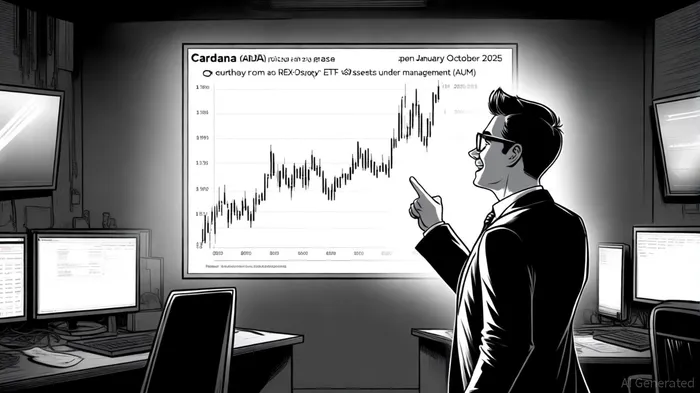






Comentarios
Aún no hay comentarios