
Revolution Medicines' Daraxonrasib: A Game-Changer in Metastatic Pancreatic Cancer?
Revolution Medicines (RVMD) has emerged as a compelling player in the race to address one of oncology's most intractable challenges: metastatic pancreatic ductal adenocarcinoma (PDAC). With a 5-year survival rate of just 3% for metastatic PDAC patients, the unmet medical need is staggering. Daraxonrasib (RMC-6236), Revolution's oral RAS(ON) multi-selective inhibitor, has shown remarkable clinical momentum, positioning the company to potentially redefine treatment paradigms.
Clinical Momentum: From Promising Data to Phase 3 Readouts
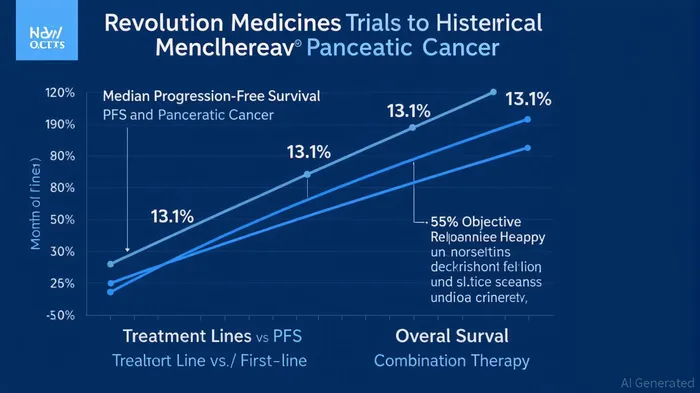
Daraxonrasib's mechanism of action—directly targeting active, GTP-bound RAS mutations (e.g., KRAS G12X)—sets it apart from traditional chemotherapies and other targeted therapies. Recent long-term follow-up data from Revolution's Phase 1/1b trial (RMC-6236-001) revealed a confirmed objective response rate (ORR) of 35% in second-line (2L+) PDAC patients with RAS G12X mutations, alongside a 92% disease control rate (DCR) and a median progression-free survival (PFS) of 8.5 months. These results, consistent across multiple datasets, have paved the way for the Phase 3 RASolute 302 trial, which is expected to complete enrollment in 2025 and report data in 2026.
The drug's potential in earlier lines of treatment is equally striking. In first-line (1L) metastatic PDAC patients, daraxonrasib monotherapy achieved a 47% ORR and 89% DCR, while combination therapy with gemcitabine nab-paclitaxel (GnP) pushed the ORR to 55%. These findings justify Revolution's plans to initiate two additional registrational trials in 2025, further evaluating daraxonrasib in earlier-stage PDAC.
The FDA's June 2025 Breakthrough Therapy Designation for daraxonrasib in previously treated KRAS G12-mutant PDAC underscores its potential to address a critical gap. This fast-track status, granted based on Phase 1 data showing durable antitumor activity and reduced RAS variant allele frequency in circulating tumor DNA, could accelerate regulatory pathways and investor confidence.
Pipeline Differentiation: RAS(ON) Inhibition in a Crowded Field
While Revolution's data is robust, it must navigate a competitive landscape increasingly crowded with RAS-targeted therapies. ImmuneeringIMRX-- Corporation's atebimetinib, an oral MEK inhibitor, is being tested in combination with mGnP for first-line PDAC, with updated survival data expected at the 2025 PanCAN Scientific Summit. Meanwhile, LY3537982 (Eli Lilly) and GDC-6036 (Genentech) remain in earlier-stage trials.
Daraxonrasib's differentiation lies in its unique mechanism: directly inhibiting RAS(ON) interactions with downstream effectors, rather than targeting downstream pathways like MEK. This approach addresses the root cause of RAS-driven oncogenesis, which is present in over 90% of PDAC cases. By focusing on the active RAS protein—a historically “undruggable” target—Revolution has positioned daraxonrasib as a foundational therapy with broad applicability across RAS mutation subtypes (G12X, G13X, Q61X).
Investment Implications: Balancing Risk and Reward
Revolution's pipeline faces inherent risks, including the high bar set by existing therapies (e.g., FOLFIRINOX, which offers median OS of ~6–8 months in first-line settings). However, daraxonrasib's superior ORR and DCR in both monotherapy and combination regimens suggest it could outperform these standards. The planned RASolute 303 trial, evaluating first-line monotherapy versus combination therapy, will be pivotal in determining its role in earlier treatment lines.
From an investment perspective, Revolution's strategic focus on RAS(ON) inhibition—backed by Breakthrough Therapy Designation and a clear path to Phase 3 readouts—offers a compelling risk-reward profile. If RASolute 302 and 303 replicate early-phase efficacy in larger cohorts, daraxonrasib could become a cornerstone of PDAC treatment, capturing a significant share of the $2.5 billion pancreatic cancer market.
Conclusion
Revolution Medicines has made strides in transforming the RAS inhibition landscape, with daraxonrasib demonstrating both clinical promise and regulatory momentum. While competition is intensifying, the drug's unique mechanism and robust trial data position it as a strong contender. For investors, the upcoming Phase 3 readouts and potential 2026 data milestones represent a critical inflection point—one that could redefine not just Revolution's trajectory, but the future of pancreatic cancer care.
Source:
[1] Revolution MedicinesRVMD-- Shares New Clinical Results [https://ir.revmed.com/news-releases/news-release-details/revolution-medicines-shares-new-clinical-results-supporting/]
[2] Immuneering Announces Updated Overall Survival Data [https://ir.immuneering.com/news-releases/news-release-details/immuneering-announce-updated-overall-survival-data-phase-2a]
[3] Revolution Medicines' Daraxonrasib Granted FDA Breakthrough Therapy Designation [https://ir.revmed.com/news-releases/news-release-details/revolution-medicines-announces-fda-breakthrough-therapy/]
[4] The Complex Journey of Targeting RAS in Oncology [https://pmc.ncbi.nlm.nih.gov/articles/PMC12211582/]
[5] Pancreatic Cancer Market Analysis [https://www.globenewswire.com/en/news-release/2024/03/12/2840388/12160/en/Global-Pancreatic-Cancer-Therapeutics-Market-to-2030.html]







Comentarios
Aún no hay comentarios