
Revolution Medicines: The $30B Acquisition Catalyst and Trading Setup
The core event is now in motion. MerckMRK-- is reportedly in talks to acquire Revolution MedicinesRVMD-- in a deal valued between $28 billion and $32 billion, with a potential announcement as soon as later this month. This isn't a rumor; it's a high-stakes negotiation that has already moved markets. Revolution's stock surged 11% on the news, a clear vote of confidence in the deal's probability. Merck's shares, by contrast, edged 0.4% lower, a muted reaction that suggests the market is pricing in the acquisition cost and execution risk.
The setup is tactical. The 11% pop reflects the high-probability pricing implied by Merck's stated range. For a biotech with a market cap of about $22.6 billion, that's a substantial premium. Yet the immediate volatility is baked in. The reports themselves note the deal may not materialize, and there's a clear risk of competition. Earlier this week, AbbVie was also reported to be in talks, though it has since denied it. That history of interest from another major player introduces a bidding war dynamic that could push the final price higher, but also adds uncertainty to the timeline and certainty of the deal.
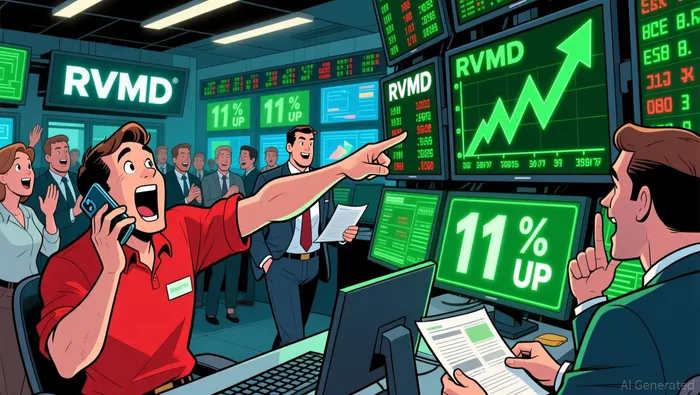
The bottom line for traders is a classic acquisition catalyst: a strong, near-term catalyst with a clear but not guaranteed outcome. The stock's surge captures the upside, but the path to closure is fraught with the typical hurdles of a mega-deal. The next few weeks will test whether the talks solidify into a definitive offer or unravel.
The Trading Setup: Technicals and Near-Term Catalysts
The immediate trading mechanics are clear. Revolution's stock surged 11% on January 9th, a move that occurred on heavy volume of over 20 million shares. This surge pushed the price above key technical resistance, breaking out from a tight consolidation pattern. The volume spike confirms the strength of the move and signals significant institutional interest in the acquisition narrative.
The primary near-term catalyst is the official announcement of a definitive agreement. Reports indicate Merck could unveil a deal as soon as later this month. For traders, this is the critical date. A definitive offer would likely lock in the premium, potentially removing the uncertainty that currently hovers over the stock. The market has already priced in a high probability of a deal, but the final terms-especially if they come in at the top end of the rumored $28-$32 billion range-could drive further upside.
Investors must monitor for two complicating factors. First, the risk of new suitor interest. While AbbVie has denied talks, the mere possibility of a bidding war, as noted by analysts, could push the final price higher but also delay closure. Second, regulatory scrutiny is a potential overhang. Mega-deals in biotech often face antitrust review, and any hint of regulatory pushback could introduce volatility ahead of a final vote.
The setup is now a race against the announcement clock. The stock's breakout above resistance suggests momentum is with the acquisition thesis. However, the path to that definitive deal remains uncertain. Traders should watch for any new developments that could alter the timeline or the final price, as those would be the immediate catalysts for the next leg up-or a potential reversal.
Risk/Reward: Deal Uncertainty and Bidding War Potential
The path to a deal is fraught with uncertainty, and the potential for a bidding war adds a volatile layer. The most immediate risk is that the Merck talks simply fall apart. The reports themselves note the deal may not materialize, and the company could enter into a deal with another suitor. This possibility is not hypothetical. Earlier this week, the Wall Street Journal reported that AbbVie was in advanced talks to buy Revolution, a report that sent the stock up nearly 30% on its own. While AbbVie has since denied the interest, the mere fact of those talks introduces a powerful dynamic. It signals that Revolution's pipeline is highly valuable, and another major player is willing to pay a premium. That history of interest creates a clear risk of a bidding war, which could push the final price higher but also delay closure and introduce execution risk.
The final value and structure of any deal remain a negotiation target, not a fixed number. The rumored range of $28 billion to $32 billion is a starting point for talks. For a company with a market cap of about $22.6 billion, that represents a substantial premium. But the ultimate price will depend on the leverage each side holds at the time of announcement. If AbbVie's earlier interest was credible, it could force Merck to sweeten its offer to win the deal. Conversely, if Merck is the only suitor, it may be able to secure the asset at the lower end of the range. The structure-cash, stock, or a mix-will also matter for how the deal integrates and for Revolution's shareholders.
Beyond the bidding war, operational execution risk is a real concern for the combined entity. Revolution Medicines develops therapies for RAS-addicted cancers, a complex and competitive field. The company's reliance on third-party manufacturing and development adds a layer of complexity to the integration. Merging these operations smoothly, especially for drugs in clinical development, is a non-trivial task. Any disruption to the development timeline for key assets like zoldonrasib, which recently received FDA Breakthrough Therapy Designation, could impact the strategic rationale for the acquisition. This execution risk is a hidden cost that Merck must manage post-close.
The bottom line is a high-stakes gamble on timing and negotiation. The stock's surge captures the premium for a deal, but the uncertainty around whether it happens, who wins it, and at what price, creates a volatile setup. Traders must weigh the potential for a higher final bid against the risk of the deal collapsing entirely.
Strategic Rationale: Why Merck Wants Revolution
Merck's pursuit of Revolution Medicines is a direct, high-stakes move to secure its future. The company is seeking to fortify its drug portfolio before its blockbuster cancer therapy, Keytruda, begins to lose patent protection in 2028. In 2024, Keytruda generated approximately $29.5 billion in global sales, accounting for nearly half of Merck's total revenue. The strategic imperative is clear: acquire a pipeline with transformative potential to replace that revenue stream.
The fit here is precise. Revolution Medicines is a late-stage clinical oncology company developing targeted therapies for RAS-addicted cancers, a prevalent and difficult-to-treat group of malignancies. Its pipeline, particularly the investigational drug zoldonrasib, offers a compelling addition. Just last week, the FDA granted zoldonrasib Breakthrough Therapy Designation for KRAS G12D-mutated lung cancer. This is a significant regulatory milestone, signaling the drug's potential to address a serious unmet need. As the first investigational drug specifically targeting the KRAS G12D mutation to receive this designation, zoldonrasib represents a potential new standard of care in a field where approved targeted therapies are currently lacking.
For Merck, this acquisition is about more than just a single drug. It's about gaining a foothold in a critical oncology segment and acquiring a development engine. The potential deal value of roughly $30 billion is a major capital allocation decision, but it aligns with Merck's recent acquisition spree. The company has already committed to buying Cidara Therapeutics for about $9.2 billion and agreed to acquire Verona Pharma for $10 billion. These moves show a pattern of aggressive portfolio building to maintain revenue momentum. Buying Revolution would be the largest such move yet, but it directly targets the oncology gap that looms as Keytruda's patent expires.
The bottom line is a defensive and offensive play. Merck is betting that Revolution's targeted RAS inhibitors, led by the newly designated zoldonrasib, can become the next generation of oncology blockbusters. The $30 billion price tag is steep, but it's a calculated investment to hedge against the patent cliff and diversify its oncology pipeline. The strategic rationale is sound, but the execution risk-both in the deal itself and in integrating Revolution's complex pipeline-will determine if this is a masterstroke or a costly overpayment.





Comentarios
Aún no hay comentarios