
Revlon's Competitive Positioning in the Beauty-Tech and At-Home Salon Revolution
The beauty-tech and at-home salon markets are undergoing a seismic shift, driven by consumer demand for convenience, personalization, and sustainability. By 2025, the global beauty-tech market is valued at $66.16 billion, with projections to surge to $172.99 billion by 2030 at a 17.9% CAGR, according to a Grand View Research report. Within this, the at-home beauty devices segment-dominated by skincare tools and haircare innovations-is expected to grow from $6.89 billion in 2025 to $14.42 billion by 2033, according to a Business Research Insights forecast. Revlon, a storied name in cosmetics, is navigating this transformation with a blend of affordability, digital engagement, and product innovation, though it faces stiff competition from tech-savvy giants like L'Oréal and Maybelline.
The Rise of Beauty-Tech and At-Home Solutions
The pandemic accelerated the adoption of at-home beauty solutions, a trend now entrenched in consumer behavior. According to Grand View Research, 38% of the 2024 beauty-tech revenue came from skincare devices, including AI-powered cleansers and LED therapy masks. Meanwhile, the at-home salon segment, part of a $122 billion global salon services market in 2024, is expanding as consumers seek professional-grade treatments without leaving home, per a GM Insights analysis. Virtual consultations, mobile beauty services, and AI-driven personalization are reshaping the industry, with brands leveraging these tools to enhance customer retention.
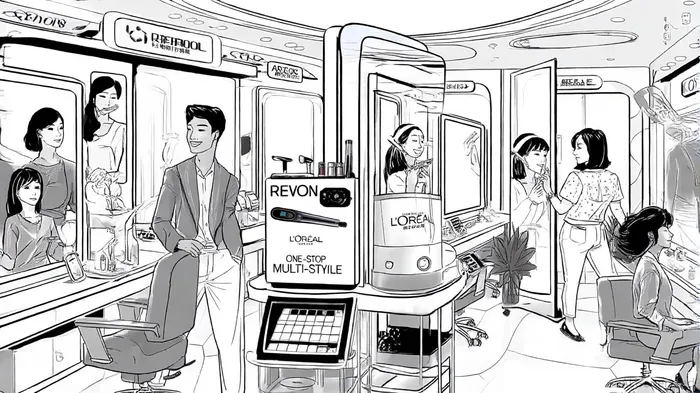
Revlon's 2025 product lineup reflects this shift. The company launched the Revlon® One-Step® Multi-Styler, a 3-in-1 hair tool that combines drying, curling, and straightening, reducing styling time by 50%, according to an Accio article. Its Super Lustrous Glimmer™ Lip Oil and Glimmer Blush Drops integrate skincare ingredients like squalane, aligning with the growing demand for "skin-infused" makeup (as detailed in the same Accio article). These innovations position Revlon as a bridge between traditional cosmetics and tech-enhanced personal care.
Revlon vs. L'Oréal: A Tale of Two Strategies
While Revlon focuses on accessible, wellness-driven products, L'Oréal has emerged as a beauty-tech pioneer. The French conglomerate unveiled the Cell BioPrint at CES 2025, a device that analyzes skin's biological age, hydration, and inflammation in five minutes, in a CosmeticsDesign article. Its Mood Mirror uses AI to recommend makeup looks based on emotional responses, blending psychology with technology (reported in the same CosmeticsDesign article). L'Oréal's dominance is further solidified by its $40 billion revenue in 2024 and its "L'Oréal for the Future" sustainability initiative, which includes lab-grown ingredients and eco-friendly packaging, as noted in a Solsaga overview.
Maybelline, a L'Oréal subsidiary, benefits from its parent's tech ecosystem but lacks standalone at-home innovations. Revlon, by contrast, has not yet matched L'Oréal's investment in AI and AR. For instance, L'Oréal's virtual try-on tools on Amazon and Sephora have reduced return rates by 20%, according to the Solsaga overview, a metric Revlon has yet to replicate. However, Revlon's strength lies in its affordability and EWG Verified clean beauty standards, which appeal to budget-conscious consumers, as discussed in a Lani-Loves comparison.
Market Share and Strategic Challenges
Revlon's market share in the at-home beauty devices segment remains opaque, but the broader beauty-tech landscape is highly competitive. L'Oréal, Philips, and Panasonic dominate the $40.19 billion beauty devices market in 2025, with L'Oréal's AI-driven tools and biotech advancements securing its leadership, according to a Business Research Insights report. Revlon's One-Step Multi-Styler and skincare-infused makeup have carved a niche, but its reliance on traditional marketing-such as influencer partnerships and social media campaigns-may not suffice against L'Oréal's data-driven personalization, as explored in a Latterly case study.
A critical challenge for Revlon is brand identity. While it retains heritage appeal, its 2022 bankruptcy filing and subsequent restructuring have left it playing catch-up in a market where tech integration is non-negotiable, according to a Statista profile. Meanwhile, L'Oréal's 2025 revenue of $40 billion underscores its ability to scale innovations globally, from North America's $13.1 billion beauty devices market to Asia-Pacific's fast-growing middle class (per the Business Research Insights report).
The Road Ahead: Sustainability and Social Commerce
Sustainability is a shared battleground. Revlon's clean cosmetics and refillable packaging align with consumer priorities, but L'Oréal's commitment to reducing greenhouse gas emissions and its HAPTA AI-powered makeup applicator for accessibility give it an edge, as noted in the Solsaga overview. Social commerce is another frontier: 6.2% of beauty sales now occur via platforms like TikTok, where L'Oréal's AR try-ons and Revlon's influencer-driven campaigns compete for attention, according to a Forbes analysis.
Conclusion
Revlon's 2025 strategies-affordable, tech-enhanced products and digital engagement-position it as a contender in the at-home beauty space. However, its lack of AI-driven personalization and biotech innovation lags behind L'Oréal's aggressive foray into beauty-tech. For investors, Revlon's potential lies in its ability to balance affordability with emerging trends like sustainability and social commerce. Yet, in a market where the Grand View Research projection for 2030 looms large, Revlon must accelerate its tech investments to avoid being overshadowed by its more agile rivals.







Comentarios
Aún no hay comentarios