
Revisiting BMEZ: Why the Widening Discount Warrants a 'Hold' Rating
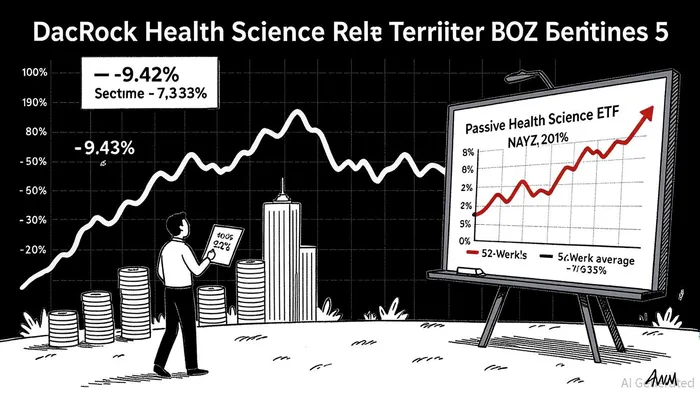
The BlackRock HealthBMEZ-- Sciences Term Trust (BMEZ) has long been a focal point for investors seeking exposure to the healthcare sector through active management. However, its persistent and widening discount to net asset value (NAV)—currently at -9.42% as of September 5, 2025—raises critical questions about its risk-reward profile. This discount, which has fluctuated between -1.98% and -12.36% over the past year, reflects structural inefficiencies inherent to closed-end funds and underscores the challenges of active management in a market increasingly dominated by passive strategies.
Active vs. Passive: A Tale of Two Strategies
BMEZ’s active management model aims to exploit market inefficiencies, particularly in sectors like healthcare, where company-specific fundamentals can drive dispersion. For instance, during the 2023 market downturn, active managers outperformed in U.S. small-cap categories by leveraging risk-adjusted strategies [1]. However, BMEZ’s recent performance has been mixed. While it outpaced the S&P 500 and the InvescoIVZ-- Healthcare ETF (THQ) in 2023, its 12-month returns have lagged, with a Sharpe Ratio of 0.32—a modest return per unit of risk compared to passive benchmarks [2].
Passive health science ETFs, such as the iShares U.S. Healthcare ETF (IYH) and the Health Care Select Sector SPDR Fund (XLV), benefit from structural advantages. These funds use in-kind redemption mechanisms to minimize capital gains and arbitrage to keep share prices aligned with NAV. For example, IYH’s NAV stood at $58.23 as of September 2025, with a 30-day SEC yield of 1.77%, reflecting its low-cost, transparent structure [3]. In contrast, BMEZ’s discount volatility—exacerbated by its closed-end structure—introduces a layer of uncertainty that passive funds inherently avoid.
Structural Inefficiencies and Market Dispersion
The widening discount for BMEZBMEZ-- is not merely a function of its active management but also a symptom of broader market dynamics. Research on ETF contagion effects highlights how sector-specific ETFs can experience mispricings during high-volatility periods, propagating inefficiencies across related assets [4]. BMEZ’s -9.42% discount, which exceeds its 52-week average of -7.33%, suggests that investor sentiment and liquidity constraints are amplifying its structural challenges.
Moreover, market dispersion in the healthcare sector has intensified. The Q2 2025 earnings season revealed a 50% performance gap between top and bottom performers in the "Magnificent 7" cohort, a trend that underscores the value of active, quality-focused strategies [5]. Yet, BMEZ’s ability to capitalize on such dispersion is constrained by its discount. For every dollar of NAV, investors pay less for BMEZ’s shares, but this discount erodes returns when the fund’s active strategies fail to outperform.
Risk-Adjusted Returns and NAV Tracking Accuracy
BMEZ’s risk-adjusted performance further complicates its case for a "Buy" rating. While its Sharpe Ratio of 0.32 indicates some reward for risk taken, this metric pales in comparison to the consistent tracking accuracy of passive ETFs. For instance, the iShares Global HealthcareIXJ-- ETF (IXJ) maintained a 0.39% NAV change in September 2025, reflecting minimal deviation from its underlying index [6]. BMEZ, by contrast, faces a Z-Score of -0.70, indicating it trades below its historical average relative to NAV [1]. This discrepancy signals that structural inefficiencies—such as distribution policies and liquidity mismatches—are eroding investor value.
Why a "Hold" Rating Makes Sense
Given these factors, a "Hold" rating for BMEZ is prudent. The fund’s active management model, while theoretically advantageous in inefficient markets, is undermined by its persistent discount and the rising efficiency of passive alternatives. Passive ETFs like IYH and XLV offer lower costs, tighter NAV tracking, and greater transparency, making them more attractive in a low-dispersion environment. Meanwhile, BMEZ’s discount volatility introduces a risk premium that may not be justified by its recent performance.
Investors should monitor two key metrics: (1) BMEZ’s ability to narrow its discount through distribution adjustments or market sentiment shifts and (2) the evolution of market dispersion in healthcare. If the sector reverts to lower dispersion or passive strategies dominate, BMEZ’s active edge may diminish further. Conversely, a surge in sector-specific inefficiencies could justify a reevaluation of its active approach.
Conclusion
BMEZ’s widening discount is a red flag for investors seeking reliable exposure to healthcare. While active management can thrive in fragmented markets, the fund’s structural inefficiencies and the robustness of passive alternatives tilt the scales toward caution. Until BMEZ demonstrates a clear path to narrowing its discount and outperforming passive benchmarks on a risk-adjusted basis, a "Hold" rating remains the most defensible stance.
Source:
[1] BlackRock Health Sciences Term Trust:BMEZ, [https://www.cefconnect.com/fund/BMEZ]
[2] BMEZ vs. BMEBME-- — Stock Comparison Tool, [https://portfolioslab.com/tools/stock-comparison/BMEZ/BME]
[3] iShares U.S. Healthcare ETF | IYH, [https://www.ishares.com/us/products/239511/ishares-us-healthcare-etf]
[4] Idiosyncratic contagion between ETFs and stocks: A high ..., [https://www.sciencedirect.com/science/article/pii/S1572308925000440]
[5] Q2 Earnings: Upside Surprises & Mag 7 Dispersion, [https://www.ishares.com/us/insights/earnings-commentary-q2]
[6] iShares Global Healthcare ETF | IXJ, [https://www.ishares.com/us/products/239744/ishares-global-healthcare-etf]





Comentarios
Aún no hay comentarios