
Reverse Stock Splits and the Erosion of Small-Cap Value: A Tale of Capital Flight and Structural Weakness
Structural Challenges: Margin Over Growth, and the Cost of Survival
Small-cap firms face a paradox. While margin expansion strategies have delivered short-term earnings improvements, they often come at the expense of long-term innovation and revenue growth. Kyndryl Holdings, for instance, has pivoted to high-margin advisory services, yet its revenue growth has stagnated. This trend reflects a broader industry shift where small-cap companies prioritize cost-cutting over investment in disruptive technologies-a strategy that may work in the short term but leaves them vulnerable in a competitive landscape demanding continuous innovation.
The reliance on reverse splits exacerbates this problem. While these actions temporarily inflate share prices, they signal financial distress and erode investor confidence. Research from international markets shows that firms undergoing reverse splits experience persistent underperformance for up to 18 months post-event, with negative abnormal returns becoming the norm. This underperformance is not merely a statistical anomaly but a reflection of market psychology: investors interpret reverse splits as a lack of faith in a company's long-term value proposition.
Capital Flight to Megacaps: The New Normal
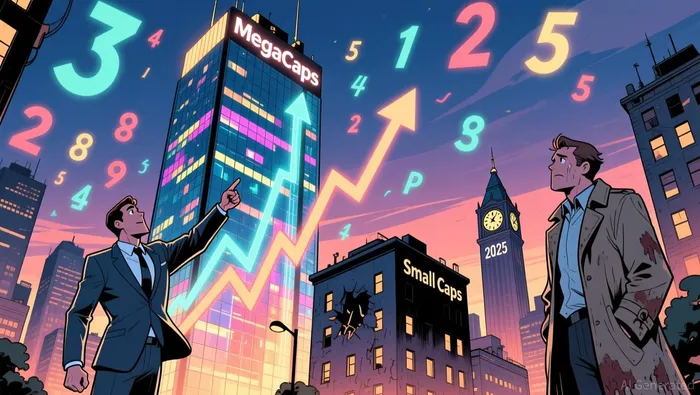 The structural challenges for small-caps are compounded by a historic shift in capital allocation. Megacaps like Meta Platforms (META), Apple (AAPL), and Nvidia (NVDA) have captured the lion's share of investor attention and capital. Meta's stock, for example, surged 67% in 2025, pushing its market cap to $1.5 trillion and enabling CEO Mark Zuckerberg to liquidate over $2 billion in shares via a Rule 10b5-1 trading plan. This concentration of capital in a handful of dominant firms has left small-caps with dwindling access to liquidity and a shrinking role in overall market value now just 1.2% of the U.S. market.
Investor behavior has further entrenched this dynamic. In high-sentiment regimes, reverse splits might temporarily boost liquidity, but in low-sentiment environments-common during periods of macroeconomic uncertainty-their negative connotations dominate. This duality underscores the fragility of small-cap valuations in a market where capital flows are increasingly dictated by momentum and hype rather than fundamentals.
Long-Term Implications: A Systemic Underperformance
The long-term implications of reverse splits and capital flight are dire. Small-cap firms that undergo reverse splits often face a self-fulfilling prophecy: reduced investor trust, higher capital costs, and diminished access to growth opportunities. Empirical studies confirm that these firms underperform their peers for years after the event, with the market failing to price in their true prospects. Meanwhile, the broader ecosystem suffers as innovation and diversification-traditionally driven by small-cap dynamism-are stifled.
For investors, the lesson is clear: reverse splits are not a silver bullet but a red flag. While they may offer a temporary reprieve, they signal deeper structural weaknesses that are unlikely to resolve without meaningful operational or strategic overhauls. In a world where megacaps dominate and small-caps struggle to compete, the risks of overexposure to reverse-splitting firms are substantial.
Conclusion
The 2025 reverse stock split frenzy is a microcosm of a larger market imbalance. Small-cap companies are caught in a vicious cycle of margin-driven strategies, capital flight to megacaps, and investor skepticism. For investors, the path forward requires a critical reassessment of small-cap allocations and a heightened awareness of the signals embedded in corporate actions like reverse splits. As the market continues to consolidate around a handful of dominant players, the structural challenges facing small-caps will only deepen-unless systemic change is prioritized over short-term survival.







Comentarios
Aún no hay comentarios