
Return-to-Office Mandates on the Rise Amid Hybrid Work Evolution
PorAinvest
viernes, 1 de agosto de 2025, 10:34 am ET2 min de lectura
CSCO--
The reinstatement of return-to-office mandates comes as a response to the need for face-to-face interaction, collaboration, and the desire to foster a company culture. For instance, Starbucks has moved to a four-day workweek requirement for corporate staff, citing the need to improve customer service and operational efficiency. Similarly, Target has announced a return to five days in the office, with an emphasis on team collaboration and customer engagement. Google has also reaffirmed its commitment to in-office work, with plans to increase the number of days employees need to be present in the office.
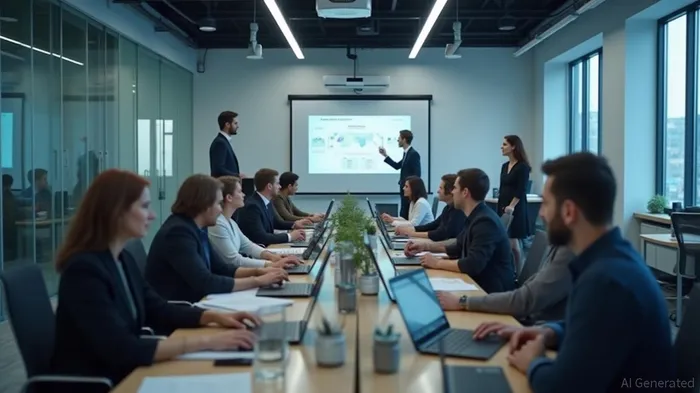
In response to these changes, office operators are investing in collaboration technologies to facilitate flexible work and engagement between in-office and remote employees. These investments include advanced video conferencing tools, virtual reality platforms, and other technologies designed to enhance communication and productivity. By leveraging these technologies, companies aim to create a more integrated and cohesive work environment, regardless of whether employees are working on-site or remotely.
The reinstatement of return-to-office mandates has significant implications for the commercial real estate market. With more companies requiring employees to be in the office, there is an increased demand for high-quality office space. This demand is particularly evident in major cities like New York, where office attendance has rebounded to 76% of pre-pandemic levels [2]. As a result, office leasing activity has surged, with Q1 2025 delivering 12.2 million square feet in leasing, the strongest showing since 2019 [2].
However, the increased demand for office space is not uniform across all types of buildings. Class A trophy buildings, which offer modern infrastructure and upscale amenities, are in high demand, with vacancy rates below 10%. In contrast, Class B and C buildings, which may have outdated infrastructure and empty floors, are struggling to find tenants. This has led to a market split, with trophy buildings commanding premium rents and older assets struggling to compete [2].
The reinstatement of return-to-office mandates is also influencing political and regulatory environments. Potential changes in corporate taxes, office-to-residential conversion plans, and small business support create uncertainty for institutional owners. However, despite these political forces, Manhattan maintains the nation's strongest leasing performance and lowest vacancy rates, according to CoStar [2].
As the end of remote work becomes a reality, tenants and landlords must navigate these changing dynamics. Tenants should audit their actual headcount, chase quality buildings, negotiate lease terms, and plan for political curveballs. Landlords, on the other hand, need to invest heavily in upgrades or explore alternative uses to remain competitive in this rapidly evolving market [2].
References:
[1] https://www.metro-manhattan.com/blog/end-of-remote-work-which-major-nyc-employers-are-mandating-returns-and-what-does-it-means-for-office-demand/
[2] https://www.metro-manhattan.com/blog/end-of-remote-work-which-major-nyc-employers-are-mandating-returns-and-what-does-it-means-for-office-demand/
CSGP--
SBUX--
Several major companies, including Starbucks, Target, and Google, have reinstated return-to-office mandates, with some offering voluntary exit programs for employees who prefer to work remotely. Meanwhile, office operators are investing in collaboration technologies to facilitate flexible work and engagement between in-office and remote employees. A survey by Cisco found a global trend toward increased in-office work, with 72% of respondents' organizations having mandates for working in the office.
Several major companies, including Starbucks, Target, and Google, have reinstated return-to-office mandates, with some offering voluntary exit programs for employees who prefer to work remotely. This shift is part of a broader global trend toward increased in-office work, as evidenced by a survey by Cisco, which found that 72% of respondents' organizations have mandates for working in the office [1].The reinstatement of return-to-office mandates comes as a response to the need for face-to-face interaction, collaboration, and the desire to foster a company culture. For instance, Starbucks has moved to a four-day workweek requirement for corporate staff, citing the need to improve customer service and operational efficiency. Similarly, Target has announced a return to five days in the office, with an emphasis on team collaboration and customer engagement. Google has also reaffirmed its commitment to in-office work, with plans to increase the number of days employees need to be present in the office.
In response to these changes, office operators are investing in collaboration technologies to facilitate flexible work and engagement between in-office and remote employees. These investments include advanced video conferencing tools, virtual reality platforms, and other technologies designed to enhance communication and productivity. By leveraging these technologies, companies aim to create a more integrated and cohesive work environment, regardless of whether employees are working on-site or remotely.
The reinstatement of return-to-office mandates has significant implications for the commercial real estate market. With more companies requiring employees to be in the office, there is an increased demand for high-quality office space. This demand is particularly evident in major cities like New York, where office attendance has rebounded to 76% of pre-pandemic levels [2]. As a result, office leasing activity has surged, with Q1 2025 delivering 12.2 million square feet in leasing, the strongest showing since 2019 [2].
However, the increased demand for office space is not uniform across all types of buildings. Class A trophy buildings, which offer modern infrastructure and upscale amenities, are in high demand, with vacancy rates below 10%. In contrast, Class B and C buildings, which may have outdated infrastructure and empty floors, are struggling to find tenants. This has led to a market split, with trophy buildings commanding premium rents and older assets struggling to compete [2].
The reinstatement of return-to-office mandates is also influencing political and regulatory environments. Potential changes in corporate taxes, office-to-residential conversion plans, and small business support create uncertainty for institutional owners. However, despite these political forces, Manhattan maintains the nation's strongest leasing performance and lowest vacancy rates, according to CoStar [2].
As the end of remote work becomes a reality, tenants and landlords must navigate these changing dynamics. Tenants should audit their actual headcount, chase quality buildings, negotiate lease terms, and plan for political curveballs. Landlords, on the other hand, need to invest heavily in upgrades or explore alternative uses to remain competitive in this rapidly evolving market [2].
References:
[1] https://www.metro-manhattan.com/blog/end-of-remote-work-which-major-nyc-employers-are-mandating-returns-and-what-does-it-means-for-office-demand/
[2] https://www.metro-manhattan.com/blog/end-of-remote-work-which-major-nyc-employers-are-mandating-returns-and-what-does-it-means-for-office-demand/


Divulgación editorial y transparencia de la IA: Ainvest News utiliza tecnología avanzada de Modelos de Lenguaje Largo (LLM) para sintetizar y analizar datos de mercado en tiempo real. Para garantizar los más altos estándares de integridad, cada artículo se somete a un riguroso proceso de verificación con participación humana.
Mientras la IA asiste en el procesamiento de datos y la redacción inicial, un miembro editorial profesional de Ainvest revisa, verifica y aprueba de forma independiente todo el contenido para garantizar su precisión y cumplimiento con los estándares editoriales de Ainvest Fintech Inc. Esta supervisión humana está diseñada para mitigar las alucinaciones de la IA y garantizar el contexto financiero.
Advertencia sobre inversiones: Este contenido se proporciona únicamente con fines informativos y no constituye asesoramiento profesional de inversión, legal o financiero. Los mercados conllevan riesgos inherentes. Se recomienda a los usuarios que realicen una investigación independiente o consulten a un asesor financiero certificado antes de tomar cualquier decisión. Ainvest Fintech Inc. se exime de toda responsabilidad por las acciones tomadas con base en esta información. ¿Encontró un error? Reportar un problema


SOBRE NOSOTROS
Nuestra historiaAutores de noticiasBase de conocimientosPolítica de privacidadTérmino de usoDescargo de responsabilidad de corretaje de tercerosTérminos de uso de AIMEDivulgaciones de riesgos de AInvest AICarrerasCONTÁCTENOS
Email: support@ainvest.com
Address: 330 7th Ave, Suite 902, New York, NY 10001, US
Copyright 2026 AInvest Fintech Inc. All rights reserved.


Comentarios
Aún no hay comentarios