
Rethinking Urban Real Estate: How Rithm's Acquisition of Paramount Could Reshape High-Cost U.S. Markets
The commercial real estate landscape in high-cost U.S. urban cores is on the brink of a transformation, driven by Rithm Capital's reported $2 billion acquisition of Paramount GroupPGRE--, a real estate investment trust (REIT) with a 17-property portfolio spanning New York City and San Francisco. This deal, emerging from a competitive bidding process involving BlackstoneBX--, SL Green, and Vornado[1], signals a pivotal moment for urban office markets still grappling with post-pandemic shifts. By examining Rithm's strategic playbook and Paramount's asset base, this analysis explores how the acquisition could stabilize and revitalize these critical markets.
A Strategic Match: Rithm's Strengths and Paramount's Assets
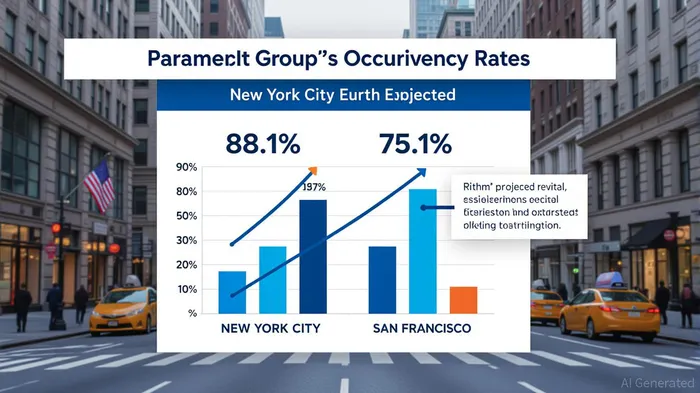
Rithm Capital, a $36 billion asset manager with expertise in mortgage servicing, origination, and alternative investments, has positioned itself as a formidable player in commercial real estate. Its recent acquisitions of Sculptor Capital Management and Crestline[2] have expanded its capabilities in debt restructuring and asset optimization—skills that align with Paramount's current challenges. Paramount, meanwhile, owns 13 million square feet of commercial real estate, with 77% of its value concentrated in New York City and 23% in San Francisco[3]. While its New York portfolio is robust at 88.1% occupancy, San Francisco's 75.1% occupancy rate reflects the city's struggles with office demand post-pandemic[4].
The acquisition could address these imbalances. Rithm's experience in mortgage servicing and debt restructuring—evidenced by its $878 million MSRs debt issuance in Q1 2025[5]—positions it to rework Paramount's $4.3 billion in debt tied to expiring leases, particularly in San Francisco[6]. By stepping into borrower roles or securing new financing, Rithm could stabilize Paramount's cash flow and prevent further asset divestitures.
Market Trends and the Urban Core Rebound
High-cost urban cores are witnessing a nuanced recovery. According to Cushman & Wakefield, Class A office leasing in central business districts has rebounded to 41% of the market share, a pre-pandemic level[7]. However, cities like San Francisco face unique challenges. Paramount's San Francisco portfolio, which includes One Market Plaza and One Front St., has seen half of its properties seized or sold since 2020[8]. Rithm's acquisition could inject capital into these assets, enabling upgrades to amenities—a strategy Paramount has already tested at One Front St.—to attract hybrid-work-era tenants[9].
Meanwhile, New York City's office market shows resilience. Q2 2025 data reveals 8.4 million square feet of leasing activity, the highest since late 2019[10]. Rithm's 88.1% leased New York portfolio could benefit from this momentum, particularly as the REIT's 7.1-year average lease term provides stability[11].
Debt Restructuring and Tenant Retention: A Dual Focus
Rithm's strategic emphasis on disciplined capital deployment[12] suggests a dual focus on debt restructuring and tenant retention. For instance, its $500 million residential transitional loan partnership[13] demonstrates its ability to secure flexible financing, which could be applied to Paramount's debt-heavy assets. Additionally, Rithm's mortgage servicing subsidiary, Newrez, reported $11.8 billion in funded volume in Q1 2025[14], indicating operational expertise that could streamline Paramount's refinancing needs.
Tenant retention strategies may also leverage Rithm's broader ecosystem. Its single-family rental (SFR) platform, Adoor, emphasizes customer experience to reduce turnover[15], a model that could be adapted to office tenants through enhanced amenities or flexible lease terms.
The Broader Implications for Urban Real Estate
This acquisition could catalyze a shift in how urban cores are managed. By combining Rithm's capital-light, fee-based model with Paramount's premium assets, the deal may set a precedent for financial firms to reinvigorate struggling real estate markets. Furthermore, Rithm's exploration of a Newrez public listing[16] hints at a broader strategy to unlock value through liquidity events—a tactic that could stabilize Paramount's shareholder base and attract institutional investors.
Conclusion: A New Era for Urban Real Estate
Rithm's acquisition of Paramount represents more than a financial transaction—it is a strategic reimagining of high-cost urban real estate. By leveraging its asset management prowess, debt restructuring capabilities, and tenant-centric strategies, Rithm could stabilize Paramount's portfolio while aligning with broader market trends like mixed-use development and experiential office spaces[17]. As cities like New York and San Francisco navigate the post-pandemic landscape, this deal may serve as a blueprint for revitalizing urban cores through innovative capital deployment and operational excellence.





Comentarios
Aún no hay comentarios