
Retail Investor Behavior and Market Sentiment: The Schwab Trading Activity Index as a Barometer of Equity Momentum
Retail investor behavior has long been a double-edged sword in equity markets-capable of both amplifying trends and serving as a contrarian signal. The SchwabSCHW-- Trading Activity Index (STAX), a proprietary metric tracking the trading activity of Charles SchwabSCHW-- clients, offers a unique lens into this dynamic. Recent data suggests that the STAX may act as a leading indicator of market momentum, even as it diverges from broader indices like the S&P 500.
According to Charles Schwab's September release, the STAX rose to 46.12 in September 2025, up from 43.69 in August, marking a five-month high. This outpaced the S&P 500's more modest gains, signaling a shift in retail investor positioning. Schwab clients were net buyers of AI-adjacent stocks like NVIDIA and Palantir while selling shares in traditional tech giants such as Apple and Meta, as noted in Schwab's August release. This divergence highlights a broader trend: retail investors are increasingly seeking opportunities beyond the "Magnificent Seven," a move that could foreshadow market rotations.
The STAX's methodology-calculating the median score of a statistically significant sample of Schwab client accounts-ensures it reflects real-time sentiment rather than institutional-driven narratives, as described on Schwab's methodology page. For instance, in August 2025, the index surged 4.55% as clients embraced higher-volatility equities, a stark contrast to the S&P 500's 1.12% rise, as the August release noted. This suggests that retail investors are often more responsive to macroeconomic catalysts, such as the Federal Reserve's rate cuts or inflation data, than broader market indices.
However, the STAX is not without its limitations. As noted in Schwab's own documentation, the index is a behavioral indicator, not a predictive tool. Divergences between the STAX and the S&P 500 may reflect de-risking or increased volatility expectations, but they do not guarantee future market direction. For example, in September 2024, the STAX fell to 47.10 while the S&P 500 hit record highs, illustrating that retail caution does not always align with institutional optimism, as shown in a Yahoo Finance article.
Academic analysis on the STAX's predictive power remains sparse. While industry reports emphasize its utility in tracking sentiment, there is no direct evidence that it reliably forecasts equity trends over the past five years, as the September release shows. This underscores the importance of using the STAX in conjunction with other indicators rather than in isolation.
For investors, the STAX offers a valuable barometer of retail confidence. Its recent rise suggests that individual traders are growing more aggressive, particularly in sectors like AI and healthcare, where Schwab clients have shown net buying activity, according to the Business Wire release. Yet, as with any sentiment gauge, extremes in the index-whether excessively bullish or bearish-can signal potential reversals. The key lies in contextualizing the STAX within broader market fundamentals and macroeconomic trends.
In conclusion, the Schwab Trading Activity Index provides a nuanced view of retail investor behavior, often diverging from traditional market benchmarks. While it may not be a perfect leading indicator, its ability to capture real-time shifts in positioning makes it a compelling tool for gauging equity market momentum. As retail participation continues to shape market dynamics, the STAX will likely remain a critical metric for investors seeking to navigate the interplay between sentiment and structure.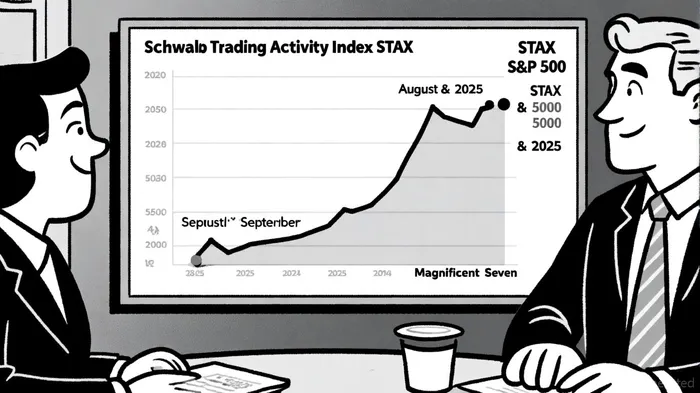





Comentarios
Aún no hay comentarios