
Retail and Healthcare Consumer Stocks: Strategic Positioning in Post-Recession Recovery
Strategic Positioning in Post-Recession Recovery: Retail and Healthcare Consumer Stocks
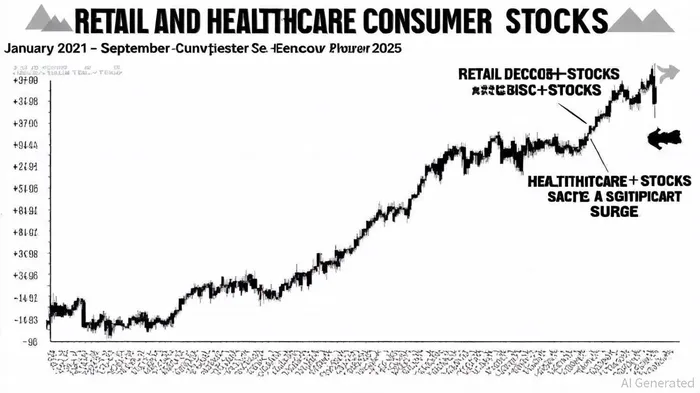
The post-2020 recession has reshaped the investment landscape, with retail and healthcare consumer stocks emerging as two of the most strategically positioned sectors for recovery. While their paths to growth differ—retail driven by cyclical demand and healthcare by defensive resilience—both sectors reflect distinct yet complementary strategies for navigating economic cycles.
Retail: Cyclical Rebound and Digital Reinvention
The retail sector's recovery has been fueled by a confluence of monetary policy, consumer behavior shifts, and technological adaptation. According to a report by the U.S. Department of Commerce, retail sales surged 3.9% year-over-year in December 2024, driven by Federal Reserve rate cuts that reduced borrowing costs and eased inflationary pressures [4]. This momentum, however, faced a temporary setback in January 2025, with a 0.9% monthly decline attributed to severe winter storms and post-holiday spending lulls [5].
Despite short-term volatility, the sector's long-term trajectory remains robust. Retailers leveraging AI-driven inventory management, omnichannel strategies, and experiential store formats are outperforming peers [5]. For instance, AmazonAMZN-- and WalmartWMT-- have capitalized on e-commerce tailwinds, while niche players like Deckers OutdoorDECK-- Corp have thrived by aligning with seasonal demand [4]. Projections indicate U.S. retail sales will reach $7.45 trillion in 2025, reflecting a 2.56% annual growth rate [6].
Healthcare: Defensive Resilience and Innovation-Driven Growth
Healthcare stocks, traditionally a safe haven during economic downturns, have demonstrated mixed performance in 2025. While the sector lagged behind tech-driven megatrends in 2024 [1], 2025 has seen a gradual rebound fueled by undervalued opportunities and innovation. For example, Eli Lilly's GLP-1 drugs and Novo Nordisk's obesity therapeutics have driven double-digit returns, with LLY posting a 25.86% one-year gain [5]. Similarly, Boston Scientific's focus on cardiovascular devices and UnitedHealth's dominant insurance market position highlight the sector's diversification [5].
Policy uncertainties, such as Medicare Advantage reimbursement challenges, initially dampened investor sentiment [1]. However, analysts now view the sector as attractively valued, with long-term drivers like an aging population and biotech breakthroughs poised to offset short-term headwinds [2]. As Charles Schwab notes, healthcare is rated “Marketperform” in 2025, suggesting alignment with broader market trends but not yet outpacing them [4].
Comparative Strategic Insights
The contrasting dynamics of retail and healthcare underscore the importance of sector-specific positioning. Retail's success hinges on macroeconomic conditions and consumer confidence, making it a cyclical play. In contrast, healthcare's stability stems from inelastic demand, offering a defensive hedge against economic volatility.
For investors, this duality presents a strategic opportunity: pairing cyclical retail exposure with defensive healthcare holdings can balance growth and risk. Retail's projected 2025 growth [6] and healthcare's undervalued segments [2] suggest a complementary approach, particularly as AI and digital transformation reshape both industries.
Conclusion
As post-recession recovery gains momentum, retail and healthcare consumer stocks exemplify the interplay between cyclical and defensive strategies. Retail's rebound is anchored in policy-driven demand and technological agility, while healthcare's resilience is rooted in essential services and innovation. Investors seeking to capitalize on these trends must weigh macroeconomic signals against sector-specific fundamentals, ensuring a diversified portfolio that aligns with both short-term volatility and long-term demographic shifts.





Comentarios
Aún no hay comentarios