
Retail-Driven Momentum in Schweiter Technologies AG: A Shareholder Structure Analysis
Retail-Driven Momentum in Schweiter Technologies AG: A Shareholder Structure Analysis
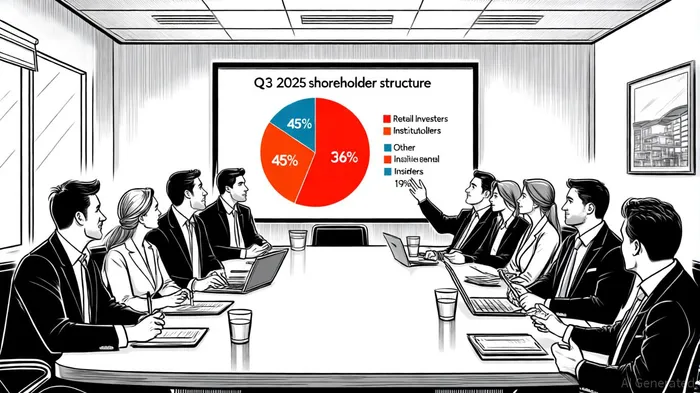
The recent surge in retail-driven momentum across global markets has once again turned the spotlight on shareholder structures as a critical lens for understanding short-to-medium-term price action. Schweiter Technologies AG (VTX:SWTQ), a Swiss-based composites innovator, offers a compelling case study. With its Q3 2025 shareholder structure revealing a striking 45% retail ownership, the company sits at an inflection point where retail sentiment could amplify or destabilize its stock price.
According to Yahoo Finance, retail investors now hold the largest stake in Schweiter Technologies AG, accounting for 45% of its equity. This is a significant shift from traditional industrial firms, where institutional ownership often dominates. The presence of such a large retail base suggests heightened retail participation, potentially driven by thematic investing in sustainability and lightweight materials-sectors where Schweiter's composites solutions are gaining traction in wind energy and transport, as noted by MarketScreener. However, this also introduces volatility, as retail-driven stocks are historically prone to sharp swings tied to social media trends or speculative trading.
Institutional ownership, at 36%, provides a counterbalance. While this is a robust figure, it is notably lower than the 35%-plus ranges cited in an earlier Yahoo Finance note, indicating a possible reallocation of institutional capital. The top 12 shareholders collectively control 50% of the company, with no single entity holding a majority stake. This fragmented structure reduces the risk of governance capture but also limits the stabilizing influence of a dominant institutional investor. For Schweiter, this dynamic could mean that institutional investors are more likely to act as liquidity providers than directional drivers in the near term.
Insider ownership, valued at CHF34 million in a company worth CHF578 million, remains modest. While this suggests limited alignment between management and shareholders, it also implies that insider transactions-such as the recent divestiture of the Bus & Rail business unit-may not be motivated by private gain. The strategic sale of non-core assets, as highlighted in the company's Semi-Annual Report 2025, aims to streamline operations and focus on high-margin composites solutions. This move could resonate with retail investors, who often favor companies with clear value-creation narratives.
The implications for price action are twofold. First, the retail-heavy structure increases susceptibility to sentiment-driven trading. A positive catalyst-such as a partnership in renewable energy or a favorable earnings report-could trigger a rapid price rally. Conversely, negative news, like a slowdown in European demand for lightweight materials, might lead to outsized sell-offs. Second, the absence of a dominant institutional bloc means that market makers and hedge funds could exploit liquidity imbalances, particularly in a stock with a mid-cap profile.
For investors, the key takeaway is to monitor both fundamental and behavioral signals. While Schweiter's strategic pivot to composites aligns with long-term industry trends, the short-to-medium-term outlook hinges on retail sentiment. A surge in retail buying, as seen in similar stocks during the 2021 meme stock frenzy, could propel SWTQ higher, even if earnings growth remains muted. Conversely, a loss of retail confidence-perhaps triggered by macroeconomic headwinds or regulatory scrutiny-could lead to a sharper correction than warranted by fundamentals.
In conclusion, Schweiter Technologies AG's shareholder structure underscores a stock at the mercy of retail momentum. For now, the balance between retail enthusiasm and institutional caution creates a volatile but potentially rewarding environment. Investors must weigh the risks of speculative trading against the company's strategic clarity and sector positioning.







Comentarios
Aún no hay comentarios