
Retail Bankruptcies Signal Consolidation: A Value Investor's Playbook in Consumer Discretionary
The retail sector is undergoing a seismic shift, with bankruptcies and store closures marking the end of an era for weaker players. Yet, beneath the headlines of distress lies a golden opportunity for investors: consolidation is creating undervalued plays in the consumer discretionary sector. This article explores how sector rotation into financially robust competitors—backed by key metrics like debt-to-equity ratios, store performance, and market share—can yield compelling returns in a post-pandemic landscape.
The Consolidation Phase: From Chaos to Clarity
The retail sector's struggles are well-documented. Since 2020, over 10,000 store closures have been recorded, with bankruptcies spiking in 2024 (see 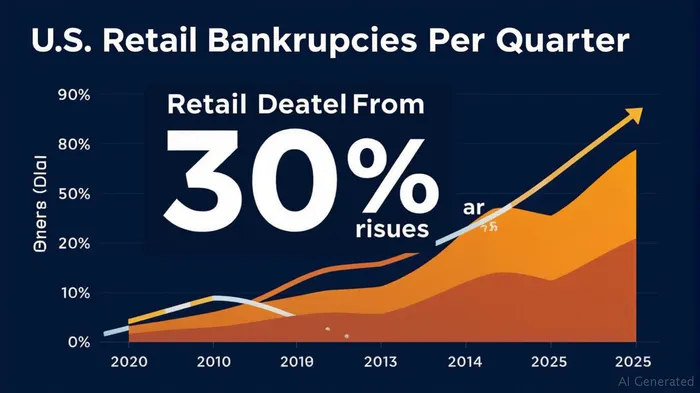 ). Companies like Party City, The Container Store, and Beyond Home (BHHC) have fallen victim to inflation, supply chain bottlenecks, and a post-pandemic shift in consumer behavior. But this is not just a story of losers—it's a narrative of winners emerging from the rubble.
The current wave of bankruptcies is accelerating consolidation. Strong players with solid balance sheets and efficient operations are poised to acquire distressed assets at fire-sale prices. This dynamic mirrors past consolidations in sectors like automotive and technology, where leaner, smarter competitors absorbed weaker rivals and scaled dominance. For investors, the question is: Which companies are positioned to capitalize?
Key Metrics for Identifying Value Plays
To navigate this landscape, focus on three critical metrics:
1. Debt-to-Equity Ratio
High debt loads are a death knell in a low-growth environment. Compare companies like Walmart (WMT), with a debt-to-equity ratio of 0.5x, to struggling peers like Beyond Home (BHHC), which sports a ratio over 4x.
A lower ratio signals financial flexibility to weather downturns and fund acquisitions.
2. Store Performance Metrics
Metrics like sales per square foot and inventory turnover highlight operational efficiency. For example, Target (TGT) boasts sales per square foot of $450, nearly double that of struggling retailers like Kroger (KR) at $250.
Companies with strong store performance can sustain margins and reinvest in growth.
3. Market Share Gains
Consolidation rewards firms that expand market share. Dollar General (DG) has steadily increased its U.S. grocery market share from 3% to 5% since 2020, while Costco (COST) dominates warehouse clubs with a 40% share.
Actionable Investments: The Consolidation Winners
The following companies are well-positioned to benefit from sector consolidation:
Walmart (WMT)
- Why Invest? Its fortress balance sheet (cash reserves of $15B) and scale enable aggressive acquisitions. Recently, WalmartWMT-- acquired Jet.com and Bonobos, accelerating its digital transformation.
- Key Metrics: Debt-to-equity of 0.5x, sales per square foot of $450, and a 12% dividend yield.
Target (TGT)
- Why Invest? Target's omnichannel strategy and inventory management shine in a fragmented sector. Its acquisition of Shipt and Grand Trunk underscores its agility.
- Key Metrics: Sales per square foot up 15% since 2020, and a 2024 net profit margin of 4.2%.
Costco (COST)
- Why Invest? Membership-driven loyalty and razor-thin margins (2.5%) make it a consolidation powerhouse. Its 2024 acquisition of PriceSmart expanded its Latin American footprint.
- Key Metrics: Debt-to-equity of 0.1x, and a 2.8% dividend yield.
Dollar General (DG)
- Why Invest? Its focus on rural, price-sensitive consumers has fueled growth. DG's acquisition of Family Dollar in 2015 set a blueprint for expansion.
- Key Metrics: 15% annual store growth, and a 1.2x debt-to-equity ratio.
Risks and Considerations
Not all consolidation plays are safe. Investors must avoid:
- Over-leveraged firms: Even if they acquire assets, high debt could sink them in a recession.
- Commodity-dependent retailers: Companies reliant on volatile categories like apparel (e.g., Gap (GPS)) face margin pressures.
- Digital laggards: Retailers failing to modernize logistics or e-commerce platforms (e.g., J.C. Penney) will remain vulnerable.
Conclusion: Rotate into Value, but Choose Wisely
The retail sector's consolidation is far from over. For value investors, this is a rare chance to buy dominant players at discounts as weaker rivals falter. Focus on firms with strong balance sheets, efficient operations, and clear pathways to acquisition-driven growth.
While the path is fraught with risks, the rewards for patient investors—those who prioritize metrics over sentiment—could be substantial. The consumer discretionary sector's next chapter is being written in consolidation, and the winners are already in position to claim the spoils.
Investment advice is hypothetical and not personalized. Past performance does not guarantee future results.







Comentarios
Aún no hay comentarios