
The Resurgence of Solo Bitcoin Mining and Its Implications for Decentralization and Profitability
In late 2025, BitcoinBTC-- mining has entered a new phase of industrialization, with public miners controlling nearly one-third of the network's hashrate and hashprice-revenue per PH/day of hashpower-plummeting to $35 from $55 in Q3 2025 according to analysis. Yet, amid this backdrop of centralized dominance and deteriorating profitability, a counter-movement has emerged: the resurgence of solo mining. Enabled by tools like Solo CKPool and driven by the allure of full block rewards, small-scale miners are defying the odds in a high-hash-rate environment. This article examines the economics, risks, and decentralization implications of this phenomenon.
The Economics of Solo Mining in 2025
Bitcoin's network difficulty has surged to over 126 trillion by mid-2025 according to mining reports, making solo mining a high-stakes endeavor. For a miner operating a 140 TH/s ASIC in a network with 500 EH/s total hashrate, the probability of mining a block in a 10-minute window is approximately 0.00000028%, translating to an average wait time of 6.79 years according to calculations. Despite these daunting odds, the potential reward remains substantial: a block reward of 3.125 BTC (worth ~$350,000–$400,000 at current prices) plus transaction fees according to data.
Infrastructure costs, however, are prohibitive. Top-tier ASICs like the Bitmain Antminer S21+ Hydro cost $8,000–$12,000 per unit and require electricity rates below $0.07/kWh to break even according to industry analysis. For context, solo mining in regions with low-cost electricity-such as Georgia's $0.03/kWh-remains the only viable path for profitability according to reports. Yet even with optimal conditions, the break-even point for a single block is 860,000 kWh of electricity, with costs ranging from $1,324 in Iran to $321,112 in Ireland according to cost data.
Solo CKPool: A Hybrid Model for Small-Scale Miners
Emerging tools like Solo CKPool have introduced a hybrid approach, enabling miners to retain full block rewards while leveraging shared infrastructure according to analysis. This platform eliminates the need for technical expertise in block submission, making solo mining more accessible. 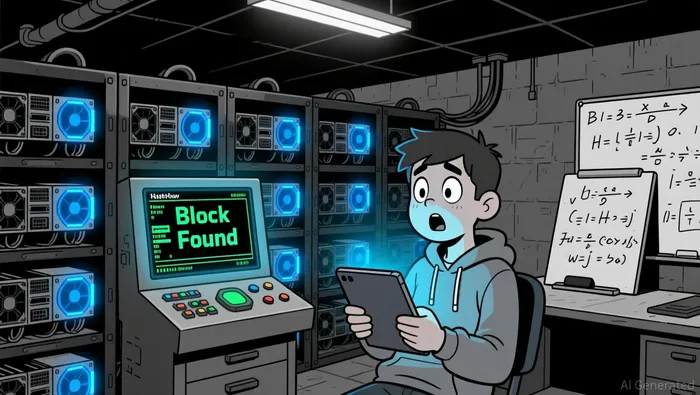 For instance, a miner using an old Bitaxe Gamma ASIC rig earned $265,000 through Solo CKPool in November 2025 according to a case study, demonstrating that even outdated hardware can yield outsized returns in rare cases.
However, Solo CKPool's impact is double-edged. While it lowers barriers to entry, it also amplifies the volatility inherent in solo mining. A miner with a 200 TH/s Antminer S21 would statistically require 12–15 years to find a single block according to calculations, making profitability contingent on unpredictable luck. This dynamic has led to a "lottery" effect, where a handful of solo miners-like the five who earned over $350,000 each in 2025-stand out against a backdrop of widespread losses according to mining data.
Decentralization: A Fragile Defense
The resurgence of solo mining is often framed as a defense of Bitcoin's decentralized ethos. By allowing individual miners to retain full rewards, platforms like Solo CKPool counteract the centralizing tendencies of industrial-scale operations according to analysis. For example, a hobbyist's $265,000 block reward in 2025 underscored how small-scale participation can reinforce network diversity according to case reports. Yet this impact is limited in scope.
Public miners now control 326 EH/s of hashrate, and the network's difficulty adjustment mechanism ensures that even a single successful solo miner contributes minimally to overall decentralization according to technical analysis. The 2024 halving further exacerbated this trend by cutting block rewards in half, forcing many miners to shut down and consolidating power among those with access to cheap energy and capital according to industry reports. While solo mining platforms preserve a symbolic foothold for individual operators, the reality is that Bitcoin's mining landscape is increasingly dominated by entities capable of optimizing for scale and efficiency according to expert analysis.
Conclusion: A High-Risk, High-Reward Niche
Solo mining in 2025 remains a niche strategy, viable only for those with access to low-cost electricity, cutting-edge hardware, and a tolerance for extreme volatility. Tools like Solo CKPool have democratized the process to some extent, but they cannot offset the structural challenges posed by rising difficulty and industrial competition. For most small-scale miners, joining a pool remains the pragmatic choice according to expert guidance.
Yet the persistence of solo mining is not without merit. It serves as a decentralized counterweight to the growing influence of public miners and reinforces Bitcoin's foundational principle of open participation. As the network approaches the next halving in 2028, the interplay between industrial efficiency and individual resilience will likely define the next chapter in Bitcoin's mining evolution.






Comentarios
Aún no hay comentarios