
The Resurgence of Small-Cap ETFs in a Lower-Rate Environment
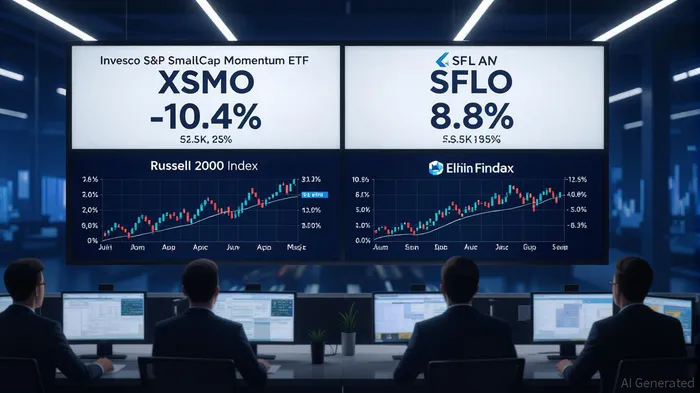
The U.S. equity market is undergoing a quiet but significant shift. As the Federal Reserve signals a potential pivot toward rate cuts in 2025, investors are recalibrating their portfolios to capitalize on the changing landscape. Small-cap ETFs, long overshadowed by their large-cap counterparts, are emerging as compelling candidates for strategic rotation. Factor-driven strategies—particularly those emphasizing momentum and fundamental quality—are outperforming traditional benchmarks, offering a blueprint for navigating a lower-rate environment.
The Case for Momentum and Growth in a Low-Rate World
The InvescoIVZ-- S&P SmallCap Momentum ETF (XSMO) has become a poster child for this trend. Tracking the S&P SmallCap 600 Momentum Index, XSMOXSMO-- focuses on small-cap stocks exhibiting strong price momentum, a factor that thrives in environments where liquidity is abundant and borrowing costs are falling. As of September 2, 2025, XSMO delivered a total return of 10.65% over the past year, outpacing the Russell 2000 Index’s 6.2% return [1]. This performance is not accidental: momentum strategies benefit from prolonged market trends, which are more likely in a low-rate setting where investors favor growth over income [4].
The Schwab Fundamental Large Cap Growth ETF (SFLO) further illustrates the appeal of factor-based strategies. While its 1-year annualized return of 8.57% as of July 31, 2025, is slightly lower than XSMO’s, SFLO’s focus on fundamentally strong large-cap growth stocks aligns with the broader macroeconomic narrative [2]. With the Fed anticipated to cut rates in September 2025, sectors like technology and healthcare—where SFLOSFLO-- has significant exposure—are poised to benefit from reduced discount rates and renewed risk appetite [5].
Strategic Rotation and the Role of Todd Rosenbluth
Todd Rosenbluth, a leading voice in ETF research, has underscored the importance of strategic rotation in this environment. “With expectations of pending interest rate cuts, the style has returned to favor,” he noted in a recent analysis [1]. Rosenbluth highlights factor-based ETFs like XSMO and the VictoryShares Small Cap Free Cash Flow ETF (another SFLO variant) as vehicles for capturing dispersion in market returns. These funds, he argues, offer a more nuanced approach than traditional market-cap-weighted indices, which can be skewed by a handful of dominant stocks [3].
Rosenbluth’s insights are particularly relevant given the current market dynamics. Small-cap stocks, historically more sensitive to interest rates due to their higher leverage and growth profiles, are seeing renewed demand. The Russell 2000’s recent record high—a first in over three years—signals a broader shift in investor sentiment [3]. For those seeking alternatives to the S&P 500, small-cap ETFs with factor tilts provide a dual benefit: diversification and exposure to sectors likely to outperform in a low-rate world.
Cost Efficiency and Long-Term Considerations
While XSMO and SFLO have shown strong returns, investors must weigh these against expense ratios and structural differences. XSMO’s 0.39% fee, for instance, is higher than the Vanguard Small-Cap Growth ETF (VBK)’s 0.07% [1]. In a low-rate environment where cost efficiency can amplify returns, this discrepancy becomes critical. However, XSMO’s semi-annual rebalancing and concentration on momentum-driven growth stocks justify its premium for some investors [4].
The iShares MSCIMSCI-- USA Momentum ETF (MTUM), with a 0.15% expense ratio, offers a broader-market alternative to XSMO. While MTUM’s focus on large-cap momentum stocks may limit its upside in a small-cap rally, its lower costs and historical resilience in consistent market regimes make it a viable option for risk-averse investors [4].
Conclusion: Proactive Allocation in a Shifting Paradigm
The resurgence of small-cap ETFs is not a fleeting trend but a structural response to monetary policy shifts. As the Fed’s rate cuts materialize, factor-driven strategies like XSMO and SFLO will likely continue to outperform, offering a blend of growth potential and diversification. For investors, the key lies in proactive allocation—leveraging insights from experts like Rosenbluth to rotate into ETFs that align with the new macroeconomic reality.
In this environment, the old adage holds true: adapt or be left behind. The small-cap rally is just beginning, and those who act now may find themselves well-positioned for the cycles ahead.
**Source:[1] Product Detail | Invesco S&P SmallCap Momentum ETF [https://www.invesco.com/us/financial-products/etfs/product-detail?audienceType=Investor&ticker=XSMO][2] Schwab Fundamental US Large Company Index Fund [https://www.schwabassetmanagement.com/products/sflnx][3] Rally in small caps just starting: VettaFi's Rosenbluth [https://www.cnbc.com/2024/11/30/rally-in-small-caps-just-starting-vettafis-rosenbluth-suggests.html][4] Should Invesco S&P SmallCap Momentum ETF (XSMO) Be on ... [https://finance.yahoo.com/news/invesco-p-smallcap-momentum-etf-102006959.html][5] Three Rate Cuts Expected in 2025? ETFs in Focus [https://finance.yahoo.com/news/three-rate-cuts-expected-2025-100000775.html]







Comentarios
Aún no hay comentarios